


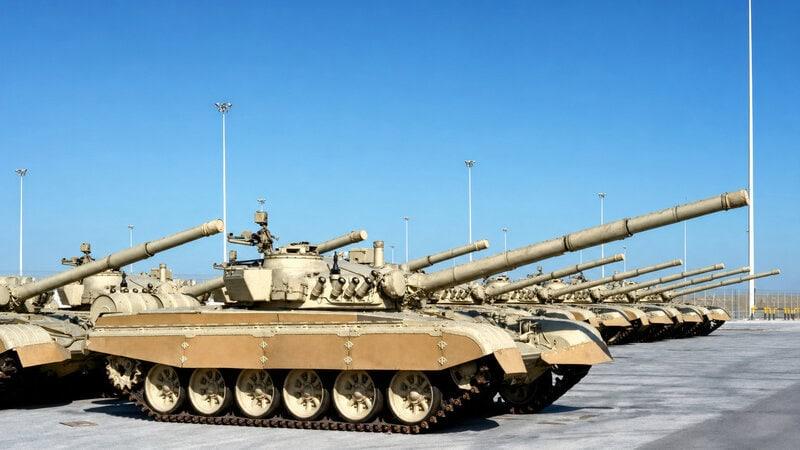

When the tanks stopped rolling after just 100 hours, the story the world was handed felt almost too clean: a swift, high-tech war, a liberated Kuwait, minimal casualties, and American power confirmed. Decades later, that version of events turns out to be riddled with myths — and the gaps between the legend and the record matter more than ever.
1. The Gulf War Was Basically an American Operation

The images that burned into global memory — Abrams tanks, U.S. Air Force jets, Pentagon briefings — made it easy to forget the war’s true shape. Between 35 and 42 nations contributed forces to the coalition, making it one of the broadest military alliances assembled since World War II. Arab states including Saudi Arabia, Egypt, and Syria sent troops, giving the effort a regional legitimacy that American-centric television coverage quietly erased from popular memory.
British armored divisions drove deep into southern Iraq alongside U.S. forces. French troops secured the coalition’s exposed western flank, protecting against any Iraqi attempt to outmaneuver the main advance. The multinational character of the effort wasn’t window dressing — it was central to the political and legal justification for the entire campaign, rooted in a series of United Nations Security Council resolutions that gave the coalition its international mandate. That this fact rarely survives in shorthand accounts of Gulf War history says more about how wars get remembered than about how they were actually fought.
2. The War Started in 1991

Ask most people when the Gulf War began, and they’ll say 1991. The combat did — but the crisis didn’t. Iraq’s invasion of Kuwait, the act that ignited everything, happened on August 2, 1990. What followed was seven months of Operation Desert Shield, a massive military buildup in Saudi Arabia, a grinding international sanctions regime, and a diplomatic scramble that drew in the United Nations, the Arab League, and every major world power.
Pinning the war’s start to January 17, 1991 — when Operation Desert Storm’s air campaign opened — erases nearly half the conflict’s timeline and misrepresents how long the world held its breath before the shooting started. The State Department’s account of the Gulf War makes clear that the crisis was already reshaping the Middle East months before a single coalition bomb fell on Baghdad. The buildup itself, involving the deployment of over 500,000 U.S. troops alone, was a historic logistical undertaking entirely separate from the combat phase that followed.
3. Iraq Sent a Million-Man Army Into Kuwait

The phrase “million-man army” attached itself to Iraq’s military like a warning label, conjuring images of an unstoppable force pouring across the Kuwaiti border. The figure wasn’t invented — Iraq did maintain approximately one million personnel in its armed forces at the time. But that was total military manpower, not the invasion force. Approximately 100,000 Iraqi Army troops actually crossed into Kuwait on August 2, 1990, a formidable thrust but a far cry from the mythologized number that dominated pre-war commentary.
Inflating the invasion force to mythic proportions served a narrative purpose both before and after the war. It made the coalition’s task seem daunting going in, and made its swift victory seem all the more impressive coming out. What it obscured was the genuine tactical uncertainty that preceded Desert Storm — planners weren’t fighting a legend, they were fighting a real army whose actual capabilities and condition were imperfectly understood from the outside.
4. Kuwait Fell After Days of Resistance

There is a version of events in which Kuwaiti forces fought bravely for days before being overwhelmed. The historical record is starker. As the State Department’s Office of the Historian documents, Kuwait was overrun in a matter of hours after the August 2 invasion began. The Kuwaiti Emir fled the country. The speed of the collapse shocked neighboring governments, accelerated the international response, and set the frantic diplomatic tone of the months that followed.
The near-instant fall is one of the most important facts for understanding everything that came next. It underscored how dramatically outmatched Kuwaiti defenses were, stripped away any illusion that time and local resistance might reverse the occupation, and forced the world to confront the question of what, if anything, would be done — urgently, not eventually. It also explains why the United States and its partners moved so quickly to secure Saudi Arabia’s borders, fearing Iraq might not stop at Kuwait.
5. The 100-Hour Ground War Made the Whole Conflict Brief

The “100-hour war” is one of history’s most effective pieces of narrative compression. The ground offensive that liberated Kuwait did last roughly 100 hours, ending with the ceasefire on February 28, 1991. But the overall Gulf War ran from August 2, 1990 — approximately seven months in total — and the ground phase was the final act of a far longer production. Before a single coalition tank crossed into Iraq, six weeks of intensive aerial bombardment had already degraded Iraqi command networks, supply lines, and frontline morale.
Collapsing the entire war into its final four days is one of the most persistent distortions in how Operation Desert Storm is remembered. It makes coalition victory look like a sprint when it was the culmination of months of preparation, diplomacy, and systematic air power. As the Naval History and Heritage Command documents, Operation Desert Shield was a massive and consequential undertaking in its own right — the unglamorous foundation on which the famous 100-hour finale was built.
6. The Gulf War Was Nearly Bloodless

The Pentagon’s televised briefings, featuring grainy footage of precision bombs threading through doorways, helped construct a seductive illusion: a clean, almost antiseptic conflict. Coalition combat deaths were indeed relatively low — approximately 292 U.S. military personnel died in the conflict, a figure formally recorded by the Defense Casualty Analysis System — and that genuinely reflected the effectiveness of coalition planning and air superiority. But Iraqi military casualties are estimated at between 20,000 and 50,000 killed, and the full range of Iraqi casualties, including civilians and war-related deaths, spans from 20,000 to over 300,000 by various estimates, with deep uncertainty on all figures reflecting chronic undercounting rather than precision.
The “bloodless war” narrative was a product of sanitized television coverage and carefully managed Pentagon briefings that restricted access to the conflict’s ugliest moments. The war looked clean from one direction. From the other, it did not look clean at all — and the long-term public health consequences for Iraqi civilians, compounded by infrastructure destruction and ongoing sanctions, extended the human cost well beyond the ceasefire.
7. The Highway of Death Proved Coalition Forces Were Indiscriminate

The images that emerged from the road between Kuwait City and Basra — miles of incinerated vehicles, charred machinery twisted into wreckage — became the war’s most haunting visual record and its most contested episode. Critics seized on the Highway of Death photographs as evidence of a massacre: retreating soldiers, some argued, had been hunted down and annihilated from the air in an act that went beyond military necessity. The accusation lodged in the public imagination and never fully left.
Military analysts subsequently argued that many of the vehicles had already been abandoned when coalition aircraft struck, and that a military convoy withdrawing with weapons and looted Kuwaiti property constituted a legitimate military target under the laws of armed conflict — though the scale and manner of the destruction remain genuinely debated. What is less debated is the episode’s strategic consequences: the imagery contributed directly to President George H.W. Bush’s decision to call a ceasefire rather than order coalition forces onward to Baghdad, making those photographs consequential far beyond their immediate shock value. The decision to halt short of regime change would define the conflict’s legacy for years afterward.
8. ‘Operation Desert Storm’ and ‘The Gulf War’ Are the Same Thing
In casual conversation — and in a surprising amount of journalism — “Operation Desert Storm” and “the Gulf War” are used interchangeably, as if they describe identical events. They don’t. Operation Desert Storm was the offensive air and ground campaign, one specific phase within the broader Persian Gulf War. The Defense Casualty Analysis System formally designates the conflict the “Persian Gulf War,” a designation that encompasses both Operation Desert Shield — the buildup — and Operation Desert Storm — the combat operations — as distinct component phases of a single conflict.
The confusion isn’t merely semantic. Using “Desert Storm” as a synonym for the entire war erases the months of preparation, sanctions, diplomatic maneuvering, and aerial bombardment that shaped the outcome long before the famous 100-hour ground offensive. The ground war was the headline; everything before it was the story that made the headline possible.
9. The Gulf War and the 2003 Iraq War Are Really the Same Conflict
To a generation that lived through both, the temptation to blend them together is understandable — same country, some of the same players, overlapping geography. But they were legally, strategically, and politically distinct events. The 1991 conflict is often called the “First Gulf War” precisely to mark it off from the 2003 U.S. invasion, a distinction that matters enormously once you examine the specifics. The 1991 war carried explicit United Nations authorization through Security Council Resolution 678 and had a tightly defined, internationally agreed objective: expel Iraq from Kuwait, nothing more.
The 2003 invasion did not enjoy equivalent multilateral backing, proceeded without a comparable UN authorization, and aimed at regime change rather than territorial restoration. Conflating the two distorts the historical record of both conflicts. It obscures how restrained and internationally legitimate the 1991 coalition’s mandate actually was, and it papers over how much more legally and morally contested the 2003 decision became — within the United States, among its traditional allies, and at the United Nations itself.
10. Saddam Hussein’s Military Was a Proven, Battle-Hardened Juggernaut

In the months before Desert Storm, Western analysts issued a stream of sobering assessments. Iraq’s army had fought an eight-year war against Iran — one of the bloodiest conflicts since World War II — and had emerged with combat-seasoned troops, extensive fortifications dug into Kuwaiti soil, chemical weapons stockpiles, and a reputation for brutality that made military planners genuinely anxious. The word used again and again was “formidable.” Some estimates projected coalition casualties running into the tens of thousands.
What actually happened was something else entirely. Mass surrenders began within hours of the ground offensive’s launch. Many Iraqi units were demoralized, dangerously undersupplied, and had spent six weeks absorbing aerial bombardment that destroyed equipment, severed communications, and shattered unit cohesion. The gap between the feared army and the one that actually took the field is itself a critical lesson of Gulf War history — and one with a long shadow. The ease of the 1991 victory fed a dangerous confidence in American military planning circles that would shape, and some historians argue distort, the assumptions carried into subsequent conflicts in the same region, most consequentially in 2003.
The Gulf War’s 100-hour finale was real, but the war itself was seven months of crisis, calculation, and carnage that television framing and official narratives quietly compressed into something far tidier than the truth. The fuller picture — its multinational scale, its Iraqi death toll, its ambiguous images, its long and deliberate buildup — is the one that actually explains what happened in 1990 and 1991, why the decisions made then reverberated across the following decades, and why getting the history right still matters.

 English
 Arabic
 French
 Spanish
 Portuguese
 Turkish
 Dutch
Dutch
 Italiano
 Russian
 Romaian
 Portuguese (Brazil)
 Greek
Greek