


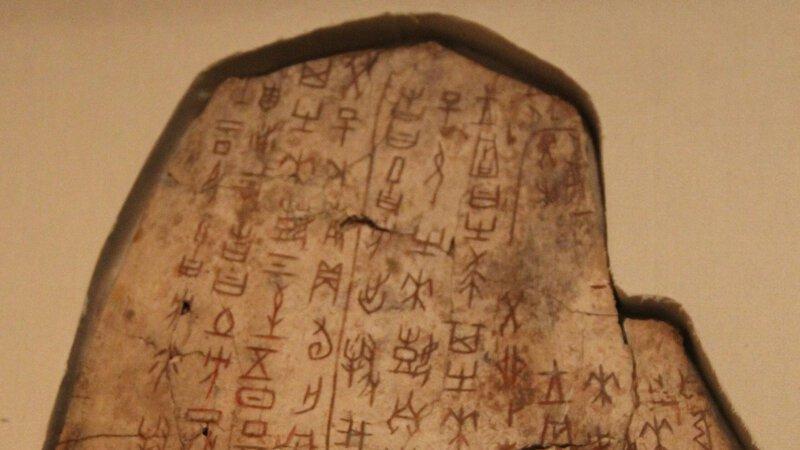

The fire had been burning for hours. Somewhere in the royal compound at Anyang, around 1200 BCE, a diviner pressed a heated bronze rod into the hollow of an ox shoulder blade and waited. The bone cracked — a sharp, branching fracture — and in that crack, a Shang king believed he heard the voice of his dead grandfather.
The Dynasty That Archaeology Proved Real

For a long time, the Shang dynasty occupied an uncomfortable middle ground between history and legend. Ancient Chinese texts described it in considerable detail — its kings, its rituals, its wars — but without physical evidence, skeptical scholars were reluctant to treat it as verified fact rather than mythology dressed in historical clothing. That skepticism collapsed in the late nineteenth and early twentieth centuries, when farmers plowing fields near Anyang, in what is now Henan Province, began pulling strange objects from the earth: flat, smooth bones covered in neat rows of incised marks that no one could immediately identify.
Archaeologists eventually recognized those marks as writing — not just any writing, but the Shang dynasty’s own hand, recording its own decisions, in its own words, from inside its own moment. The Shang became the earliest archaeologically confirmed dynasty in Chinese history not because historians declared it so, but because the dynasty had, unknowingly, buried its own transcripts. It ruled from roughly 1600 to 1046 BCE, a span of almost 600 years governed by a succession of kings, centered on the fertile plains of the Yellow River in northern China. Every detail recovered from it carries the particular weight of things confirmed rather than merely claimed.
A Bronze Age Civilization on the Yellow River

To understand the Shang, it helps to stand — imaginatively — on the North China Plain and look around. The Yellow River, which the Chinese have called both “the Mother River” and “China’s Sorrow,” ran unpredictably through this landscape, capable of catastrophic floods that could reshape geography and destroy harvests in a single season. That kind of environment does not reward individualism. It rewards collective organization, central authority, and a ruler with the credibility to make hard decisions and have them obeyed.
The Shang provided exactly that. As documented in the Metropolitan Museum of Art’s scholarship on the Bronze Age of China, the Shang presided over one of the ancient world’s most sophisticated metalworking traditions, producing ritual vessels, weapons, and ceremonial objects whose technical complexity ranks among the finest bronze work produced anywhere on earth at that time. These were not crude castings. They were precisely engineered objects made through a piece-mold process that required coordinated workshops, specialized labor, and reliable supplies of copper and tin — commodities that had to be sourced, transported, and carefully controlled across long distances.
The late Shang capital at Anyang, known historically as Yin, was a substantial urban center. It contained palaces, ceremonial structures, and royal tombs stocked with jade ornaments, bronze vessels, and — grimly — the remains of human sacrificial victims whose deaths were sometimes predicted and authorized by oracle. The social structure was sharply hierarchical: a divine king at the apex, aristocratic clans who owed him military service, master artisans casting bronze in royal workshops, farmers working the plain to generate the agricultural surplus that sustained the whole structure, and at the lowest tier, slaves whose lives could be — and were — spent as ritual offerings to the ancestors.
Oracle Bones: The World’s Most Consequential Discarded Records

The objects that proved all of this were, by the standards of the people who made them, disposable. Shang oracle bones were typically the shoulder blades of oxen or the flat undersides of turtle shells — plastrons — chosen because they were large, smooth, and cracked predictably when heat was applied. The ritual followed a consistent sequence: a diviner carved a question into the surface, applied a heated rod to prepared hollows on the reverse side, read the resulting crack pattern as a divine response, and interpreted the answer. A favorable crack might confirm a planned campaign or harvest ritual; an unfavorable one might delay or redirect it entirely.
What makes Shang oracle bones genuinely extraordinary is what sometimes happened after the divination. Once the predicted event occurred, a diviner would return to the bone and carve a second inscription recording the actual outcome. Did the harvest come in? Did the battle go well? Did the queen survive childbirth? These follow-up notations transformed the bones from petitions into annotated transcripts — a feedback loop between the living and the dead, verified by subsequent events and preserved in fired bone. They are not mythology. They are records with built-in fact-checking, a quality rare in documents of any ancient civilization.
More than 150,000 oracle bone fragments have now been recovered, cataloguing royal deliberations on warfare, weather, agriculture, illness, diplomatic relationships, and ritual sacrifice. Taken together, they constitute an accidental encyclopedia of Bronze Age life — a record no one planned to preserve for posterity, which survived precisely because it was buried and forgotten. As the Stanford Program on International and Cross-Cultural Education notes in its Shang dynasty curriculum, these inscriptions represent the earliest confirmed written records from Chinese history.
The Writing System That Became Modern Chinese

The script on those bones is not a dead language in the way that Linear A or Elamite are dead — systems severed from any living tradition and only partially reconstructed. The Shang writing system is the demonstrable ancestor of modern Chinese characters. The same structural logic, the same combination of pictographic and phonetic elements, the same fundamental approach to encoding meaning on a surface — all of it flows in an unbroken tradition from Bronze Age shoulder blades to contemporary screens. That makes it one of the longest continuously evolved writing systems in human history.
Approximately 5,000 distinct characters have been identified on oracle bones. Scholars have deciphered roughly half — enough to read complete sentences composed by people who have been dead for three thousand years. The experience is quietly vertiginous. A diviner asks whether the king should send troops east. Another records a question about the pain in the king’s tooth. A third asks about Lady Hao — confirmed by excavation to have been a real Shang queen and military commander, whose tomb at Anyang was found stocked with bronze weapons, vessels, and jade objects — inquiring whether she would have a safe delivery. Carved into bone by someone who knew her personally is both the question and, sometimes, what happened afterward.
Unlike Mesopotamian cuneiform, which began as an accounting system for tracking grain and livestock and evolved only gradually toward narrative use, Shang script appears in its earliest confirmed examples already saturated with religious and political significance. It was not invented to count things. It was first recorded, at least in the surviving evidence, in the service of communicating with the dead.
Kings, Ancestors, and the Architecture of Political Power

That theological function was never separate from the political one. The Shang king’s authority rested in substantial part on his position as the sole intermediary between the living world and the royal ancestors believed to govern it. Rainfall, military victory, harvest abundance, dynastic continuity — all of it was understood to flow from the goodwill of ancestors who could be petitioned, appeased, and consulted. The king was the only person with the standing to conduct that consultation at the highest level.
This arrangement gave the king a monopoly on the most consequential information in the kingdom. When the oracle spoke — when the bone cracked and the diviner interpreted the pattern — that was not merely religious ceremony. It was policy formation. The oracle ritual was simultaneously an act of devotion and an instrument of political control, one that happened to generate a written record of every significant decision the dynasty made. Over the course of nearly six centuries of Shang rule, that system grew increasingly elaborate and institutionalized — less improvised ritual, more systematic record-keeping conducted by a recognized class of diviners operating within a defined bureaucratic structure.
The Shang also maintained a military apparatus capable of launching large expeditions. Oracle bone inscriptions record campaigns against neighboring peoples, with troop numbers sometimes cited in the thousands. The dynasty’s geographic reach extended well beyond the capital region, sustained through a network of subordinate lords who owed military service and tribute in exchange for legitimacy granted by the Shang king.
The Fall of the Shang and the Question of Di Xin

The dynasty ended in 1046 BCE, when the Zhou people — long subordinate to the Shang — overthrew the last Shang king, Di Xin, and established their own dynasty. Chinese tradition remembers Di Xin as a tyrant of spectacular depravity: a ruler whose cruelty and excess made his removal a moral necessity. Historians approach that portrait with appropriate skepticism. Victors write history, and the Zhou had every incentive to frame their conquest as liberation rather than opportunistic rebellion. Di Xin’s reputation was largely constructed by the very people who replaced him, using the writing system his dynasty had developed and refined. The irony is complete, and the lesson is enduring: the historical record always reflects the interests of those who control it.
What archaeology can confirm is that Shang material culture — its bronze-casting traditions, its ritual practices, its writing conventions — was substantially absorbed and continued by the Zhou rather than erased. The Zhou adopted the oracle bone tradition, adapted Shang ceremonial bronze forms, and built their own legitimating ideology partly in dialogue with the civilization they had conquered. The Shang did not simply end. It was, in significant ways, inherited.
Why the Shang Still Matters
The oracle bones were not saved by careful archivists. They were buried as ritual waste — used objects whose purpose was spent — and they remained buried for three thousand years. When farmers first unearthed them in the late nineteenth century, the bones were sold as “dragon bones,” ground into powder and consumed as a traditional medicine ingredient. An unknowable quantity of Shang writing was destroyed in this way before anyone understood what it was. The fragments that survived did so by chance, purchased by collectors and eventually recognized by scholars who identified the incised marks as ancient script.
What those bones established — and what the full archaeological record of the Shang dynasty continues to deepen — is a civilization of genuine complexity at the documented roots of Chinese history. Chinese writing, the practice of ancestor veneration, the centrality of ritual in political life, the idea that the ruler mediates between the human and the divine: all of these trace back, in verifiable form, to the Shang. Not as myth requiring faith, but as documented, inscribed-in-bone fact requiring only translation.
Somewhere in a museum archive — in Beijing, in Taipei, in Tokyo, in London — an oracle bone fragment sits in a labeled drawer, not yet fully studied. A question is carved into its surface. A king asked something three thousand years ago, a diviner read the crack, and the outcome was recorded in a script that became the writing system used by more people today than any other on earth. We have the bone. We have the characters. We are still reading the answer.

 English
 Arabic
 French
 Spanish
 Portuguese
 Deutsch
 Turkish
 Dutch
Dutch
 Russian
 Romaian
 Portuguese (Brazil)
 Greek
Greek