



More than two and a half millennia before the phrase “human rights” existed, a Persian king walked into the greatest city on earth and chose mercy over massacre — and the Jewish people called him their messiah for it. This is the story of Cyrus the Great, told from a highland birth wrapped in prophecy to a legacy that still echoes in the halls of the United Nations.
Born into a Royal Bloodline, circa 600 BC

Around 600 BC, in the rugged uplands of Persis in what is now southwestern Iran, a child entered the world who would one day rule from the Aegean to the Indus. He was Cyrus II, scion of the Achaemenid clan — a Persian royal line that had long chafed under the dominance of the Medes, the more powerful regional power. That simmering resentment would become the fuel of an empire.
Ancient sources refused to let the birth be ordinary. Herodotus recorded that the Median king, Astyages, was tormented by a dream prophesying that the infant would one day topple him — so the king ordered the baby killed, and the baby survived. Whether legend or distorted memory, the story signals something true about how history would remember Cyrus: as a man who seemed destined, from his first breath, to overturn the established order of the world.
Cyrus Topples the Median King and Unites the Iranian Tribes, circa 550 BC

In a reversal that stunned the ancient Near East, Cyrus defeated Astyages around 550 BC — fulfilling, as it happened, the very prophecy that had once made the king want him dead. According to National Geographic, he went on to unite the major Iranian tribes under a single banner, forging a political bloc no neighboring power could easily challenge.
What made the victory remarkable was what came after it. Rather than executing the Median nobility or selling them into slavery, Cyrus folded them into his own administration, giving former enemies a stake in the new order. It was strategic mercy — a calculated bet that loyalty bought through inclusion would outlast loyalty extracted through fear. It worked, and the Achaemenid Empire was born.
The Conquest of Lydia Brings the Aegean World Within Reach, circa 547 BC

By around 547 BC, Cyrus had turned his ambitions westward toward Lydia — the fabulously wealthy kingdom in western Anatolia ruled by Croesus, a name still synonymous with riches. Croesus consulted the Oracle at Delphi before crossing the Halys River to confront Cyrus, and received the famous double-edged prophecy: if he crossed, he would destroy a great empire. He crossed. The empire destroyed was his own.
With Lydia absorbed, Cyrus’s frontier now touched the Aegean Sea and the prosperous Greek coastal cities clustered along its shores. The Mediterranean world — accustomed to calibrating power in terms of Egypt, Babylon, and the Greek city-states — suddenly had to reckon with an eastern superpower of entirely new dimensions. The message was unmistakable: a different kind of conqueror had arrived.
The Bloodless Fall of Babylon, 539 BC

October 539 BC produced one of antiquity’s most astonishing scenes. Persian forces entered Babylon — the largest, richest, most awe-inspiring city on earth — and according to the Nabonidus Chronicle, scarcely a battle was fought. The Metropolitan Museum of Art notes that Cyrus had shrewdly exploited a fracture already running through Babylonian society: King Nabonidus had offended the powerful priestly class by neglecting the cult of Marduk, the city’s paramount god, leaving much of the population primed to welcome an alternative ruler.
Cyrus understood that entering through the Ishtar Gate as a restorer rather than a destroyer was worth more than any military trophy. He presented himself as the chosen of Marduk, come to right the wrongs of an impious king. It was political theater of the highest order — and it worked. The city that had seemed impregnable surrendered its loyalty before its walls were truly tested.
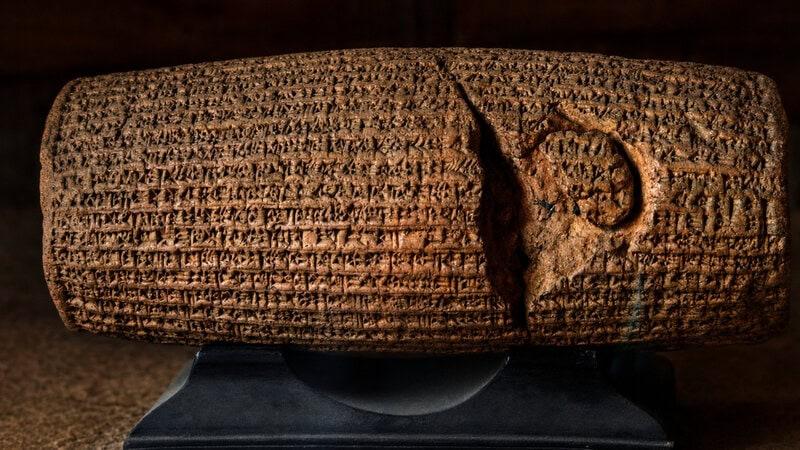
The Cyrus Cylinder — An Ancient Charter of Religious Tolerance, 539 BC

Shortly after securing Babylon, Cyrus gave his policy of tolerance a physical form. His scribes pressed a proclamation into a clay barrel — the artifact now known as the Cyrus Cylinder — decreeing that displaced peoples and their gods should be returned to their homelands, and that ruined temples across his new empire should be restored. The document was as much royal propaganda as humanitarian decree, but its scope was genuinely extraordinary for an age when conquered peoples routinely expected deportation and enslavement.
Scholars and the United Nations have pointed to the Cyrus Cylinder as one of history’s earliest written expressions of what we would now call religious tolerance. Historians rightly debate how universal Cyrus’s intentions truly were — the cylinder was addressed primarily to Babylonian audiences and served clear political purposes — but the policy had real consequences for real people. Among those people were tens of thousands of Jewish exiles living in captivity in Babylon, whose lives were about to change entirely.
Roughly 42,000 Jewish Exiles Freed — the Return from Babylonian Captivity, 538 BC

In the year following the conquest, Cyrus issued a decree that reverberated through Jewish history like no act by a foreign ruler before or since. The Jewish people — forcibly deported to Babylon by Nebuchadnezzar decades earlier — were free to return to Judah. Cyrus also ordered the return of the sacred vessels Nebuchadnezzar had looted from Solomon’s Temple in Jerusalem. The Book of Ezra records that roughly 42,000 people made the journey home.
It is difficult to overstate what this moment meant. A dispersed people, cut off from their land and their Temple, faced the very real possibility of dissolving into the Babylonian world around them, their religious identity fading with each generation. Cyrus’s decree reversed that trajectory. The exiles returned, rebuilt their Temple, and gathered and codified the texts that would become the Hebrew Bible. The survival and flourishing of Judaism — and, through it, of Christianity and Islam — runs through this single Persian proclamation.
The Bible Names a Persian King the Messiah — Isaiah’s Extraordinary Prophecy

No honor the Jewish tradition could bestow on Cyrus was more striking than the one recorded in the Book of Isaiah. Chapter 45, verse 1 addresses him directly, using the Hebrew word mashiach — messiah, meaning “anointed one.” It is the only place in the entire Hebrew Bible where that title is given to a ruler who was not Jewish. The text presents him as God’s chosen instrument, called by name even though, as the passage pointedly notes, he had not known the God of Israel.
For Jewish communities still living in exile when these words circulated, the theological claim was electrifying: the divine hand could move through the most unexpected of agents. Framing the liberation as a messianic act transformed what might have been remembered as a fortunate change in imperial policy into something closer to a covenant moment — and locked Cyrus into Jewish religious memory for millennia. He remains, uniquely, a gentile hero of the Hebrew scriptures.
An Empire Stretching from the Aegean to the Indus
By the final years of his reign, the empire Cyrus had assembled defied easy comprehension. Britannica records that the Achaemenid Empire stretched from the Greek-settled coasts of the Aegean in the west to the Indus River valley in the east — an arc of territory encompassing dozens of peoples, languages, and religions living under a single sovereign. Persians, Medes, Babylonians, Lydians, and Jews were among them, each permitted, under Cyrus’s governing philosophy, to maintain their own customs and worship their own gods.
It was the largest empire the ancient world had yet produced, a scale that would not be surpassed until Alexander the Great dismantled and inherited it two centuries later. What made it more than a feat of military logistics was the administrative philosophy holding it together: Cyrus had built not merely an empire of territory but, to a remarkable degree, an empire of consent — and that, perhaps more than the sheer size of his domains, is why the ancient world marveled at him.
Cyrus Falls in Battle Against the Massagetae, circa 530 BC

The end came not in a throne room but on the steppe beyond his empire’s northeastern frontier, somewhere near the Aral Sea, around 530 BC. Cyrus had pushed his campaigns into the territory of the Massagetae, a nomadic people whose warrior queen, Tomyris, proved an adversary unlike any he had faced before. Ancient accounts of his death relate that Cyrus had earlier killed Tomyris’s son, and she vowed a reckoning. Herodotus, writing with characteristic dramatic flair, reported that after the battle she dipped his severed head in a vessel of blood, declaring he had thirsted for blood in life and would have it now in death. Most modern historians treat the detail as legend, but the death in battle itself is broadly accepted.
The starkness was almost poetic. The man who had walked into Babylon without a battle, who had freed tens of thousands and been called a messiah, died far from any city, chasing one more horizon. It was a sharp reminder that even the most celebrated architects of ancient civilization were mortal — and that empires built on conquest, however enlightened, are always one frontier too far from disaster.
A Legacy Outlasting His Empire — From Xenophon to the United Nations

Death did not diminish Cyrus — it canonized him. The Greek soldier-historian Xenophon wrote the Cyropaedia, a semi-fictional account of Cyrus’s life that functioned as a handbook on enlightened leadership. It found extraordinary readers across the centuries: Alexander the Great studied it, and later Thomas Jefferson owned two copies. As scholars at Northeastern Illinois University have noted, Cyrus’s decision to rule through inclusion rather than annihilation — permitting subjects to live and worship by their own traditions — set a template for multicultural governance that remains a case study in how empires can sustain themselves.
The Cyrus Cylinder, rediscovered in the ruins of Babylon in 1879, was placed on display at the United Nations in 1971 and now rests in the British Museum, where it continues to anchor modern debates about tolerance and human rights. That a clay barrel pressed in 539 BC still commands attention in international forums may be the most remarkable fact about Cyrus the Great of all.
From a highland birth surrounded by prophecy to a legacy still debated by historians and diplomats today, Cyrus the Great lived a life that collapsed the distance between ancient history and modern ideals — demonstrating that how a ruler treats the powerless can echo far longer than any military triumph.

 English
 French
 Spanish
 Portuguese
 Deutsch
 Turkish
 Dutch
Dutch
 Italiano
 Russian
 Romaian
 Portuguese (Brazil)
 Greek
Greek