



The man lying on the frozen ground outside Valley Forge in the winter of 1777 was not shot. He had not charged a British line or crossed a river under fire. He was shaking — violently, helplessly — while lice moved through the seams of his coat and a fever consumed him from the inside out, and there was almost nothing anyone around him could do.
The Enemy No Musket Could Stop

That scene, multiplied across hundreds of campsites and thousands of suffering men, tells the real story of American Revolutionary War casualties — a story that most history textbooks have quietly skipped over for two and a half centuries. Of the estimated 25,000 American military personnel who died during the Revolutionary War, approximately 17,000 were not killed by British soldiers. They were killed by typhus, typhoid, dysentery, and influenza. Disease claimed more than double the roughly 6,800 Americans who died in combat. The ratio is not a rounding error. It is the dominant fact of the war’s human cost.
These were not glorious deaths. There were no last stands, no flags, no dispatches sent home describing the fallen man’s courage. There was fever, and confusion, and then silence — in a tent, in a barn, on the rotting deck of a prison ship anchored in New York Harbor. The true American Revolution death toll is far grimmer, and far more complex, than the story Americans have chosen to remember.
What the Numbers Actually Look Like

Laying out the American Revolution casualties in full is itself an unsettling exercise. Approximately 6,800 Americans were killed in action over the course of the war. Another 17,000 died from disease — a figure that represents more than double the battlefield dead. Between 6,100 and 8,500 were wounded. An estimated 11,500 were captured. Some historical breakdowns put the figures even more starkly: roughly 8,624 killed in battle, approximately 10,000 dying in camp from illness and exposure, and around 8,500 perishing while held as prisoners of war.
Those numbers already strain comprehension. But some historians argue they are still too conservative. When accounting for deaths after discharge — men who staggered home sick and died weeks later, men whose names never appeared on any regimental roll — estimates of total Patriot deaths during active military service climb considerably higher. Incomplete state records, chaotic short-term enlistments, and the absence of any unified record-keeping system mean the true figure may never be known with confidence.
To understand the scale of the disease deaths alone, consider this: Philadelphia was the largest city in colonial America at the war’s outbreak, with a population of roughly 16,000 people. The approximately 17,000 Americans who died of illness during the Revolution exceeded the entire population of that city. That is not a metaphor. That is a measure of catastrophe.
For a broader look at how many died in the American Revolution and why historians continue to debate the numbers, the range of scholarly estimates is itself telling.
The Invisible Killers: Typhus, Dysentery, and the Filth of Camp Life

To understand how so many men died of sickness, you have to understand what a Continental Army encampment actually looked like — and smelled like. Hundreds, sometimes thousands, of men crowded into poorly ventilated barracks or drafty tents. Latrines were dug too close to water sources. Germ theory did not exist. Sanitation, as a concept, was only dimly and inconsistently practiced. The result was a perfect incubator for mass death.
Typhus moved through camps on the bodies of lice, which traveled freely between men sleeping side by side. Typhoid fever spread through water contaminated with human waste. Dysentery — an intestinal infection that could reduce a healthy soldier to a skeletal, delirious wreck within days — thrived in the same filthy conditions. Influenza swept through tent rows with terrifying speed, carrying off men already weakened by cold and hunger. American Revolution disease deaths were not random misfortune; they were the predictable consequence of asking tens of thousands of men to live in close quarters without the tools to stay alive.
Valley Forge, the winter encampment of 1777 to 1778, became the iconic symbol of this suffering. Washington’s army did not nearly collapse that winter because the British outmaneuvered them. It nearly collapsed because men were dying of disease, exposure, and malnutrition before the spring thaw. Hundreds perished in those months — not in battle, but in the anonymous agony of camp hospitals that had run out of almost everything.
The cruel irony is that the very thing that gave the Continental Army its cohesion — the solidarity of men fighting together — was also what killed so many of them. The closer soldiers stayed to one another, the faster illness moved through their ranks. Patriotism and proximity were, in the most literal sense, vectors of death.
Dying in Chains: The Prison Ships
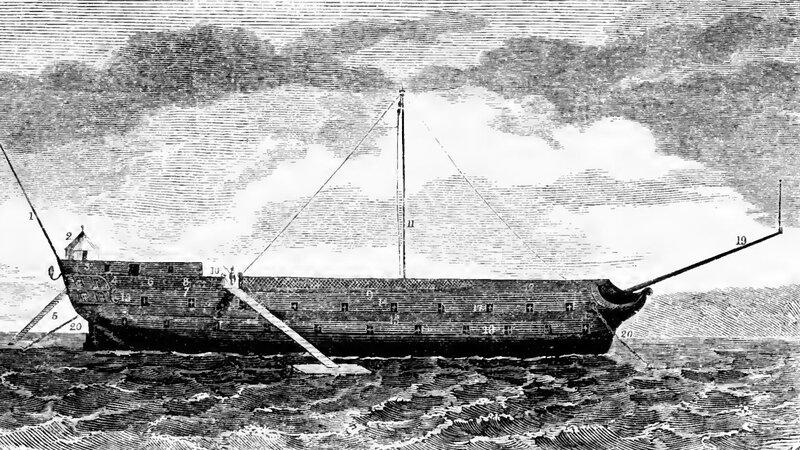
If disease in the camps was the war’s largest killer, the British prison ships anchored in New York Harbor were its most concentrated horror. The most notorious of these was the HMS Jersey, a decommissioned warship converted into a floating prison that held captured American soldiers in conditions that amounted to a slow death sentence.
Thousands of men were packed below decks with little light, almost no ventilation, and rations that barely qualified as food. The water was brackish and contaminated. Smallpox and dysentery moved through the holds unchecked. Bodies were hauled ashore and buried in shallow graves along the Brooklyn waterfront — graves so shallow that bones reportedly washed out with the tides for years afterward.
The numbers attached to this dimension of the war are staggering. The estimate of approximately 8,500 Americans dying in British captivity rivals the entire battlefield death count for the war. Imprisonment, in this conflict, was not a pause in the fighting — it was often a death sentence delivered slowly, below the waterline, far from any flag or ceremony. The human cost of the American Revolution in captivity remains one of its least-examined chapters.
These deaths have largely vanished from popular memory of the Revolution. Americans celebrate the battles — Bunker Hill, Trenton, Yorktown — but the men who died coughing in the hold of the Jersey have no equivalent monument in the national imagination. Their suffering was real. Their deaths shaped the war’s outcome just as surely as any musket volley. They have simply been forgotten.
Why the Real Toll Is So Hard to Count

The wide range of scholarly estimates for Revolutionary War deaths is not a failure of historians. It is evidence of how chaotic and underfunded the American war effort truly was. The Continental Army had no unified death registry. Men enlisted for short terms, sometimes as few as three months, then went home — often already sick. Many died days or weeks after discharge, in their own beds, from illnesses contracted in camp. Those deaths rarely entered any official record.
Militia units, which contributed enormously to the war effort, kept even worse records than the Continental Army. State militias varied wildly in their administrative capacity. Some deaths were recorded; many were not. When historians attempt to reconstruct the full American Revolution death toll, they are working with fragments — partial muster rolls, pension applications, letters, and local burial records — trying to assemble a complete picture from an archive that was never complete to begin with.
The 17,000 figure for American Revolution disease deaths is itself a conservative estimate. The actual number of men killed by illness — accounting for those who died after discharge, those whose deaths were never recorded, and those whose service is simply lost to history — is likely substantially higher. The uncertainty is not a reason to dismiss the numbers. It is the story. The gaps in the record are evidence of a nation at war with insufficient resources to even count its own dead.
For those interested in the methodological challenges, historians discussing how casualties compare in the American Revolution have wrestled openly with these limitations.
George Washington’s Quiet Battle Against Disease

George Washington understood, perhaps more clearly than any other leader of his era, that his most dangerous enemy did not wear a red coat. He wrote repeatedly to Congress warning that disease would destroy his army faster than the British ever could. He was not exaggerating. He watched it happen.
His most consequential response came in 1777, when he made the controversial decision to variolate — inoculate — his troops against smallpox. Smallpox was a catastrophic threat to an army in which most soldiers had never been exposed to the disease, and Washington had seen firsthand how quickly it could devastate a military force. The inoculation process of the era carried its own risks: soldiers were deliberately infected with material from a mild smallpox case and then quarantined while they developed immunity. The procedure occasionally killed. Congress worried the army would be temporarily weakened and vulnerable. Soldiers feared the process itself.
Washington pushed forward anyway. It was one of his least-celebrated decisions — there is no famous painting of it, no national holiday commemorating it — and it was almost certainly one of the most consequential commands he ever issued. Military genius in the Revolutionary War, it turns out, was not only tactical. It was also epidemiological, fought with quarantines and inoculation needles as much as with muskets and artillery.
A broader accounting of American Revolution facts, battles, and casualties offers additional context for Washington’s campaigns against both the British and the invisible enemies in his own camps.
Casualties Beyond the Patriots: Loyalists, British, and Civilians
Any honest accounting of American Revolution casualties must reach beyond Continental Army muster rolls. The British army and its Hessian auxiliaries suffered their own significant losses — estimates of British and Hessian dead from combat and disease range into the thousands, though those figures are similarly difficult to pin down with precision. Loyalist militias, fighting on the British side, added further dead to a conflict that was simultaneously a war of independence and a bitter civil war between Americans.
Civilians paid a price that no military ledger fully captures. The Revolutionary War brought smallpox epidemics that devastated communities far from any battlefield. A particularly deadly outbreak swept through much of North America between 1775 and 1782, killing tens of thousands of civilians — Indigenous peoples, enslaved people, and free colonists alike. Estimates of civilian deaths from war-related disease and violence are speculative but substantial. The Revolution was not fought on a contained battlefield. It moved through towns, farms, and households, leaving death in places that never appeared on any map of the fighting.
Enslaved people occupy a particularly painful chapter in this accounting. Thousands escaped to British lines after Lord Dunmore’s 1775 proclamation offered freedom to enslaved people who fled Patriot masters and joined British forces. Many died of disease in British camps and on ships. Others were returned to enslavement when the war ended. Their casualties — their suffering, their choices, their deaths — belong in any serious reckoning with what the Revolution actually cost.
The Death Toll’s Long Shadow on American Memory
Americans have always preferred a certain kind of Revolutionary War death — dramatic, purposeful, witnessed. The soldier cut down at Bunker Hill. The troops crossing the Delaware on a freezing Christmas night. These images carry meaning because they show sacrifice in a form we recognize: a man choosing danger and meeting it face to face.
The 17,000 men who died of disease offer no such image. Neither do the 8,500 who perished on prison ships. Their deaths were slow, anonymous, and stripped of the dignity that battle deaths — however terrible — at least occasionally preserved. Reckoning with the full American Revolution death toll does not diminish the Revolution’s heroism. It deepens it, enormously, by revealing the true price that ordinary men paid for an idea they believed in enough to camp beside a contaminated creek in the middle of winter.
For those who want to explore the full scope of Revolutionary War service and sacrifice, primary research into Revolutionary War records continues to uncover lives that official histories left out.
There is one detail that serves as a fitting, melancholy epilogue to all of this. The bones of the prison-ship dead — washed from their shallow graves on the Brooklyn shore by years of tides — were eventually collected and interred in a public tomb in what is now Fort Greene Park in Brooklyn in 1808. It is among the earliest war memorials in the United States. Almost nobody visits it. Almost nobody knows it is there. That invisibility is its own kind of truth about what dying for your country really meant in 1776: not a glorious charge into history, but, far more often, a slow and anonymous surrender to fever in the dark — unmemorialized, undercounted, and quietly extraordinary.

 English
 Arabic
 Spanish
 Portuguese
 Deutsch
 Turkish
 Dutch
Dutch
 Italiano
 Russian
 Romaian
 Portuguese (Brazil)
 Greek
Greek