


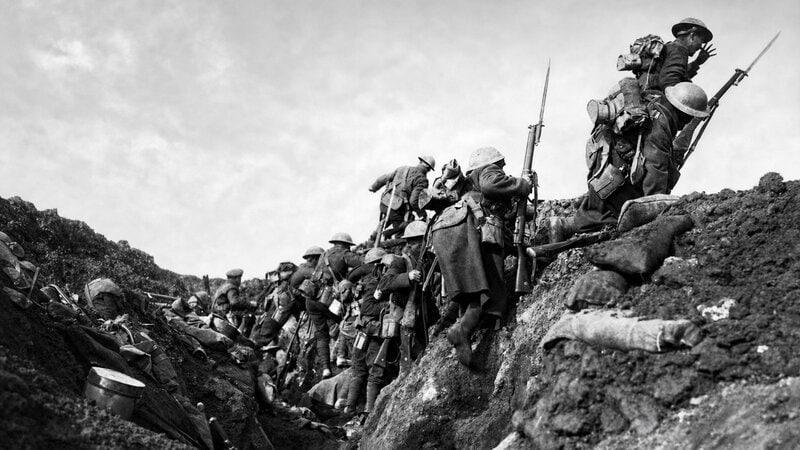

Most people know that World War I ended on November 11, 1918 — but that date is far less final than the history books suggest. From the telegram that started it all to reparations paid nearly a century later, the true arc of the WW1 years stretches far beyond the famous moment the guns fell silent. Understanding the full timeline — what came before that railway carriage in Compiègne and what festered long after it — is the only way to reckon honestly with what the war actually was.
28 July 1914: A Single Telegram Starts the Bloodiest War the World Had Ever Seen

It arrived not with a cannon shot but with a telegram. On July 28, 1914, Austria-Hungary’s declaration of war on Serbia — transmitted electronically, almost antiseptically — set in motion the deadliest conflict the modern world had yet seen. The assassination of Archduke Franz Ferdinand in Sarajevo on June 28 had lit the fuse; the five weeks of ultimatums, mobilizations, and failed diplomacy that followed were the cord burning down. Now the powder keg exploded. Within days, a web of interlocking alliances snapped taut across the continent: Germany declared war on Russia on August 1 and on France on August 3, then sent its armies crashing through neutral Belgium, compelling Britain to enter the fight on August 4.
Leaders on every side spoke of a short, decisive campaign — the troops would be home before the leaves fell, the saying went. They were catastrophically wrong. What they had just started would consume four years, three months, and fourteen days, kill an estimated 17 million people, and leave scarcely a family in Europe untouched. Knowing when World War I started and ended is only the beginning of understanding what it actually was.
August 1914: Germany’s Gamble Through Belgium Sets the Western Front on Fire

Germany had a plan — it had been quietly refining it for years. The Schlieffen Plan called for a massive westward arc through Belgium designed to encircle and crush France in a matter of weeks, after which German forces would wheel east to deal with the more slowly mobilizing Russian army. On August 2, German troops moved into Luxembourg; on August 4, they swept into Belgium. France, meanwhile, lunged in the opposite direction, pushing into Alsace — the border territory it had lost to Germany after the Franco-Prussian War of 1871 — hoping to reclaim it in the war’s opening hours.
Neither gamble paid off cleanly. The Belgian army resisted longer than expected, costing Germany critical days. At Mons in late August, Britain’s professional British Expeditionary Force met the German advance and fought a brutal, grinding retreat southward. The war of movement that both sides had counted on was already dying by September, when the First Battle of the Marne halted the German advance and forced a general retreat to the Aisne River. Something far grimmer than anyone had planned for was about to take its place.
Late 1914: Christmas in the Trenches — and the Mud That Would Last Four Years

By December 1914, the fluid opening campaign had hardened into something no war planner had envisioned: a continuous line of opposing trenches running roughly 400 miles from the English Channel to the Swiss border, dug into the earth and going nowhere. The Western Front had been born, and it would dominate the next three and a half years of the conflict. Both sides had attempted to outflank each other in a series of engagements known as the Race to the Sea; both had failed, and now they began to dig in.
Then, on Christmas Eve and Christmas Day 1914, something extraordinary happened. In several sectors of the front, German and British soldiers climbed out of their trenches, crossed No Man’s Land, exchanged cigarettes, food, and greetings, and in some places kicked a football across the frozen mud. The informal truce was spontaneous, localized, and remarkable precisely because it was unauthorized. Both sides’ high commands moved quickly to discourage any repeat, and the mutual slaughter that resumed in January 1915 ensured that such goodwill would be nearly impossible to sustain. The Christmas Truce is remembered today as a flicker of humanity in an inhuman war — all the more poignant because of everything that followed it.
1915: Gallipoli, Poison Gas, and the Death of Any Remaining Illusions

If 1914 had shattered the illusion of a short war, 1915 buried it. Early Allied offensives on the Western Front confirmed the nightmare arithmetic of trench warfare: massed infantry advancing across open ground into machine guns, barbed wire, and pre-registered artillery produced staggering casualties for gains measured in yards. In April 1915, Germany crossed another threshold at the Second Battle of Ypres, deploying chlorine gas against Allied lines — the first large-scale use of chemical weapons in the conflict. The attack spread terror as much through its novelty as its lethality, and both sides would be deploying poison gas routinely within months.
Far from the Western Front, the Allies attempted a strategic end-run at Gallipoli, hoping to force the Dardanelles strait, knock the Ottoman Empire from the war, and open a supply route to Russia. The campaign — championed most forcefully by First Lord of the Admiralty Winston Churchill — became one of the war’s defining disasters. Fierce Ottoman resistance, failures of coordination between naval and ground forces, and punishing terrain turned the Gallipoli peninsula into another killing ground. By January 1916 the Allies had evacuated, having suffered approximately 250,000 casualties and gained nothing of lasting strategic value. The First World War was settling into the shape that would define it: a conflict measured not in breakthroughs but in attrition.
1916: The Year of Attrition — the Somme and Verdun Devour a Generation
Historians reach for words like “catastrophic” and find them insufficient for 1916. At Verdun, beginning in February, Germany launched a campaign explicitly designed — in the words of German Chief of Staff Erich von Falkenhayn — to “bleed France white.” The objective was not a breakthrough but annihilation: to kill French soldiers faster than France could replace them. The battle ground on for ten months. Simultaneously, British and French forces launched the Battle of the Somme on July 1, partly to relieve the pressure on Verdun. On that single opening day, the British Army suffered approximately 57,000 casualties — the bloodiest day in its history. By the time the Somme finally sputtered out in mid-November, the two battles together had consumed somewhere in the region of 1.8 million killed, wounded, or captured on all sides.
The front lines had moved, at most, by a handful of miles. The key dates of World War I in 1916 represent the conflict at its most mechanically savage — a year in which entire nations fed their young men into an industrial process that produced corpses with terrible efficiency and decisive victories with almost none. No single year did more to determine how the war would be remembered by those who survived it, or mourned by those who did not.
1917: Revolution, Mutiny, and America’s Entry Reshape the War

By early 1917, the war had been bleeding Europe for nearly three years with no end in sight. Then, within months, the strategic picture shifted in multiple directions at once. In March, Tsar Nicholas II abdicated following the February Revolution in Russia, throwing Russia’s continued participation in the war into question. In April, widespread mutinies broke out across the French army after the catastrophic failure of the Nivelle Offensive — at one point, up to half of French infantry divisions were affected, a crisis the French command suppressed so effectively that it remained largely unknown to the German side.
Germany’s decision to resume unrestricted submarine warfare in February 1917 — sinking any ship in British waters, including neutral American vessels — had simultaneously been pushing the United States toward its breaking point. The intercepted Zimmermann Telegram, in which Germany’s Foreign Secretary Arthur Zimmermann proposed a military alliance with Mexico against the United States, supplied the final push. On April 2, 1917, President Woodrow Wilson asked Congress for a declaration of war; four days later, it passed. On December 7, the United States declared war on Austria-Hungary as well. America’s entry into World War I brought fresh manpower, enormous industrial capacity, and critical financial support to exhausted Allied forces. The scales, after years of agonizing stasis, had begun to tip — though it would take months before American troops arrived in sufficient numbers to matter on the battlefield.
1918: Germany’s Last Gamble and the Collapse of the Central Powers

With Russia knocked from the war by the Bolshevik Revolution of October 1917 and the subsequent Treaty of Brest-Litovsk in March 1918, Germany transferred dozens of divisions from the Eastern Front westward for a final, desperate offensive before American forces could arrive in strength. The Spring Offensive — Operation Michael — launched on March 21, 1918, achieved greater territorial gains than anything seen on the Western Front since 1914, briefly threatening to split the British and French armies. But the advance outran its supply lines, Allied resistance stiffened, and American divisions began arriving at the rate of 250,000 men per month.
By August, the tide had turned irreversibly. The Hundred Days Offensive, beginning with the Battle of Amiens on August 8 — what German General Erich Ludendorff called “the black day of the German army” — drove the Central Powers back continuously. Bulgaria signed an armistice on September 29; the Ottoman Empire followed on October 30; Austria-Hungary on November 3. Kaiser Wilhelm II abdicated on November 9 and fled to the Netherlands. Two days later, the armistice with Germany was signed.
11 November 1918, 11 a.m.: The Guns Fall Silent — but the War Isn’t Actually Over

The moment is one of the most iconic in modern history. At the eleventh hour of the eleventh day of the eleventh month of 1918, the Armistice signed in a railway carriage in the Forest of Compiègne took effect, and the guns of the Western Front fell silent. Church bells rang. Crowds poured into the streets of London, Paris, and New York. The Armistice date of November 11 became — and remains — the hinge on which the war’s memory turns.
Yet the hours leading up to that moment were darkly absurd: with the ceasefire time known in advance, commanders on both sides continued ordering attacks right up to 11 a.m., producing thousands of casualties on the war’s final morning for positions and objectives that would be irrelevant within hours. More than 10,000 men were killed, wounded, or reported missing on November 11 alone — more casualties than on D-Day in 1944. More fundamentally, the Armistice was a ceasefire, not a peace. It stopped the killing on the Western Front but resolved nothing: no final borders, no reparations, no fate of empires had been determined. Every explosive political question that had ignited the conflict in 1914 was still live, handed to diplomats who would gather in Paris and attempt the impossible task of reordering the world.
1919: The Paris Peace Conference Redraws the Map — and Plants the Seeds of the Next War

On June 28, 1919 — exactly five years to the day after Franz Ferdinand’s assassination in Sarajevo — Germany signed the Treaty of Versailles in the Hall of Mirrors at the Palace of Versailles, formally ending the state of war between Germany and the Allied powers. The treaty imposed the notorious Article 231, known as the “war guilt” clause, holding Germany solely responsible for the conflict. It was paired with sweeping territorial losses — including Alsace-Lorraine to France, the Polish Corridor to the newly created Poland, and all overseas colonies — along with reparations ultimately set at 132 billion gold marks, a sum severe enough to destabilize the German economy and generate a resentment that would smolder for two decades.
The symmetry of the date felt deliberately humiliating; the consequences would prove catastrophic. Separate treaties simultaneously dissolved the Austro-Hungarian and Ottoman empires, redrawing the map of Europe and the Middle East along lines that were often hastily drawn, occasionally vindictive, and almost always unstable. New nations appeared — Poland, Czechoslovakia, Yugoslavia, the Kingdom of Serbs, Croats and Slovenes — while old empires vanished or contracted sharply. Minority populations found themselves on the wrong side of freshly drawn borders, nursing grievances that nationalist politicians would exploit for years. The settlements of 1919 created the architecture of resentment that the twentieth century would spend the next thirty years trying — and largely failing — to dismantle.
Into the 1920s: The Last Shots of WWI Were Fired Years After the Armistice

The Library of Congress’s authoritative WWI timeline doesn’t end in 1918 or even 1919 — it runs to 1921, because the war’s consequences refused to observe the calendar. The Greco-Turkish War, born directly from the unresolved territorial promises of the Paris settlements, raged from 1919 to 1922 and ended with a forced population exchange of roughly 1.5 million people. Across Eastern Europe, newly independent nations fought one another over borders the peacemakers in Paris had drawn carelessly or left deliberately vague, and those conflicts continued well into the early 1920s. American troops remained stationed in the German Rhineland until 1923. The last echoes of World War I, in any meaningful sense, sounded long after the railway carriage at Compiègne had fallen silent.
Perhaps the most startling coda of all: Germany’s final payment on its post-war reparations obligations — specifically the bonds issued under the post-World War II London Debt Agreement of 1953, which had restructured the original reparations debt — was completed on October 3, 2010. Nearly a century after the guns of August first opened fire in 1914, a wire transfer closed the last financial account of the Great War. No cleaner proof exists that a war’s true end is rarely the moment anyone announces it.
What the Full Arc of the WW1 Years Actually Tells Us
The dates most people learn — 1914 to 1918 — capture the period of formal, large-scale fighting. They do not capture the full reality of what World War I was or what it set in motion. The war began with a telegram and ended with an armistice that was really a pause. It was formally concluded by treaties that created as many crises as they resolved. Its debts were still being settled in the twenty-first century. Its redrawn borders generated conflicts that lasted decades. And the political conditions it created — economic humiliation, wounded nationalism, institutional collapse — provided the kindling for a second, even more destructive world war just twenty years later.
The WW1 years were not a clean, bracketed event. They were a catastrophe with a beginning that can be precisely dated and an end that, depending on how you measure it, has barely arrived. Understanding that full arc is not a matter of historical pedantry — it is the only honest way to account for the world the war left behind, and for the shadows it still casts today.

 English
 Arabic
 French
 Spanish
 Portuguese
 Deutsch
 Turkish
 Dutch
Dutch
 Italiano
 Russian
 Portuguese (Brazil)
 Greek
Greek