


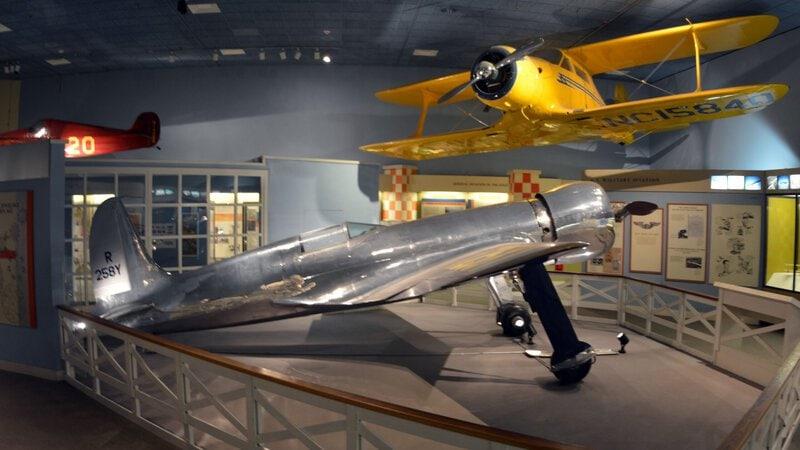

On September 13, 1935, a sleek silver aircraft screamed across the sky above Santa Ana, California at 352 miles per hour — faster than any land-based plane had ever flown. When the fuel ran dry seconds after the record was set, the pilot belly-landed in a beet field, climbed out of the cockpit with cuts on his hands, and immediately began calculating how he could go faster next time. That pilot was Howard Hughes, and the gap between those two moments — the record and the wreckage, the triumph and the dirt — is the gap that defines everything that followed.
The Day He Outran Everything

The machine Hughes flew that September afternoon was the H-1 Racer, an aircraft he had personally designed and financed. It was a jewel of engineering — smoothly riveted skin, retractable landing gear, an engine tuned to the edge of destruction. Hughes sat behind the controls in his goggles and pressed the plane to its absolute limit, running the fuel tanks bone dry in pursuit of a number no one had yet reached. He got there. Then he put a racing aircraft into a California beet field with barely a scratch on the airframe and a world speed record in his pocket.
It is tempting to treat this as pure triumph. But even in 1935, the thing that drove Howard Hughes to that altitude was not entirely healthy. The obsessive preparation, the refusal to delegate a single engineering decision, the compulsion to personally occupy the most dangerous seat in the aircraft — these were not just the habits of a daredevil. They were the early signatures of a mind that needed control the way most people need oxygen. He was at peak fame, peak physical daring, peak power. And the rot was already beginning, quiet and patient, beneath the glamour.
The Aviator (2004), Martin Scorsese’s epic biographical film written by John Logan and starring Leonardo DiCaprio, dramatizes exactly this arc — Hughes at his most mythic, and the forces already gathering to unmake him. The real history, it turns out, is even stranger and more heartbreaking than the film.
Who Was Howard Hughes Before the Legend?

Howard Hughes was born on December 24, 1905, in Houston, Texas, heir to the Hughes Tool Company — a business built on a revolutionary oil drill bit that dominated the petroleum industry. The money was not merely substantial; it was the kind of wealth that insulated a person from every ordinary consequence. He never had to negotiate, compromise, or be told no by anyone who could enforce it. That turned out to be both his superpower and his curse.
By his early twenties Hughes had decamped to Hollywood, financing and directing Hell’s Angels (1930), a World War I aviation epic so ambitious that he personally flew dangerous aerial sequences himself, unwilling to trust the shots to anyone else. The dual obsession — film and flight — was established early and completely. He was not dabbling in aviation while producing movies, or dabbling in movies while engineering aircraft. He was doing both at the highest level simultaneously, a combination no one before or since has managed at comparable scale.
The thread that runs through his entire life is that of a man who inherited the keys to a machine age and then decided to personally pilot every machine it contained. John Logan’s screenplay for The Aviator compresses and dramatizes the years 1927 to 1947, but the core biographical facts — the record runs, the crashes, the film empire, the unraveling — are grounded in documented reality.
The Aviation Records That Were Actually Real

The H-1 Racer’s 1935 speed record was only the beginning. In 1937, Hughes set a transcontinental speed record, flying from Los Angeles to Newark in 7 hours, 28 minutes, and 25 seconds — a journey that earned him a reception worthy of a conquering general. Then, in July 1938, he crowned everything with an around-the-world flight completed in 3 days, 19 hours, and 17 minutes in a Lockheed 14 Super Electra, obliterating Wiley Post’s existing record by nearly four days. When he landed at Floyd Bennett Field in New York, an estimated 25,000 people were waiting.
These records were not publicity stunts executed by a rich man with nothing better to do. Hughes personally engineered aircraft modifications for each attempt, planned routes with meticulous care, and trained with the discipline of a professional aviator. He happened to be funding each operation with industrial money, but the airmanship was entirely genuine — elite-level skill married to elite-level resources.
For viewers asking how faithfully The Aviator renders these moments: the flight sequences are among the most accurate in the picture. DiCaprio’s Hughes in the cockpit — focused, joyful, almost serene in a way he never manages on the ground — captures something real about what flying gave Hughes. It was the one domain where his need for total control and the demands of the activity were in perfect alignment. In the air, perfectionism kept you alive.
Hollywood Mogul, Test Pilot, and the Thin Line Between Them

While Hughes was chasing speed records he was simultaneously producing Scarface (1932) and The Outlaw (1943), and eventually ran RKO Pictures. The two careers operated on parallel tracks, powered by the same personality: total control, zero delegation, catastrophic impatience with anyone who questioned a decision he had already made in his own head. His behavior on a film set and his behavior in a cockpit were functionally identical. He was always the final authority. He was always the one whose judgment superseded everyone else’s.
Scorsese’s film, which has attracted decades of critical response on Letterboxd, renders this dual career with genuine insight: Hughes as a wealthy industrialist whose empire is less a business operation than an architectural projection of his inner world. When the architecture starts cracking, the empire cracks with it.
The hinge point — in the film and in the documented biography — is the XF-11 crash of July 7, 1946. Hughes was test-flying an experimental reconnaissance aircraft over Beverly Hills when a malfunction caused one propeller to reverse pitch. The plane came down through three houses. He fractured his skull, collapsed a lung, cracked multiple ribs, and was resuscitated at the scene by a Marine Corps officer who happened to be nearby. Doctors expected him to die. He did not die. But the man who walked out of the hospital was not quite the same man who had climbed into the cockpit.
The Machine That Wouldn’t Fly — and the Man Who Needed It To
The H-4 Hercules — nicknamed the Spruce Goose, though it was built primarily from birch wood — was one of the great engineering follies and engineering acts of defiance of the twentieth century. Commissioned during World War II to transport troops across the Atlantic without risking them to German submarines, the flying boat had a wingspan longer than a football field and was powered by eight massive radial engines. By the time it was ready, the war was over and the government wanted nothing to do with it.
Hughes poured roughly $18 million of his own money into the aircraft. On November 2, 1947, surrounded by journalists expecting public humiliation, he climbed into the cockpit himself and flew it — once, for approximately one mile, at an altitude of about 70 feet. It was enough. He had proven the thing could fly. He never flew it again.
The metaphor is almost too neat to be true, except that it is true. A man who could no longer reliably touch a doorknob with his bare hand taxied an enormous aircraft into open water and briefly, defiantly, made it airborne. The same period brought a U.S. Senate investigation into Hughes Aircraft’s wartime contracts — depicted in The Aviator as a sharp, combative public confrontation — and Hughes’ testimony was widely viewed as a personal victory. He demolished his interrogators in public. He was, simultaneously, losing the ability to function in private.
OCD, Isolation, and the Empire That Consumed Its Builder

The obsessive-compulsive disorder that progressively consumed Hughes is documented by multiple biographers and former aides — it is not a Hollywood dramatization. The contamination fears were real. The rigid rituals around food, doorknobs, and physical contact were real. The periods of total seclusion in darkened screening rooms, during which Hughes sometimes refused to see another human being for weeks, are confirmed by firsthand accounts from people who worked for him.
The cruel irony at the center of Hughes’ story is that the hyper-control that made him a world-record aviator and a feared studio boss was the same neurological engine driving his destruction. His perfectionism was not a quirk sitting alongside his genius — it was the same mechanism, expressed in different directions. In the cockpit, it produced records. In his private life, it produced a prison he built around himself one ritual at a time.
DiCaprio’s performance in The Aviator — particularly the scenes in which Hughes is trapped in compulsive loops, repeating phrases, paralyzed by contamination terror — became one of the defining portrayals of mental illness in American cinema precisely because it found the human being inside the pathology. The film’s reception on IMDb reflects how durably that performance has resonated with audiences two decades on. By the late 1940s, the endpoint of the film’s timeline, the public Hughes was already fading. The private Hughes was becoming the reclusive figure who would eventually spend his final decades in darkened hotel rooms, communicating by handwritten memo — a trajectory the historical record confirms in full, unsensationalized detail.
What the Film Gets Right, and Why It Still Matters
Scorsese’s decision to confine The Aviator to the years 1927 through 1947 is the film’s most important structural choice. It captures Hughes at his most mythic and his most human — before the full collapse. By ending on dread rather than outright tragedy, the film is historically honest, because in 1947 the worst was genuinely still ahead. To dramatize the final decades would require a different, darker, and almost unwatchable film.
For anyone drawn to the question of how much of the story is true: the speed records, the crashes, the Senate hearing, the Hercules flight, the OCD episodes — all are real and all are documented. The film’s dramatic license operates in compression and dialogue, not invention. John Logan and Scorsese did not need to fabricate drama. The life contained enough.
Where the film occasionally simplifies, the historical record fills in texture worth knowing. Hughes’ relationships with Katharine Hepburn and Ava Gardner, both depicted in the film, were genuinely significant and are documented in both women’s memoirs and biographies. His battles with Pan Am chairman Juan Trippe over airmail routes and government contracts were not merely personal rivalries but fights over the shape of commercial aviation in the postwar United States. His influence on how Hollywood handled censorship through The Outlaw predates and prefigures arguments that would reshape the industry decades later. The film touches each of these threads; the history rewards anyone who pulls on them further.
What The Aviator ultimately renders, and what the history confirms, is a portrait of what American ambition looks like when it operates without any external limit — no bank saying no, no board with override authority, no rival capable of outflying him. The answer, in Howard Hughes’ case, is that it turns inward. It feeds on itself. The same force that drove him to 352 miles per hour over Southern California eventually drove him into rooms he would not leave for months.
Return, then, to the beet field in 1935. The fastest man alive, sitting in the dirt, out of fuel, with a world record and cuts on his hands. Already planning the next attempt. Already unable to stop. It is the image of genius and compulsion fused so completely into a single human being that separating them was never really possible — and the tragedy of Howard Hughes is that by the time anyone understood that clearly, including Hughes himself, the plane had already run out of sky.

 Arabic
 French
 Spanish
 Portuguese
 Deutsch
 Turkish
 Dutch
Dutch
 Italiano
 Russian
 Romaian
 Portuguese (Brazil)
 Greek
Greek