


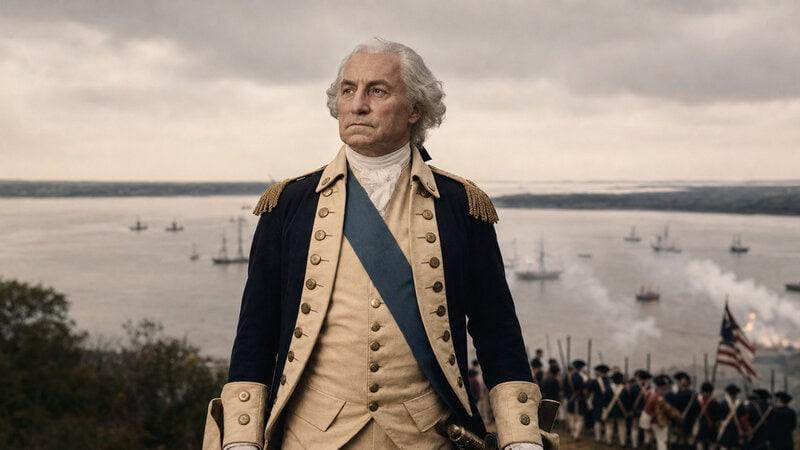

On the morning of August 27, 1776, George Washington stood on Brooklyn Heights and watched his army being destroyed. British and Hessian troops had slipped through Jamaica Pass in the dead of night, and by dawn they were rolling up the American left flank — soldiers scattering into marshes, cornfields, and chaos, with the East River at their backs and no escape route in sight.
The Summer America Nearly Died

Most Americans think of 1776 as the year of triumph — the Declaration of Independence, the birth of a nation, the beginning of something inevitable. The real story of that year is far darker. It is a story of survival against almost certain annihilation, of an army that crumbled within weeks of its greatest rhetorical moment, and of ordinary people — soldiers, civilians, and children — caught inside a catastrophe they had no power to control.
The Battle of Long Island alone cost the Continental Army roughly 1,000 men killed, wounded, or captured in a single day, making it one of the most punishing American defeats of the entire Revolutionary War. Washington’s men were outnumbered, outmaneuvered, and pinned against a river. One aggressive British crossing that night might have ended the Revolution before the ink on the Declaration was even dry.
This is the history that Lauren Tarshis drops her readers into with the fifteenth installment of her I Survived series. The protagonist is Nathaniel Fox, an eleven-year-old runaway who stumbles into New York City at the worst possible moment — and whose fictional ordeal mirrors, with striking accuracy, the documented terror that real New Yorkers lived through in the summer and fall of 1776.
A Boy Alone in a City at War
Nathaniel Fox is not a soldier, a statesman, or a general. He is a child who has fled a cruel uncle and found himself alone in the most dangerous city in colonial America at precisely the moment that danger arrived in force. That choice of protagonist is not accidental. It places the reader exactly where history so rarely puts us — at street level, without power or information, making desperate decisions in real time.
New York City in 1776 was uniquely volatile. Its population was split sharply between Patriots and Loyalists, neighbors eyeing each other with open suspicion. Rumors of British invasion circulated daily. Supply chains were unreliable. Across the harbor, the largest naval armada Britain had assembled in the Western Hemisphere was preparing to move. For a boy with no family and no allies, the city offered no safe corner.
Thousands of actual civilians found themselves in exactly this position. Families who had delayed leaving, servants who had nowhere to go, children separated from parents by the chaos of mobilization — all were caught inside a military situation they could not escape and barely understood. The American Revolution Museum has highlighted how books like Tarshis’s serve a genuine historical function by centering these overlooked voices, making the Revolution feel like something that happened to people rather than something that happened in documents.
Britain’s Master Plan to Slice America in Two

To understand why the New York campaign of 1776 was so decisive, you have to understand what Britain was actually trying to accomplish. The strategic logic was elegant and brutal: seize control of New York and the Hudson River corridor, and you separate New England from the middle and southern colonies. Cut that artery, and the rebellion starves — of supplies, of communication, of the unity that made coordinated resistance possible.
General William Howe arrived in the summer of 1776 with a force that dwarfed anything Washington could put in the field. The Continental Army numbered fewer than 20,000 men at its peak during this period, and many of those were sick, poorly equipped, and minimally trained. Militia units came and went. Enlistments expired. Disease moved through the camps faster than orders did.
Geography compounded every disadvantage. Manhattan is an island. Long Island sits directly across the harbor. Whoever controlled the waterways controlled the war — and Britain’s Royal Navy owned the water completely. Washington was trying to defend island terrain against an enemy that held the sea, with an army that had never fought a pitched engagement at this scale. The New York campaign was not a sideshow. It was the central contest of the war’s first year, and in the summer of 1776, Washington was losing it badly.
August 27, 1776: America’s Worst Day

The Battle of Long Island was a tactical masterpiece — for the British. Howe sent a diversionary force to engage the American front while executing a flanking march through Jamaica Pass in the early hours before dawn. The pass was guarded by only five officers. By the time Washington’s commanders understood what was happening, British troops were already behind them, closing a trap that the Americans had no prepared position to escape.
The human cost was staggering and, in places, achingly heroic. Maryland regiments fought rearguard actions near the Old Stone House in Brooklyn, charging British lines repeatedly — not because they could win, but to buy time for other soldiers to withdraw. Many of those men never made it back.
Soldiers drowned in the marshes of Gowanus Creek trying to escape. Others were captured in cornfields or cut down in open ground. By nightfall, Washington’s remaining force was crowded onto Brooklyn Heights, exhausted, demoralized, and hemmed in on three sides. The East River — cold, wide, and patrolled by British ships — was the only direction left. One British push across the river into Manhattan that night might well have ended the American Revolution entirely.
It did not come. Howe paused to consolidate, perhaps expecting a surrender he considered inevitable. That pause gave Washington the only meaningful gift the campaign would offer him.
The Miracle in the Fog

On the nights of August 29 and 30, Washington executed one of the most remarkable military retreats in recorded history. Under cover of darkness — and then a thick fog that rolled in before dawn could expose them — he moved approximately 9,000 soldiers across the East River in small boats. Oars were muffled with cloth. Men were ordered to silence. By the time the fog lifted and British scouts reached Brooklyn Heights, the American army was gone.
The retreat saved the army. It did not save New York. British forces took Manhattan within weeks, and on the night of September 20 into September 21, 1776, a massive fire swept through the city — its cause still debated by historians — destroying a significant portion of New York’s buildings. Residents who hadn’t already fled watched their neighborhoods burn. Those who remained hid in cellars, fled north along congested roads, or tried to salvage what they could from the ruins. This is the urban nightmare that Nathaniel Fox navigates in Tarshis’s story — not a battlefield with clear lines and comprehensible order, but a city in flames, full of desperate people making desperate choices.
By November, Washington had retreated through New Jersey with a shrinking, demoralized force. Enlistments continued to expire. Soldiers deserted. To nearly everyone watching that winter, the cause appeared finished.
What the Textbooks Usually Skip

The sanitized version of 1776 tends to leap from the Declaration of Independence in July to Valley Forge and Yorktown, skipping the months in between when the men who signed that declaration watched their army collapse around them. Historians who focus on this period often argue that the fall of 1776 — not any later moment — was the Revolution’s true crisis point. The war came closer to ending in British victory during these months than at almost any other time.
What also gets omitted is the role of ordinary people: the militias whose local knowledge fed Washington’s intelligence network, the civilians who sheltered exhausted soldiers, the spies who operated in occupied New York at enormous personal risk, and the children who simply endured whatever the war dropped on them. These are the figures who form the backbone of books like Tarshis’s — people whose names rarely appear in official records but whose choices shaped outcomes as surely as any general’s orders.
Tarshis researches each I Survived installment carefully, grounding her fictional protagonists in documented conditions and verified details of daily life. Reviewers have noted that her approach transforms abstract dates and troop movements into felt experience — which is how history actually lodges in memory, particularly for younger readers encountering it for the first time.
For readers who want to experience this story in a different format, a graphic novel adaptation makes the chaos and emotion of the New York campaign visually immediate, giving a new generation of readers a way into the same history through a different door.
Why Nathaniel Fox Still Matters
The Revolution was not won by inevitability. It was not the unfolding of a predetermined plan. It was won — barely, repeatedly — by people who kept going when every rational calculation said to stop. That is what makes Nathaniel Fox, fictional as he is, an honest vessel for real history. An eleven-year-old boy with no army and no resources, surviving by instinct and luck and a refusal to quit, is not so different from the actual soldiers who crossed the East River in rowboats on a foggy August night.
The colonies declared independence on July 4, 1776, and spent the next six months nearly losing everything that declaration promised — in the very city where those promises mattered most. The men who signed the Declaration watched New York burn and kept moving. The soldiers who survived Long Island rowed through the dark and kept fighting. And on December 26, 1776, Washington loaded what remained of his army into boats and crossed the Delaware River toward Trenton, making one final gamble in the closing days of an almost catastrophic year.
That crossing echoed Brooklyn — the darkness, the freezing water, the desperate act of moving forward when standing still meant death. The difference was that this time, Washington was rowing toward the fight instead of away from it. That shift, from retreat to attack, is where 1776 finally turned. But it turned only because an army had survived long enough to make the crossing — and in the brutal logic of that year, survival itself was a form of victory.

 English
 French
 Spanish
 Portuguese
 Deutsch
 Turkish
 Dutch
Dutch
 Italiano
 Russian
 Romaian
 Portuguese (Brazil)
 Greek
Greek