



The smoke rose so thick and black over the Thames estuary that sailors miles out to sea could navigate by it. Londinium — the bustling Roman trading port that had barely existed a generation earlier — was burning, and on the ridge above it stood a queen watching her warriors turn an empire’s ambitions to ash.
The Woman Before the Legend

Before she became the warrior-queen of Roman nightmares, Boudica was something more specific and more human: a widow, a mother, and a political figure who had tried to do everything Rome asked of her. Her husband, King Prasutagus of the Iceni tribe — whose territory covered much of what is now Norfolk and Suffolk — had ruled as a client king, walking the careful line that allowed some British rulers to maintain a degree of local power beneath the Roman umbrella. When he died, around 60 or 61 AD, he left his kingdom jointly to Rome and to his two daughters, a compromise he presumably believed would protect his family and his people.
Rome ignored the will entirely. Imperial officials descended on Iceni lands and treated the kingdom as conquered territory, stripping nobles of their estates and confiscating what they wished. When Boudica protested, the response was an act of deliberate, calculated humiliation: she was publicly flogged, and her daughters were assaulted. The message was blunt — client kingdoms existed at Rome’s pleasure, not by any enforceable right.
The ancient sources who describe Boudica — most crucially Tacitus, writing a generation later, and Cassius Dio, writing even further removed — are Roman men shaping a Roman narrative, and every detail they offer must be held in that light. Tacitus describes her as tall and fierce-voiced, with long copper-red hair and a harsh gaze, capable of commanding the attention of vast crowds. Whether those physical details are accurate or literary convention, the result — an uprising that nearly ended Roman Britain — was entirely real.
The Iceni’s grievances were not unique; they were the concentrated form of a pattern spread across the province. Roman taxation was punitive, and Roman financiers had extended loans to British tribal leaders under terms that were now being called in aggressively. The philosopher Seneca — Nero’s own tutor — had reportedly extended enormous sums into Britain and then demanded sudden repayment, destabilizing the local economy. The temple to the divine emperor Claudius at Camulodunum, which Britons had been compelled to fund, stood as a daily monument to their subordination. The revolt did not come from nowhere; it came from a long accumulation of humiliations that needed only a single unbearable spark.
Three Cities, One Season of Fire

Boudica’s first target was Camulodunum — modern Colchester — the oldest Roman settlement in Britain and the site of that hated Claudian temple. The city fell quickly and completely. The temple, which had served as a last refuge for its defenders, was razed. The Ninth Legion Hispana, marching in relief, was ambushed before it could arrive; its infantry was annihilated in a catastrophe that sent shockwaves all the way back to Rome. The cavalry escaped; almost nothing else did.
The Trinovantes tribe, whose own grievances against Rome ran as deep as the Iceni’s, joined the uprising. The coalition army swelled to a size that ancient sources record as approximately 230,000 warriors — a figure that modern historians treat with appropriate skepticism but which captures something real about the scale of mobilization. This was not a raid. This was a society in revolt.
The Roman governor, Gaius Suetonius Paulinus, was at the far end of the province when the uprising erupted — on the Isle of Anglesey, crushing the druid stronghold there. He marched south immediately, but faced an agonizing calculation: he did not have enough soldiers to garrison the cities and also field a viable army. Londinium and Verulamium — modern St Albans — were, in his cold military arithmetic, expendable. He ordered their abandonment and left their populations to whatever fate came with Boudica’s advance.
What came was fire. Both cities burned. Archaeologists excavating beneath modern London still encounter what is known as the Boudican destruction layer — a dark stratum of burned debris, pottery, and ash sitting several meters below street level, a physical record of a single catastrophic season. The destruction Boudica’s forces wrought was thorough enough to leave a permanent mark in the archaeological record of three separate cities, an achievement that required a genuinely massive and organized force to accomplish.
By the time Suetonius had assembled his available forces — roughly 10,000 soldiers drawn from the Fourteenth Legion, detachments of the Twentieth, and supporting auxiliaries — the emperor Nero in Rome was reportedly debating whether to write the province off entirely. Against a coalition numbered in the hundreds of thousands, what could 10,000 possibly do?
The General Who Chose His Ground

Suetonius was not a man given to despair. He had spent his career in difficult terrain against difficult enemies — campaigns in North Africa and his recent Anglesey operation marked him as a commander who understood that the right ground could multiply a smaller force’s effectiveness to a decisive degree. He chose his battlefield with the care of a man who knew his life, his army, and the future of the province depended on getting it right.
The site he selected — traditionally associated with a location along Watling Street, the Roman road running through the midlands, though the precise location remains debated by historians — was a narrow defile with dense forest at his back and an open plain sloping away in front. The forest ensured he could not be encircled or attacked from the rear. The narrowing approach meant that Boudica’s overwhelming numerical advantage would be funneled and compressed, reducing her usable front to roughly equal his own. The tens of thousands behind that front line would push and crowd and ultimately hinder rather than help.
He arranged his legionaries in a tight wedge formation with cavalry protecting the flanks against the tree line. Everything about the position was designed to neutralize the one thing the British coalition had in abundance: numbers.
The Battle of Watling Street

On the day of battle, according to Tacitus, Boudica rode along her lines in a chariot with her daughters beside her, addressing her warriors in a speech that Tacitus records — though almost certainly composed himself in keeping with Roman rhetorical tradition. Whether those exact words were spoken or not, the image is striking: a mother with her injured daughters, rallying her people against the army that had wronged them.
Her warriors were supremely confident — so confident, Tacitus tells us, that their families had come to watch the victory. Wagons full of women and children were arranged in a rough semicircle at the edge of the plain, positioned to witness the final defeat of Rome in Britain. It was a detail that would prove fatal.
The Roman volleys of pila — heavy javelins designed to bend on impact and tangle in shields — came first, stripping the advancing British warriors of their protection. Then the legionaries moved forward in their wedge, disciplined and silent, pushing into the disordered mass that the narrow approach had created. The British lines, pressed from behind by the sheer weight of their own numbers, had nowhere to retreat when the Roman advance broke them — except backward into their own wagons.
The wagons that had been arranged to frame a victory became a wall that sealed a catastrophe. The rout turned into a slaughter. Ancient sources claim 80,000 Britons died against 400 Romans — numbers that almost every modern historian regards as wildly exaggerated in both directions, but which convey, even through their distortion, the completeness of the collapse. The Battle of Watling Street was, by any measure, one of the most decisive engagements ever fought on British soil. Archaeological finds in the region continue to shed light on the military culture of the Celtic forces Boudica commanded, including a recently discovered war trumpet that may date to this turbulent period.
What Rome Learned in Defeat

Boudica did not survive to face Roman justice. Both Tacitus and Cassius Dio agree on her death in the immediate aftermath of the battle, though they differ on the manner — Tacitus says she took poison, Dio says she fell ill. What both agree on is the essential point: she died free, and Rome never got its triumph over her. Where she was buried remains one of British history’s most persistent and unresolved mysteries, with theories ranging across multiple counties and not a shred of confirmed physical evidence to support any of them.
Suetonius moved into his punitive phase with brutal efficiency, and for a moment it seemed the province might be pacified by sheer terror. But Rome’s administrators recognized that crushing an already-exhausted and devastated population would only create the conditions for another revolt. The new procurator sent to replace the official whose abuses had triggered the uprising was directed toward a more conciliatory policy. The financial stranglehold on British tribes was eased. The revolt had been crushed militarily, but it forced a genuine recalibration of how Rome governed Britain — Boudica’s war achieved something even in defeat.
Suetonius himself was eventually recalled. His post-battle campaign was deemed too severe, too destabilizing — an implicit Roman acknowledgment that the revolt had exposed real failures of colonial administration rather than simple British ingratitude. The Boudican revolt stands as one of the most serious challenges Roman imperial governance ever faced in a western province, and the fact that Rome responded not only with force but with genuine policy reform tells you something about how deeply it registered.
The physical evidence Boudica left behind is still recoverable for those who look. The dark burn layer beneath London. The gap in Roman-era construction at Colchester. Coin hoards buried in terror and never retrieved, found scattered across the region by modern archaeologists — the savings of people who hid what they valued and did not survive to go back for it.
History’s Most Dangerous Near-Miss

Consider what changes if Suetonius had still been pinned down in Anglesey when the uprising reached its peak, or if he had chosen more open ground, or if Boudica’s forces had not allowed their wagons to be positioned as a trap for their own retreat. Roman Britain lasted until around 410 AD — nearly four more centuries of roads, cities, the early introduction of Christianity, and the administrative structures that would shape everything that came after. All of it balanced, in a single season of 60 or 61 AD, on one general’s choice of a valley.
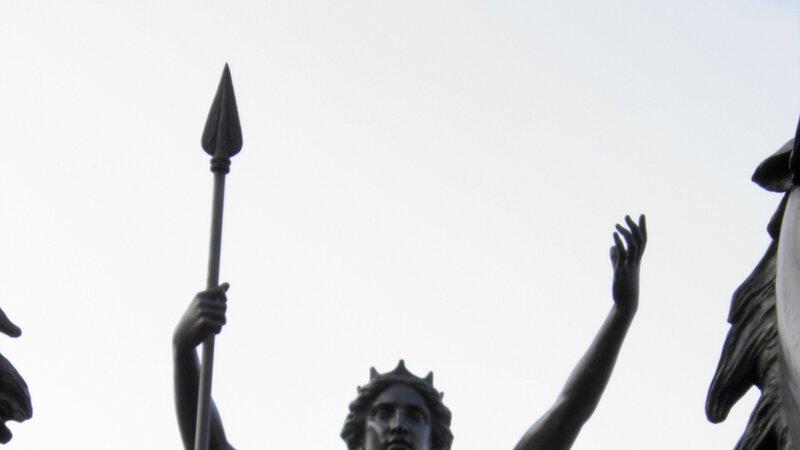
The medieval period largely ignored Boudica. She was rediscovered by Tudor writers who found in her defiance of a continental empire a convenient mirror for Queen Elizabeth I — an irony almost too neat to be believed, but historically documented. The Victorians embraced her more extravagantly still, installing the famous bronze of her chariot on the Thames Embankment directly opposite the Houses of Parliament, where she stands today: a rebel queen who tried to destroy Britain’s first empire, repurposed as a symbol of its second.
What makes her story endure past the bronze and the myth is the human core of it. She was a widow whose grief was met with a flogging. A mother whose daughters were assaulted by the administrators of a self-proclaimed civilizing power. A queen who looked at what Rome had done and decided, with full knowledge of what it would cost, to answer it with fire — and who came, by the margin of one general’s tactical judgment and the placement of some wagons, terrifyingly close to winning.

 English
 Arabic
 French
 Spanish
 Portuguese
 Deutsch
 Turkish
 Italiano
 Russian
 Romaian
 Portuguese (Brazil)
 Greek
Greek