


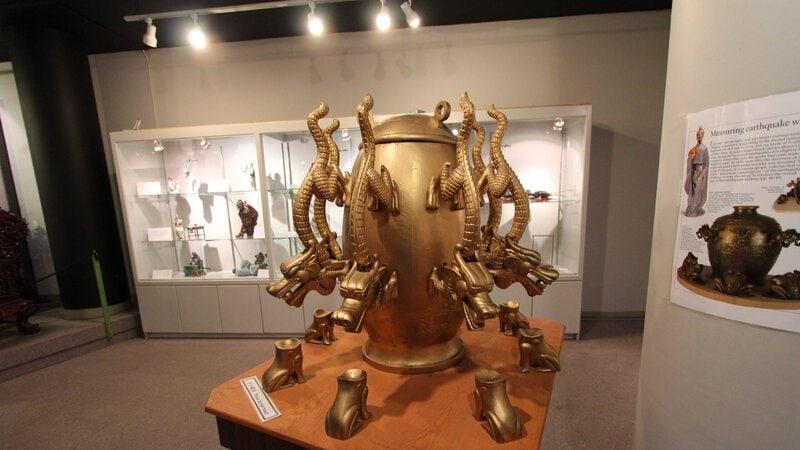

In 132 CE, the court at Luoyang watched a bronze urn do something impossible. The device — about the size of a wine jar, ringed by eight dragon heads, each cradling a bronze ball in its jaws — suddenly released one of those balls. It dropped with a soft metallic ring into the open mouth of a toad crouching below. No one in the capital had felt a thing. Days later, a messenger arrived from the northwest: there had been an earthquake, hundreds of miles away, in exactly the direction the dragon’s head had been facing. The machine had felt the earth move before any human in the room knew the earth had moved at all.
A Machine That Felt the Earth Move

The man behind that device was Zhang Heng — astronomer, poet, engineer, and one of the most restless intellects the ancient world produced. His seismoscope, as it is now called, was not a lucky accident or a curiosity. It was the product of a civilization operating at full intellectual throttle: a society that had already transformed writing materials, was mapping the heavens with mechanical instruments, and was working out mathematical concepts that Europe would not engage with for another millennium. The Eastern Han dynasty, ruling from Luoyang between 25 and 220 CE, was by almost any measure the most scientifically productive society on earth during its peak years.
And yet. That same civilization — brilliant enough to detect earthquakes hundreds of miles away — was catastrophically blind to the fault lines cracking through its own palace walls. Within roughly sixty years of Zhang Heng’s triumph, the dynasty would be a hollow shell: its capital burned, its emperor a pawn shuttled between warlords, and three rival kingdoms already sharpening their swords in the ruins. The Eastern Han’s story is one of history’s great paradoxes — a civilization that extended human perception to remarkable limits while steadily losing the ability to perceive itself.
The Phoenix Restart: How the Eastern Han Was Born

To understand what was at stake, you have to go back to the rupture. The original Han dynasty — the Western Han, founded in 202 BCE — had given China more than two centuries of growth, consolidation, and Confucian bureaucratic culture. Then a reformist official named Wang Mang pulled off something genuinely audacious: he seized the throne, declared a new dynasty called the Xin, and spent the years from 9 to 23 CE attempting top-down social reforms so sweeping and so poorly executed that they collapsed into famine, flood, and open rebellion.
Out of that wreckage climbed Liu Xiu, a minor scion of the old Liu imperial family who combined military talent with political instinct in exactly the measure the moment demanded. By 25 CE he had fought his way to the throne, declared himself Emperor Guangwu, and made a deliberate, symbolic choice: he would not return to Chang’an, the old Western Han capital weighted with factional memory. Instead he established his court at Luoyang, roughly 230 miles to the east — neutral ground, a fresh start, a dynasty that needed to earn its legitimacy rather than simply inherit it.
This is the hinge moment that splits the Han dynasty into its two great arcs. Historians call the first phase the Western Han (202 BCE-9 CE) and the second the Eastern Han (25-220 CE), named for the direction of the new capital. The Liu family bloodline connected them across both eras, but the Eastern Han was in many ways a different animal: more commercially active, more intellectually effervescent, and — as it would turn out — far more structurally fragile. It arrived carrying both the glory of a centuries-deep Confucian inheritance and all of its accumulated tensions.
The Golden Age in Full Bloom

At its height, the Eastern Han was a genuinely remarkable place. Luoyang swelled into a metropolis with a population that may have approached half a million people, making it one of the largest cities on the planet in the second century CE. The Silk Road was humming: Roman glassware moved east, Central Asian horses moved west and south, and Chinese silk moved in all directions, stitching together an exchange network that stretched from the Mediterranean toward the Pacific. The empire’s population has been estimated at around 60 million people, fed by iron-tipped plows and sophisticated irrigation systems that made Han agriculture among the most productive in the ancient world.
Underpinning all of it was a cultural commitment to scholarship that bordered on the devotional. The Imperial Academy — the Taixue — eventually enrolled tens of thousands of students, training young men in the Confucian classics that formed the foundation of the civil service examination system. To govern, you had to know your texts. To advance, you had to demonstrate learning. This created a class of scholar-officials who were, at their best, genuinely educated administrators — and who produced, as a byproduct, some of the most consequential intellectual work in human history.
Daily life for prosperous Eastern Han families was materially rich in ways that still surprise. Tomb models recovered by archaeologists show multi-story residential towers. Wealthy households owned lacquered furniture, bronze mirrors, and ceramic wares of considerable sophistication. A merchant class had grown prosperous enough to make Confucian officials visibly uncomfortable — commerce was officially ranked below farming and scholarship in the social hierarchy, but money had a way of climbing regardless. It was a society stretched between its ideals and its appetites, productive and restless and, for a few generations, brilliantly alive.
The Invention Factory: Paper, Seismographs, and the Math That Changed the World

It was in this climate of institutional scholarship and practical ambition that the Eastern Han produced its most enduring contributions to human civilization. The first and arguably the most consequential came from a court official named Cai Lun, who around 105 CE refined and promoted a process for making paper from bark, hemp waste, rags, and fishing nets — cheap, abundant materials that could be pulped and pressed into lightweight sheets. Before this, writing in China meant either expensive silk or heavy bamboo strips. Cai Lun’s paper was neither. It was portable, affordable, and capable of carrying text across distances and social classes that silk and bamboo never could. That innovation would travel west along the Silk Road, reach the Islamic world by the eighth century, arrive in Europe by the twelfth, and ultimately create the conditions that made print culture possible. The Eastern Han handed humanity one of its most transformative communication technologies.
Then there was Zhang Heng. Born in 78 CE and dying in 139 CE, he was the kind of mind that seems to belong to no particular era. He produced estimates of pi that rivaled later European calculations. He argued — correctly — that the moon shines by reflecting sunlight. He constructed a water-powered armillary sphere to track celestial movements. And in 132 CE he presented the seismoscope to the court: a device whose basic mechanical principle — an internal pendulum-like mechanism detecting ground motion and triggering a directional indicator — would not be meaningfully improved upon for many centuries. Zhang Heng was not a specialist. He was a polymath in the fullest sense, and he was entirely a product of Eastern Han intellectual culture.
Quieter but no less significant was the mathematical tradition embodied in the Nine Chapters on the Mathematical Art, a text compiled and extensively commented upon during the Eastern Han period. This work introduced systematic methods for solving what we would now call systems of linear equations — procedures analogous to what later became known as Gaussian elimination — and engaged seriously with negative numbers, centuries before European mathematicians would accept that such quantities could legitimately exist. Han dynasty achievements in mathematics were not decorative; they were tools for surveying land, calculating taxes, and managing the logistics of empire. The abstractions were inseparable from the practical.
What links paper, the seismoscope, and the mathematics of the Nine Chapters is a shared ambition: each was a technology for extending human reach — over nature, over distance, over abstraction itself. The tragic irony is that the same civilization was, simultaneously, developing a spectacular blindness to its own internal collapse.
The Rot Sets In: Child Emperors, Eunuchs, and Warlord Clans

The structural failure of the Eastern Han was not sudden. It was slow, almost architectural in the way it accumulated — each generation adding another crack to a foundation that looked solid from the outside long after it had been hollowed out from within.
The early emperors — Guangwu and his immediate successors — were capable rulers who kept the machinery of government functioning. But after them came a succession of child emperors, some ascending the throne in infancy. Real power passed to whoever controlled the boy: empress dowagers acting as regents, then their clans, then the palace eunuchs who exploited their physical proximity to the emperor with ruthless efficiency. The cycle became predictable and vicious. An empress’s family would dominate the court; the young emperor, upon reaching adulthood, would ally with eunuchs to break the clan’s grip; the eunuchs would then entrench their own power; the next emperor would use a new aristocratic family to dislodge the eunuchs. Each rotation left the throne weaker and the palace more thoroughly poisoned.
The crisis came to a head in what historians call the Partisan Prohibitions of 166 to 184 CE, when powerful eunuchs moved against hundreds of Confucian scholar-officials who had openly criticized court corruption. Many were imprisoned, exiled, or killed. It was a catastrophic self-inflicted wound. The Eastern Han was a Confucian meritocracy — its bureaucratic class was its nervous system, the mechanism through which information traveled from the provinces to the center and orders traveled back. By purging that class, the eunuchs dismantled the very system that made centralized government possible. The administrative breakdown that followed was not metaphorical. It was literal: the center could no longer effectively govern the periphery, and the periphery knew it.
Power drained outward, pooling in the hands of regional governors and military commanders who had always derived their authority from the throne but now increasingly acted on their own. The warlords were forming — not in a dramatic moment of rebellion, but in the slow withdrawal of imperial authority from a landscape growing desperate.
The Yellow Turban Rebellion and the Final Unraveling

Desperation had a face by 184 CE. A charismatic healer and religious organizer named Zhang Jue had spent years building a mass movement rooted in a millenarian form of Taoist-influenced belief, promising that the Han’s “Blue Heaven” was ending and a new “Yellow Heaven” would rise. His followers, who bound their heads in yellow cloth, numbered in the hundreds of thousands — peasants who had survived floods, famines, locust plagues, and epidemic disease, and who had watched the court consume itself in factional warfare while the countryside starved. The Yellow Turban Rebellion erupted across multiple provinces simultaneously, a coordinated uprising on a scale the empire had rarely confronted.
The Han court suppressed it, eventually. But the cost was something the dynasty could not afford. To field armies quickly enough, the central government empowered regional governors to raise, equip, and command their own troops. It was a practical solution to an immediate crisis. It was also the moment the Eastern Han effectively privatized its own military — and in doing so, signed its death warrant. Those regional armies did not dissolve when the Yellow Turbans were defeated. They remained, loyal to their commanders, and their commanders were no longer answerable to the emperor in any meaningful sense.
What followed was a final spiral of remarkable grimness. In 189 CE, the warlord Dong Zhuo marched his forces into Luoyang, seized control of the court, and installed a puppet emperor. When forced to retreat westward in 190 CE, he burned Luoyang behind him — the great capital, with its vast population and its libraries and its bronze instruments — reduced to ash as a parting gesture of contempt. The emperor became a hostage of the political moment, passed between factions. By 196 CE, the general Cao Cao had maneuvered the last Han emperor, known as Emperor Xian, into a new capital at Xu, where he would reign in name for another quarter century while Cao Cao ruled in fact.
The timeline is worth holding in mind. Zhang Heng unveiled his seismoscope in 132 CE. By the 190s, the dynasty that produced him was effectively finished: its capital a ruin, its emperor a figurehead, its territory fracturing into the rival states that would become the Three Kingdoms. From scientific achievement to political extinction in barely two generations.
The Legacy: Why the Eastern Han Still Echoes
The Eastern Han dynasty officially ended in 220 CE when Emperor Xian abdicated, and the three-way division of China into Wei, Shu, and Wu became formal. But endings in history are rarely as clean as abdication documents suggest. The Eastern Han’s legacy did not end — it dispersed, carrying forward in ways that remain visible today.
Paper traveled the Silk Road westward, transforming first the Islamic world and then medieval Europe, making possible the preservation and transmission of knowledge at a scale that reshaped civilization. The mathematical methods developed and codified during the Eastern Han period laid groundwork that later contributed to advances in algebra and practical computation. And the cultural identity forged across both Han periods proved almost impossibly durable: the dominant ethnic group of China still calls itself the Han people — 汉族 — two thousand years after the dynasty that gave them that name. That is one of the most striking acts of collective self-definition in the history of any civilization.
What the Eastern Han’s collapse teaches, though, is something darker and more instructive than a catalogue of inventions. It demonstrates that institutional genius and institutional rot are not mutually exclusive — that a society can be producing world-historical breakthroughs in one wing of the palace while the other wing devours itself with factional violence, child rulers, and the systematic persecution of the educated administrators who keep everything running. The Eastern Han did not fail because it was primitive or ignorant. It failed because it could not turn its remarkable perceptive capacities inward, onto itself.
Somewhere in Luoyang, in the years when Cao Cao’s armies were consolidating their grip, Zhang Heng’s seismoscope presumably still sat in whatever hall had housed it — bronze dragons frozen in their ring, waiting for the next tremor, silent and precise and perfectly useless against the crisis at hand. The instrument could register an earthquake from hundreds of miles away. It could not detect an empire dying from within. That, in the end, is the Eastern Han in a single image: a civilization of extraordinary reach and extraordinary blindness, one of the ancient world’s most remarkable experiments, brought down not by any force it could measure, but by the slow failures it refused to see.

 English
 Arabic
 French
 Spanish
 Portuguese
 Deutsch
 Turkish
 Dutch
Dutch
 Italiano
 Russian
 Portuguese (Brazil)
 Greek
Greek