


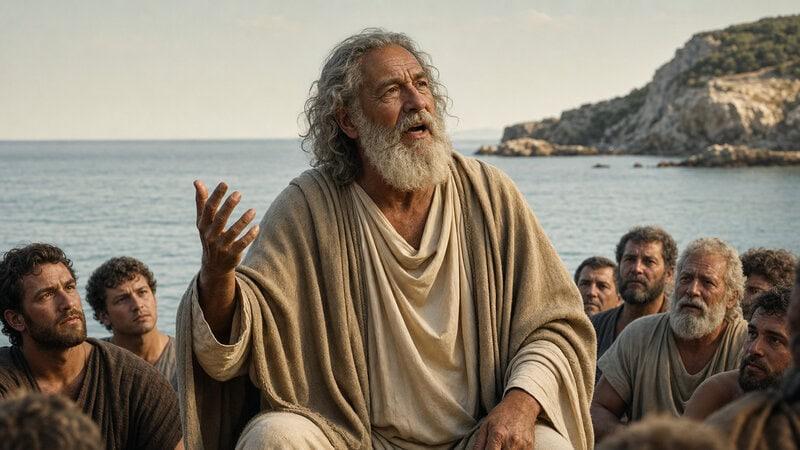

Imagine a story so gripping that it survived wars, the collapse of civilizations, and three centuries without a single written word — passed from singer to singer, campfire to palace hall, changing with every breath. The Odyssey is that story, and its own journey from spoken word to printed page is as dramatic as anything Odysseus faced on the wine-dark sea.
c. 1200 BC — The Fall of Troy Sets the Story in Motion

Around 1200 BC, a city on the northwestern coast of what is now Turkey was burning. Archaeologists call it Troy VIIa, and its destruction layers align with the era Greeks would later remember as the Trojan War — a decade-long siege that ended with wooden horses, fire, and the long, treacherous journeys home. It is from that chaos that Odysseus sets sail for Ithaca, launching the ten-year wandering at the heart of the poem.
The world the poem dimly remembers was the Late Bronze Age: a sophisticated network of palace economies, long-distance trade, and maritime activity that collapsed catastrophically around 1180 BC. That collapse left a wound in Mediterranean civilization, and the stories born from it — of heroes lost at sea, of gods meddling in human lives — would echo for millennia. Without Troy, there is no Odyssey.
c. 1100-800 BC — The Dark Ages Keep the Story Alive Through Song

When the Bronze Age world shattered, literacy went with it. For roughly three centuries, the Greek world had no writing system, no administrative records, no texts of any kind — and yet the stories survived. They were kept alive by oral poets called aoidoi, singers who performed at feasts and festivals, carrying entire narrative traditions inside their memories. The story of Odysseus was one of them.
These singers did not memorize scripts the way an actor learns lines. Instead, they worked with a toolkit of formulaic phrases — “rosy-fingered Dawn,” “wine-dark sea,” “much-enduring Odysseus” — and stock scenes that could be assembled differently for each audience, occasion, and mood. Every performance was, in a real sense, a new version of the poem. There was no single correct Odyssey during these three centuries, only an ever-shifting river of song.
What is remarkable is not merely that the stories persisted, but that they retained recognizable shape across generations with no written anchor whatsoever. The oral tradition was not a degraded substitute for writing; it was a sophisticated technology in its own right, with its own rules, its own quality controls, and its own form of fidelity.
c. 800-700 BC — Homer Shapes the Definitive Version (Probably)

Somewhere in the 8th or early 7th century BC, a poet we call Homer appears to have shaped the sprawling oral tradition into something close to the poem we know today: 24 books, roughly 12,000 lines, set in the aftermath of Troy. Scholarly consensus places this crystallization in Ionia — the western coast of modern Turkey — a cultural crossroads where Greek traditions mingled with influences from the broader Mediterranean world.
Whether Homer was a single inspired poet, a loose tradition of singers, or a legendary figure invented to personify the poems themselves remains one of the great unresolved questions of classical scholarship. What seems clear is that Homer, whoever he was, almost certainly could not write. The poem was still composed and performed orally, shaped in the mouth and ear rather than on any page. This is not a paradox but a reminder that literary greatness and literacy are not the same thing.
c. 750-700 BC — The Phoenician Alphabet Arrives in Greece, Making Writing Possible

Around the mid-8th century BC, Greeks adapted the Phoenician consonantal script into something revolutionary: an alphabet with vowels, flexible enough to capture the sounds of spoken Greek with unprecedented precision. It was one of the pivotal technological moments in Western history. The earliest surviving Greek inscriptions date from this period — scratched onto pottery, stone, and metal — announcing that a new era of recorded language had begun.
But writing down an epic poem of 12,000 lines was an entirely different undertaking from scratching a name onto a wine jug. The scribal infrastructure, the supply of writing materials, and the cultural habit of committing literature to text had yet to develop. The gap between the alphabet’s arrival and the Odyssey‘s first written form was not negligence; it was the natural lag of a technology still finding its footing in a world that had always trusted the human voice. Writing arrived in Greece; it took time to become a home for poetry.
c. 566 BC — Athens Orders a Standard Text for Public Performance

By the 6th century BC, the Athenian tyrant Peisistratos — or his sons — had recognized something that rulers throughout history have understood: controlling a culture’s foundational stories means shaping the culture itself. Ancient tradition credits the Peisistratid regime with commissioning a standardized version of Homer’s epics for performance at the Panathenaic Festival, the great civic celebration held every four years in Athens. Professional reciters called rhapsodes were required to perform the Iliad and the Odyssey in sequence and in order, implying that a fixed text was now being enforced.
This was a landmark moment in the long, strange life of the poem. For centuries the Odyssey had been a living, variable thing — shaped by each singer’s tradition and each audience’s expectations. Now political power stepped in and declared: this version, in this order. The river of oral tradition was being dammed into a canonical lake. The poem had become an institution.
c. 550-500 BC — The Odyssey Enters the Greek Literary Canon

By the mid-6th century BC, the Odyssey had become something more than entertainment. It was a foundational document of Greek civilization, studied alongside the Iliad as the twin pillars of education and cultural identity. Philosophers, historians, and playwrights began treating Homer as an authority — someone to quote, argue with, and measure themselves against. Plato, writing a century later, would wrestle seriously with whether Homeric stories were morally safe for the young citizens of his ideal republic, a debate that itself testifies to how seriously the poem was taken.
This canonization marked a profound shift. A story that had once lived entirely in performance — in the air between a singer’s mouth and an audience’s ears — was now being copied onto papyrus, debated in academies, and annotated by scholars. The campfire had become a classroom.
c. 3rd-2nd Century BC — Alexandrian Scholars Try to Reconstruct the ‘True’ Text
When scholars at the great Library of Alexandria set out to collect and compare manuscripts of the Odyssey, they made a troubling discovery: no two copies were quite the same. Centuries of oral performance and independent scribal copying had produced dozens of versions, sometimes differing in single words, sometimes in entire passages. The scholar Zenodotus began the work of comparison, and Aristarchus later produced a critical edition around 150 BC, marking lines he considered spurious or later additions with editorial symbols — the obelos and the asterisk — that became the ancestors of modern textual criticism.
The crisis these scholars faced was itself living proof of the oral tradition’s long shadow. Every manuscript was authentic to someone’s performance tradition, and the Alexandrians had to develop an entirely new intellectual discipline — textual criticism — just to navigate the resulting chaos. Centuries of variable singing had left numerous valid but divergent texts, each one a snapshot of the poem at a different moment in its journey. The Library of Alexandria did not simply preserve the Odyssey; it had to make difficult editorial choices about which Odyssey to preserve.
c. 2nd Century BC-AD 1453 — Byzantine Scholars Preserve the Poem Through the Middle Ages
The Odyssey survived the fall of Rome and the long twilight of the ancient world largely because Byzantine Christian monks and scholars considered Greek literature worth copying. Working in monasteries and scriptoria, they reproduced manuscripts generation after generation, preserving texts that would otherwise have vanished entirely. For most of medieval Western Europe, Homer was a name known only by reputation — the original Greek was inaccessible to a Latin-speaking world, surviving there only in brief summaries and secondhand allusions.
Then, in 1453, Constantinople fell to the Ottoman Turks. Greek scholars fleeing the city carried manuscripts westward into Italy, placing ancient texts directly into the hands of Renaissance humanists hungry for exactly such material. Homer’s poems, including the story of Odysseus’s long voyage home, became central to the Renaissance’s reinvention of Western intellectual culture. The fall of one civilization rescued the literature of another.
1488 — The Odyssey Is Printed for the First Time
In Florence in 1488, the scholar-printer Demetrius Chalcondyles produced the first printed edition of Homer’s complete works. It was a moment of profound historical irony: a poem born in a world without writing, which had survived centuries of purely oral transmission, was now being reproduced by a machine capable of generating hundreds of identical copies. For the first time in the poem’s long life, anyone with sufficient means could own a version of the Odyssey that was letter-for-letter identical to every other copy in circulation.
The text Chalcondyles printed was based on Byzantine manuscripts, which were themselves descended from the Alexandrian critical editions, which were themselves attempts to reconstruct a poem that had never existed in a single definitive form. The 1488 Homer was a document layered with roughly 2,500 years of transmission — a palimpsest of every singer, scribe, and scholar who had ever touched the story of Odysseus. The printing press did not freeze the poem so much as it froze one particular moment in its endless evolution.
1795-Present — Scholarship Confirms the Poem Was Always Oral First
In 1795, German scholar Friedrich August Wolf published a landmark work arguing that the Odyssey and Iliad had not been composed by a single literary genius writing at a desk, but had instead grown from a tradition of older, shorter oral songs assembled over time. The argument ignited two centuries of fierce scholarly debate — the so-called Homeric Question — that has never been fully resolved.
A crucial piece of the puzzle fell into place in the 1920s and 1930s, when American classicist Milman Parry studied living oral epic singers in Yugoslavia. He demonstrated that the repetitive formulaic phrases so characteristic of Homer — those rosy-fingered dawns and wine-dark seas — were not decorative mannerisms but functional tools for improvised composition in performance, exactly as they would have been in ancient Greece. His fieldwork turned a literary argument into an empirical one.
Today the scholarly consensus holds that the Odyssey emerged from roughly four centuries of oral tradition before anyone thought to write it down, meaning the poem passed through countless mouths and took countless shapes before settling into the form we read now. The story of Odysseus finding his way home across a hostile sea turns out to mirror the poem’s own journey: long, circuitous, shaped by forces beyond any single person’s control, and arriving — finally — in a form no one at the outset could have predicted.
From a burning Bronze Age city to a Florentine printing press, the Odyssey‘s own history is as improbable and adventure-filled as the tale it tells. Great stories, it turns out, do not merely survive time. They are transformed by it — and that transformation is part of what makes them great.

 English
 French
 Spanish
 Portuguese
 Deutsch
 Turkish
 Dutch
Dutch
 Italiano
 Russian
 Romaian
 Portuguese (Brazil)
 Greek
Greek