


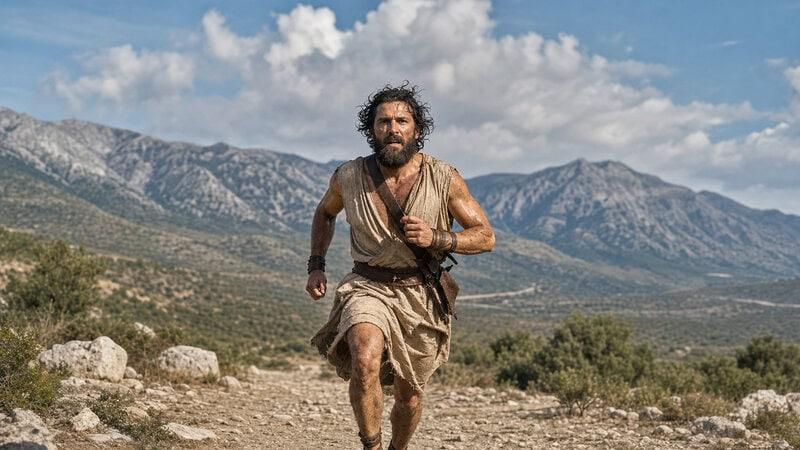

Picture the scene you were probably taught: a lone Greek soldier, lungs burning, legs giving way, staggers into Athens and gasps a single word of triumph before collapsing dead. It is one of history’s most enduring images — and it is almost certainly wrong.
The Wrong Run Made Famous

The real runner’s story begins not after the Battle of Marathon, but before it. In September 490 BC, with a Persian army already camped on the plain of Marathon and the fate of Athens hanging by a thread, a professional runner named Pheidippides was dispatched on a mission that makes the famous 26-mile dash look like a warm-up lap. He ran to Sparta — roughly 140 miles away, through mountain passes and punishing terrain — to beg the greatest military power in Greece for help. He made it in under two days. He delivered his message. Then he ran back.
That run — urgent, desperate, diplomatically consequential, and physically extraordinary — is the one that actually mattered. It is also the one that history has almost entirely forgotten. Instead, we remember a story that later writers invented, attached to a shorter route, and handed down as though it were eyewitness testimony. The race run by millions every year, on every continent, commemorates a journey that probably never happened quite the way we tell it. The journey that did happen remains the province of specialists and a small, fierce community of ultramarathon runners who test themselves against the same route each autumn.
To understand why Pheidippides ran at all, you have to understand what was waiting for Athens on the beach.
Persia at the Gates: Why the Run Was Necessary

By 490 BC, the Persian Empire under Darius I was the dominant superpower of the known world — a vast, organized, professionally militarized state stretching from the Aegean coast of modern Turkey to the borders of India. Greece, by contrast, was not a nation. It was a loose, quarrelsome patchwork of city-states that spent as much energy fighting each other as cooperating against outside threats. What had drawn Persian wrath specifically toward Athens was the city’s role in supporting the Ionian Revolt — an uprising by Greek cities on the Anatolian coast against Persian rule that Darius had crushed, but not forgotten.
Now his fleet had arrived. A Persian force, estimated by ancient sources at figures that modern historians debate and treat with considerable skepticism, had landed on the coastal plain of northeastern Attica — a broad, flat stretch of ground near the town of Marathon, ideally suited for cavalry and mass infantry maneuver. Waiting for them was an Athenian citizen army of roughly 10,000 hoplites, joined by a small allied contingent from the city of Plataea. The Athenians were outnumbered, exposed, and acutely aware that their walls would not save them if the Persians chose to march directly on the city.
What Athens needed was Sparta. The Spartans were the undisputed masters of land warfare in Greece — their professional soldier-citizens, trained from childhood for battle, represented exactly the kind of heavyweight military alliance that might make a Persian general reconsider his options. But Sparta was days of hard marching away, even for a Spartan army moving at speed. Athens needed to ask, and it needed an answer fast. So it sent the one asset it had that could cross that distance quickly: a man trained his entire life to run.
Pheidippides: The Hemerodrome

Pheidippides was not simply an athletic citizen pressed into emergency service. He was a hemerodrome — literally a “day-runner” — a professional long-distance messenger whose role in the ancient Greek world was something like a human telegraph system. These were recognized military and civic specialists, men whose bodies and minds were conditioned through years of training to cover enormous distances across terrain that would destroy an ordinary traveler.
Our primary source for this story is Herodotus, the Greek historian writing in the fifth century BC and the closest thing we have to a contemporary account of the Battle of Marathon. Herodotus records that Pheidippides left Athens the day before the full moon and arrived in Sparta the following day — covering approximately 140 miles through the mountain passes of the Peloponnese in something under 48 hours. There were no paved roads. There were rugged trails, uneven footing, steep ascents, river crossings, and the grinding fatigue of moving through a landscape that had not been built for speed. Modern athletes competing in the Spartathlon ultramarathon, which retraces Pheidippides’ route across 153 miles, operate with GPS navigation, aid stations, and support crews. Pheidippides had sandals and urgency.
Herodotus includes one detail that he records without apparent skepticism: somewhere on that road, Pheidippides encountered the god Pan. According to the account, Pan called out to Pheidippides by name and asked why Athens showed him so little honor, promising that he would be a friend to the city if properly worshipped. Whether this is understood as a vision, a hallucination brought on by extreme physical depletion, or a genuine divine encounter in the Greek religious sense, it tells us something real about how the Greeks understood the journey. The appearance of a god registers the extremity of what was being asked of this man.
Sparta Says No — For Now

The Spartans, Herodotus tells us, were willing in principle. They had no particular interest in watching Athens fall to Persia. But they were bound, at that moment, by religious obligation. The festival of the Carneia was underway — a sacred period during which Spartan military tradition forbade marching to war until the full moon had passed. The law was not negotiable. The full moon was still days away.
Consider the brutality of that diplomatic moment. Pheidippides had run 140 miles in under two days through mountain terrain, arrived in Sparta almost certainly exhausted and certainly desperate, delivered his city’s plea — and the answer he carried back was, in essence, we will come when our festival is over. It was not a refusal. It was a delay. But with a Persian army sitting on the beach at Marathon, a delay was its own kind of verdict.
Athens made its decision without waiting. The Athenian general Miltiades, pressing his case before the Athenian war council, argued for immediate attack rather than a defensive posture behind city walls. It was an aggressive, counterintuitive choice — charging a larger, better-equipped force rather than sitting and hoping for relief. The council agreed. Sparta would come when the moon allowed. Athens would fight now.
The Spartans did eventually march, moving with characteristic efficiency once their religious obligations were satisfied. They arrived at Marathon after the battle was already decided, walked the ground where the dead still lay, and — according to Herodotus — acknowledged what the Athenians had accomplished.
The Battle: September 490 BC

What happened on that plain in September 490 BC remains one of the most studied and debated engagements in military history. According to ancient sources and the broad scholarly consensus, the Athenian hoplites did something the Persians did not expect: they attacked at a run.
The logic was tactical. Persian armies relied heavily on archers — massed arrow fire that could devastate an infantry line advancing slowly across open ground. By charging at speed, the Athenians reduced the time they spent in the killing zone. They closed distance before the archers could find their range and rhythm. The Persians, expecting a static defensive formation, found a wall of bronze-armored men moving faster than an army was supposed to move.
The Battle of Marathon ended in a rout. Ancient sources record that the Persians lost approximately 6,400 men, while Athenian dead numbered 192 — figures that, even if only approximately accurate, represent one of the most lopsided outcomes in the ancient world. Those 192 Athenians were buried on the battlefield in a mound called the Soros, which still stands today. The Persian fleet withdrew.
For Athens, the victory was more than military. It became the city’s founding myth — proof that a community of free citizens, fighting for their own land under their own laws, could defeat the professional armies of the world’s largest empire. The Battle of Marathon is inseparable from the story Athens told about itself for generations afterward: that democracy had stood, that it had held, and that ordinary men had been capable of extraordinary things.
How the Wrong Story Became the Famous One

The Athens-run story — the dying messenger, the gasped proclamation, the noble collapse — does not appear in Herodotus. It comes primarily from Plutarch, who was writing roughly 500 years after the battle. Plutarch records a tradition of a runner carrying news from Marathon to Athens and dying immediately after delivering his message. In different versions of this story, the runner is named Thersippus, or Eucles, or left unnamed entirely. The figure Plutarch describes is not Pheidippides.
What happened over the centuries between Herodotus and Plutarch, and in the centuries that followed, was a gradual collapse — the merging of two separate figures into one legendary character. The name Pheidippides, carrying all its heroic resonance from Herodotus’s account of the Spartan mission, was eventually attached to Plutarch’s post-battle death story. The 140-mile diplomatic run was forgotten. The 26-mile dramatic finale was remembered. The conflated myth was tidy, emotional, and exactly the kind of story that survives retelling.
It survived all the way to 1896. When the modern Olympic Games were revived in Athens that year, the French scholar Michel Bréal and Pierre de Coubertin proposed a long-distance race honoring the run from Marathon to Athens — a route that carried meaning because the myth carried meaning. The race was a success. It entered the Olympic program. In 1908, at the London Olympics, the distance was adjusted to 26.2 miles so that the course could begin near Windsor Castle and finish in front of the royal box — a logistical accommodation to the British monarchy that became, through sheer repetition, the standard distance run by millions of people worldwide today.
The modern marathon’s origins are, in other words, a story built on a myth built on a misreading built on a royal family’s viewing preferences. It is a beautiful accident.
Why the Real Run Still Matters
There is no glory waiting at the end of Pheidippides’ actual journey. No crowd. No finish line. No proclamation that would echo across centuries. He ran 140 miles through mountains to deliver a diplomatic plea, received an answer that amounted to not yet, and ran back. Whatever happened to him afterward — whether he fought in the battle itself, whether he survived the year, whether he ever learned what his run had or had not changed — Herodotus does not record. He disappears from the account as quietly as he entered it.
That anonymity is its own kind of truth. Since 1983, the Spartathlon ultramarathon has retraced his route — all 153 miles of it, with a strict time limit that eliminates all but the most extraordinarily conditioned athletes in the world. The race exists because a British RAF wing commander named John Foden read Herodotus carefully, wondered whether a human being could actually accomplish what Pheidippides was said to have done, and decided to find out. Elite ultra-runners from dozens of countries now attempt it annually. Most do not finish.
Pheidippides’ run matters not because it was celebrated, but because it captures something the famous story does not: the cost of serving a city that might not survive the week. His was not a heroic death sprint. It was a grueling, unglamorous, physically devastating act of duty with no guarantee of outcome and no promise of remembrance. The Persians were already on the beach when he left. He ran anyway.
The marathon you know is a beautiful accident of historical confusion, shaped by misattribution, mythology, and the viewing preferences of the British royal family. The real story — of a professional runner sent alone into the mountains on behalf of a democracy facing extinction, covering 140 miles in under two days, receiving a delayed answer, and returning across the same ground — is far harder and far more human. It is also, almost certainly, the one that actually happened.

 English
 Arabic
 French
 Spanish
 Portuguese
 Deutsch
 Turkish
 Dutch
Dutch
 Italiano
 Romaian
 Portuguese (Brazil)
 Greek
Greek