


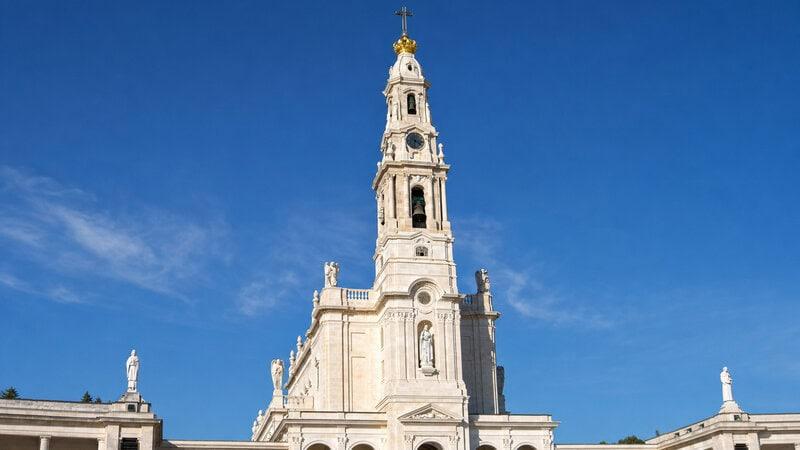

On the morning of May 13, 1917, three children were doing what they did every day — guiding a small flock of sheep across a rocky, sun-baked plateau outside a poor village in central Portugal — when something that defied ordinary explanation began. What followed over the next five months would transform a forgotten stretch of Portuguese scrubland into one of the most visited religious sites on earth, and leave behind questions that remain genuinely unresolved more than a century later.
The Setting and the Children

The Cova da Iria was unremarkable land: holm oaks, wild lavender, the dry smell of limestone warming under a spring sun. Lúcia dos Santos, the eldest of the three, was the one who spoke first when a luminous figure appeared hovering above a small holm oak tree. Her cousins — Francisco Marto, ten, and his younger sister Jacinta, nine — stood beside her. The woman, robed in white and radiating what the children described as blinding brightness, told them not to be afraid. She asked them to return on the thirteenth of each month for six consecutive months, to pray the Rosary daily, and to make sacrifices for sinners and for world peace. Then she was gone.
The three children came from farming families in Aljustrel, a hamlet just outside Fátima in the diocese of Leiria. Their world was shaped by deep Catholic faith, hard rural labor, and the anxieties of a Portugal convulsed by political upheaval — the monarchy had collapsed in 1910, and the new republic was aggressively anticlerical. Lúcia, the eldest and the one the figure consistently addressed, was by all accounts composed and stubborn under pressure. Francisco was quieter and more contemplative. Jacinta, the youngest, was the most emotionally intense — she prayed with unusual fervor and, by later accounts, seemed from early on to grasp that what they had witnessed carried a serious weight.
None of them initially wanted to tell anyone. Lúcia, knowing her mother’s skeptical temperament, stayed silent for days. When the story emerged, the reaction was a mixture of ridicule and anger. Lúcia’s mother, Maria Rosa, was convinced her daughter was either lying or deluded and pressed her repeatedly to admit she had invented the whole thing. Lúcia did not recant. Neither did the younger children, even when local civil authorities — alarmed by the growing crowds gathering at the Cova da Iria — detained all three in August 1917, interrogated them separately, and threatened imprisonment to extract a retraction. The children’s accounts remained consistent throughout. This consistency, maintained under conditions designed to break it, would later become one of the central points in the Church’s formal investigation.
Six Apparitions: Month by Month

The pattern was precise. The Lady came on the thirteenth, always above the same holm oak, always with the same opening request: pray the Rosary for peace. With each apparition the crowd grew, and the stakes of what the children reported escalated.
- May 13: Only the three children witnessed the first apparition. The Lady said she came from heaven and asked them to return each month for six months.
- June 13: A small crowd of curious locals gathered. Witnesses reported a faint luminous cloud near the oak and a buzzing or humming sound, though only the children claimed to see the figure itself.
- July 13: Thousands arrived. This apparition was the most theologically consequential — the Lady reportedly revealed the first two of what would become known as the Three Secrets, including a vision of Hell and a prophecy concerning Russia and a future war. The children were also told that a great miracle would occur on October 13 to confirm the truth of the apparitions.
- August 13: The children never reached the Cova. The local civil administrator, Artur de Oliveira Santos, had them arrested and held in Ourém, apparently hoping that removing the visionaries would end the phenomenon. It did not. Thousands still gathered at the site. The apparition reportedly occurred instead on August 19, in a different location near Valinhos, after the children were released.
- September 13: Crowds had grown to tens of thousands. Many witnesses reported seeing a luminous globe moving across the sky toward the oak. The Lady told the children the promised miracle would take place the following month.
- October 13: What happened here would become known as the Miracle of the Sun.
Throughout this sequence, the children reported being told that World War I — then in its fourth devastating year — would end, but that if humanity did not change course, a worse conflict would follow, and that Russia would be a source of future suffering. For three illiterate shepherd children in a provincial Portuguese village to be articulating such statements was striking enough that the Fátima apparitions attracted scrutiny well beyond religious circles from the very beginning.
The Three Secrets of Fátima

The secrets reportedly revealed during the July 13 apparition became the most contested element of the entire story. Lúcia eventually described them in written accounts produced decades later, under obedience to her religious superiors. The first secret was a vision of Hell — vivid and terrifying, described in imagery drawn from classical Catholic eschatology. The second was a prophecy: that World War I would end, but that a worse war would begin if Russia was not consecrated to the Immaculate Heart of Mary, with a great persecution of the Church to follow.
The Third Secret was sealed and sent to the Vatican, where it remained locked away for decades, generating enormous speculation. In 2000, the Holy See released what it stated was the complete text: a vision of a bishop dressed in white — widely understood to represent a pope — being killed by soldiers, with other clergy and laypeople dying around him. Vatican officials, including then-Cardinal Joseph Ratzinger, interpreted this as a prophetic reference to the 1981 assassination attempt on Pope John Paul II. John Paul II publicly accepted this interpretation and credited Our Lady of Fátima with deflecting the bullet that nearly killed him; he later had that bullet set into the crown of the Fátima statue at the shrine.
A persistent minority of traditionalist Catholics have argued that the text released in 2000 is incomplete and that a further, undisclosed portion contains more explicit warnings about a crisis within the Church. The Vatican has consistently denied this. The question remains a point of ongoing debate in some Catholic circles, though no documentary evidence for a withheld text has been made public.
Francisco and Jacinta did not live to see any of these later developments. Both died young, victims of the influenza pandemic that swept through Europe in 1918 and 1919 — Francisco in April 1919 at age ten, Jacinta in February 1920 at age nine. Lúcia entered religious life, eventually becoming a Carmelite nun in Coimbra, and remained the sole living link to the events at the Cova da Iria until her death in February 2005 at the age of 97.
October 13, 1917: The Miracle of the Sun

Rain had been falling for hours. The crowd assembled at the Cova da Iria — estimates run to approximately 70,000 people, including journalists from Lisbon sent explicitly to cover the expected failure of the promised miracle — was soaked, cold, and restless. The ground had turned to mud. The sky was a flat, impenetrable grey.
Then, by most accounts, the clouds parted.
What witnesses described over the next several minutes has never been fully explained. The sun appeared as a silver disc, sufficiently dimmed to be looked at directly without pain. It began to rotate, throwing off arcs of colored light — red, yellow, blue, violet — that washed across the crowd, the mud, and the surrounding trees. Then, in the moment that terrified the crowd most completely, it appeared to detach from the sky and plunge toward the earth in a spiraling descent, growing larger and generating intense heat. People cried out, fell to their knees, and prayed aloud. Then the sun returned to its position in the sky. Those present reported that the ground and their clothing, which had been thoroughly soaked, were now dry.
What gives the Miracle of the Sun its unusual evidentiary character is that the phenomenon was reported not only by pilgrims at the Cova but by people in surrounding towns and villages — some located several miles away, with no connection to the pilgrimage — who described a similar anomaly in the sky at the same time. It was not, therefore, an experience confined to believers in a state of religious excitement at a single location.
Natural explanations proposed over the decades have included atmospheric optical phenomena, a solar parhelion misidentified under the charged conditions of the day, and mass psychological suggestion amplified by expectation. Critics note that some people present at the Cova reported seeing nothing unusual at all. Proponents point to the number and geographic spread of independent witnesses as evidence that something objectively observable occurred. No explanation — scientific, meteorological, or psychological — has achieved consensus among researchers. The Fátima apparitions of 1917 remain, on this point especially, genuinely unresolved.
The Church’s Response and the Making of a Pilgrimage Site

The Catholic Church moved with deliberate caution. A formal diocesan investigation gathered testimony, examined documents, and weighed evidence over more than a decade. In 1930, the Bishop of Leiria issued a declaration approving the Fátima apparitions as worthy of belief — the Church’s measured formulation, which means the faithful are permitted to accept the events as genuine, not that they are required to do so. The Sanctuary of Fátima was formally established, and the remote agricultural plateau began its transformation.
The scale of what followed is difficult to overstate. Multiple popes visited Fátima across the twentieth and twenty-first centuries. Devotion to Our Lady of the Holy Rosary of Fátima — the full official Catholic title associated with the apparitions — became a defining current in global Marian devotion and shaped how millions of Catholics understood and practiced the Rosary throughout the twentieth century. Fátima now draws millions of pilgrims annually from every continent.
Francisco and Jacinta Marto were beatified by Pope John Paul II during his May 2000 visit to the shrine. On May 13, 2017 — the exact centenary of the first apparition — Pope Francis traveled to Fátima and canonized them both, making the two shepherd children officially saints of the Catholic Church. The date of the canonization was deliberate: a centenary, a return to the Cova, and an unambiguous statement that the Church regards the story as far from concluded.
Why Fátima Endures

What makes the Fátima story so durably compelling is precisely that it refuses to resolve neatly into either pure faith or pure skepticism. The crowd of October 13 was real and included hostile witnesses. The newspaper reports filed from the scene that day are preserved. The diocesan documents, the testimonies gathered under oath, the written accounts produced by Lúcia across decades of religious life — all of these exist and have been examined by historians, theologians, and skeptics alike.
The children themselves — three small people who never sought celebrity, who were ridiculed and threatened and pressured to recant from the very beginning — held to their account for the rest of their lives. They gained nothing materially from doing so. Two of them died before reaching adolescence. One spent 87 years as a cloistered nun, largely hidden from public view, carrying a story she had not chosen and could not put down. That biographical reality does not settle the theological question. But it is a fact, and it is not a trivial one.
When tens of thousands of people in multiple locations simultaneously report seeing the sky behave in ways that contradict known physical laws, the question they leave behind resists any single framework — theological, historical, or scientific — that has yet been brought to bear on it. A century on, that question is still open. That, as much as anything, is why the world keeps returning to Fátima.

 English
 Arabic
 French
 Spanish
 Portuguese
 Deutsch
 Dutch
Dutch
 Italiano
 Russian
 Romaian
 Portuguese (Brazil)
 Greek
Greek