


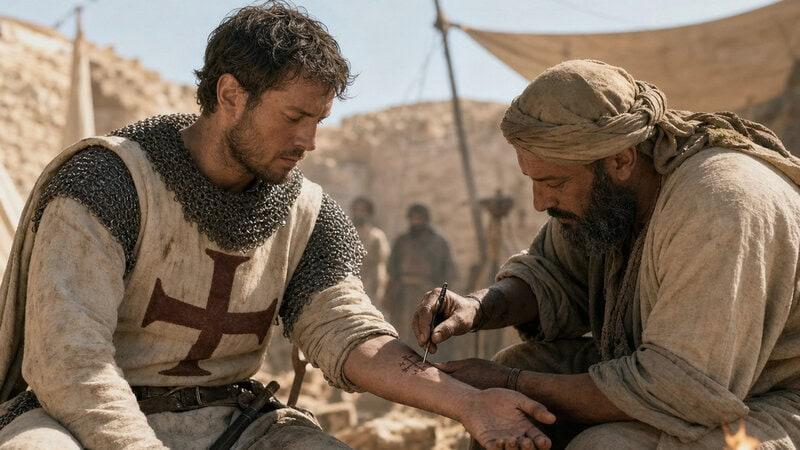

Somewhere outside Jerusalem’s gates in the twelfth century, a Frankish soldier held out his wrist to a Coptic craftsman crouching beside a small fire. The needle dipped, the skin broke, and five crosses — one large, four small — were pressed permanently into the flesh, not as decoration, but as the most important document the man would ever carry.
A Needle, a Campfire, and a Dying Wish

The stakes were grimly practical. Canon law required that a Christian receive a Christian burial, but a soldier who died anonymous in a foreign field had no parish records, no papers, no witnesses. If his body was found by strangers, there was no way to prove he was not a pagan, a heretic, or simply an unknown corpse to be left for the birds. The tattoo solved that problem. It was a portable, permanent certificate of faith — proof of pilgrimage, proof of baptism, proof that this body deserved consecrated ground.
The emblem those craftsmen pressed into skin was the Jerusalem Cross, also called the five-fold cross and the Crusader’s cross. Deceptively simple at first glance — just a large cross surrounded by four smaller ones — it is in fact one of the most layered symbols in Christian history, carrying at least five distinct strata of meaning that accumulated over centuries without erasing one another. To trace those layers is to follow a story that moves from the bloody capture of Jerusalem in 1099, through throne rooms and cathedral floors, all the way to a tattoo shop in Jerusalem’s Christian Quarter that is still open today.
What You Are Actually Looking At

Before unpacking what the Jerusalem Cross means, it helps to see precisely what it is. At the center sits a large cross described in formal heraldic language as a cross potent — each of its four arms ends in a horizontal bar, giving them the stubby, crutch-like shape of a capital T. This central cross divides the emblem into four equal quadrants. Nestled inside each quadrant is a smaller Greek cross, with arms of equal length and clean, unadorned ends. The total count is exactly five crosses, which is why the symbol earned its five-fold nickname.
The visual hierarchy is deliberate and elegant. The thick, authoritative arms of the cross potent draw the eye first, establishing dominance. Then the gaze travels outward to the four quieter Greek crosses standing like sentinels in the corners. As a heraldic cross and Christian cross variant, the Jerusalem Cross was designed to be read at a distance — on a shield, a battle surcoat, a banner snapping in the wind — which is why the geometry is bold, unambiguous, and recognizable even at the scale of a wrist tattoo.
Birth of a Symbol: The First Crusade and Godfrey of Bouillon

Many scholars believe the Jerusalem Cross dates back to the eleventh century, and more specifically to the First Crusade’s violent capture of Jerusalem in July of 1099. When the dust settled and the Crusaders needed a ruler for their newly won city, a Frankish lord named Godfrey of Bouillon stepped forward — declining the title of king but accepting the role of Advocate and Protector of the Holy Sepulchre. His coat of arms featured the five-cross design, and in doing so he set the emblem on a path to becoming the defining visual identity of the Latin Kingdom of Jerusalem.
There is honest scholarly debate about whether the specific five-cross configuration was truly new after 1099 or whether it drew on earlier Byzantine or early Christian motifs that had been circulating for generations. Some historians argue the design predates the Crusades entirely; others insist the particular heraldic codification — one cross potent, four Greek crosses, arranged with this precision — was a product of the Latin Kingdom’s need to project legitimacy and sacred authority simultaneously. What is beyond dispute is how quickly the symbol proliferated once it was in circulation: within decades it appeared on coins minted in the kingdom, on the vestments of clergy serving the Church of the Holy Sepulchre, and on the shields of knights who had sworn their lives to defend the city.
Five Crosses, Five Meanings

The richness of the Jerusalem Cross meaning lies in the fact that no single interpretation exhausts it. Five layers of meaning were woven into the design over time, each coherent on its own, and all of them operative at once.
- The five wounds of Christ. The most theologically immediate reading maps the five crosses onto Christ’s physical suffering during the Passion — the nail through each hand, the nail through the feet, and the lance wound opened in his side by a Roman soldier. Every glance at the emblem became a meditation on the Crucifixion, making the symbol simultaneously a battle standard and an act of devotion.
- Geography as theology. The large central cross represents Jerusalem itself, understood in medieval Christian cosmology as the literal center of the world — the umbilicus mundi. The four smaller crosses stand for the four corners of the earth, the distant regions to which the Christian mission was called to carry the faith outward from that sacred hub.
- Christendom’s political ambition. The four small crosses were also read as representing the four Crusader states — the Kingdom of Jerusalem, the Principality of Antioch, the County of Tripoli, and the County of Edessa — framing military conquest not as colonialism but as sacred order radiating outward from a divine center. It was theology doing the work of political cartography.
- Number symbolism. Five held deep significance in medieval Christian thought: the five books of the Pentateuch, the five senses through which the faithful experienced and expressed their devotion. Encoding that number into the emblem’s very structure connected it to a broader web of scriptural and philosophical meaning.
- Heraldic identity. Finally, the emblem functioned as a pure dynastic and institutional identifier — a recognizable mark of holy governance and sacred mission. Abstract theology collapsed into something a knight could paint on a shield and an illiterate soldier could recognize across a chaotic battlefield.
Skin Deep: The Crusader Tattoo Tradition

Return to that campfire outside the city gates, and the picture becomes richer still. The craftsmen offering pilgrim tattoos were not random street vendors. Coptic Christian families in Jerusalem — among them the Razzouk family, whose tattooing lineage is documented across many generations — practiced the art of pressing woodblock-stamped designs into the skin of pilgrims as a sacred souvenir of arrival. The Jerusalem Cross was among the most requested designs, a mark that declared: I was here. I made it. I am one of the faithful.
The practical logic behind the wrist placement is worth dwelling on. The wrist is visible even when the rest of a body is hidden under armor or wrapped in a cloak. A soldier dying in the field might be stripped of everything — weapons, surcoat, purse — but the tattoo remained. It could not be lost, stolen, or forgotten. In an era with no centralized record-keeping and no reliable way to identify a body except by the testimony of witnesses who might themselves be dead, that permanence was everything.
There is a striking irony lurking here. The medieval Church officially discouraged body modification, associating it with pagan practice. Yet it tacitly accepted — and in some readings quietly encouraged — this specific tradition among those risking their lives in the name of Christendom. Popular religion and official doctrine have always run on slightly different tracks, and the pilgrim tattoo is one of history’s more striking examples of that gap.
The Razzouk family still tattoos pilgrims in Jerusalem today, using some of the same woodblock designs that have been passed down through the centuries. The Jerusalem Cross remains a common request. It is one of the rare medieval symbols still being literally inscribed on living human skin in the city that gave it its name.
From Crusader Shields to Cathedral Floors

The symbol’s journey did not stop at the body. As Crusaders returned to Europe — sometimes triumphant, more often battered — they brought the Jerusalem Cross with them as architectural memory. It appeared as floor tile patterns in churches built by returning knights, as carved stone reliefs above doorways, as embroidered altar cloths in chapels dedicated to the Holy Land campaigns. The emblem became a way of memorializing a pilgrimage, of saying in stone and thread what the returning soldier could no longer say in person.
Its most durable institutional home is the Order of the Holy Sepulchre, the Catholic chivalric order whose mission — then and now — is the support of Christian communities in the Holy Land. The Jerusalem Cross is the order’s official emblem, giving the symbol a living institutional identity that has outlasted the Crusader kingdoms by nearly eight centuries. The order continues to invest knights and dames in a ceremony that places the five-cross emblem at the center of its ritual life — a direct and unbroken line from the shields of the Latin Kingdom to the present day.
The symbol has also proved remarkably portable across denominational lines. It appears in Anglican, Lutheran, and Eastern Orthodox contexts, each tradition absorbing and reinterpreting its layers of meaning without discarding the others. This is what a strong visual vocabulary does: it survives the fracturing of the institutions that created it because the image itself carries enough meaning to remain useful to whoever inherits it. The heraldic precision of the original blazon — cross potent, four Greek crosses, one in each quadrant — meant that craftsmen who had never seen an original could reproduce it faithfully, preserving the design’s integrity across time and geography.
What the Jerusalem Cross Means Today
Today the Jerusalem Cross turns up in jewelry stores, on cathedral walls, and in the confirmation gifts handed to teenagers in parishes from Kansas to Korea. People wear it as a pendant, tattoo it on forearms, embroider it on stoles. Most who carry it are aware it means something important, even if the full depth of its five layers remains just below the surface of their understanding.
That layering is itself the lesson. The Jerusalem Cross meaning did not arrive complete and finished in 1099. Each century added a stratum — wound theology, imperial geography, political ambition, number symbolism, dynastic heraldry — without erasing what came before. It is a palimpsest in metal and ink, a symbol that keeps absorbing new readings while retaining the old ones underneath. Understanding what the Jerusalem Cross means, historically and spiritually, requires holding all five layers simultaneously — the way you hold a prism up to light and see not one color but several, each real, none complete without the others.
The most honest place to end is back in Jerusalem, in the Christian Quarter, where the Razzouk family’s shop still receives pilgrims from around the world. A traveler sits down, rolls up a sleeve, and watches the same five-cross stamp pressed into skin with the same practiced motion that Coptic craftsmen used a thousand years ago. The needle moves. The ink settles. And somewhere in that small, stubborn transaction — so low-tech it would have been recognizable to a twelfth-century Frankish soldier — an ancient conversation about faith, death, and the need to be known continues without interruption.
In an age of digital identity and instant verification, there is something stubbornly, irreducibly human about the idea that the most important thing you could carry across a dangerous world was a mark burned permanently into your own flesh.

 Arabic
 French
 Spanish
 Portuguese
 Deutsch
 Turkish
 Dutch
Dutch
 Italiano
 Russian
 Romaian
 Portuguese (Brazil)
 Greek
Greek