


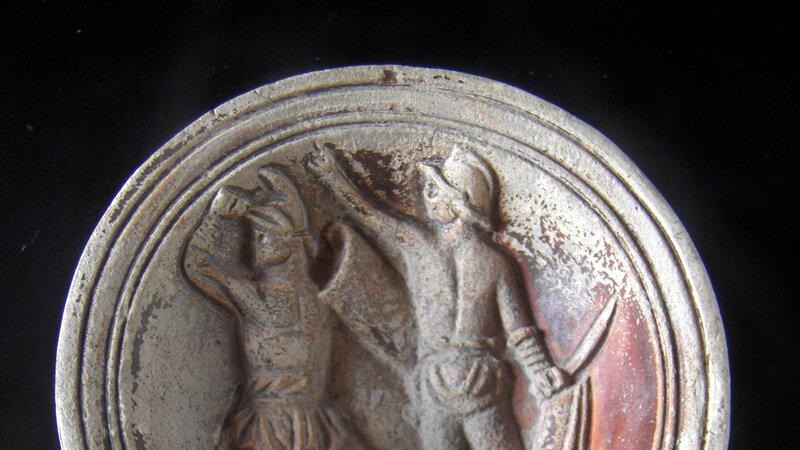

The sand is dark with effort, two men circling each other in the oval shadow of fifty thousand screaming Romans — and then it’s over. The loser sinks to one knee, raises a finger, and waits. The crowd surges. The editor of the games looks out from his shaded box, reads the roar, and extends his hand. The fallen gladiator rises, nods once to the crowd, and walks back toward the Gate of Life. Nobody died today. The bookkeeper breathes a quiet sigh of relief.
Everything You Know About Gladiators Is Probably Wrong

The merciless slaughter, the emperor’s thumb stabbing downward, the arena as a daily abattoir — everything the popular imagination has built around gladiatorial combat is shaped more by Hollywood than by history. Films like Ridley Scott’s Gladiator (2000) gave us magnificent cinema and a deeply misleading body count. The gladiatorial games of ancient Rome were built on the theater of death, yes, but the operative word is theater. The actual mortality rate per bout was far lower than popular culture suggests, and the Romans had reasons — practical, financial, and deeply human — to keep their fighters breathing.
The real history of the gladiator is stranger, more nuanced, and more human than the movie version. It is the story of a professionalized sport operating inside a brutal society, of men who were simultaneously despised and adored, of an entertainment economy that understood, in its own calculating way, that dead stars are bad for business.
Who Were the Gladiators, Really?

Strip away the mythology and the gladiators of history emerge as a surprisingly varied group. Most were enslaved people, prisoners of war, or condemned criminals — men who entered the arena without choice. But a notable portion were volunteers, known as auctorati: free men who signed contracts with a trainer, surrendering certain legal rights in exchange for regular meals, shelter, medical attention, and the chance at prize money and fame. That last detail tends to surprise people. Given a brutal enough life outside the arena, the arena could look like opportunity.
Gladiators trained in dedicated schools called ludi, run by a businessman-trainer called a lanista. The lanista owned or contracted his fighters the way a modern sports franchise holds players under contract, and he had every incentive to protect his investment. A promising fighter represented years of accumulated cost — housing, feeding, coaching, treating injuries. A dead gladiator was a total write-off.
Archaeological analysis of gladiatorial remains, including skeletal studies from burial sites in Ephesus, suggests their diets leaned heavily toward barley, legumes, and other complex carbohydrates — earning them the ancient nickname hordearii, or “barley men.” They received medical care that, by the standards of Roman urban poverty, was genuinely attentive. They lived in structured barracks. They were, in a grotesque but real sense, valuable property treated accordingly.
What the mythology rarely captures is how fully these men existed as cultural figures. The walls of Pompeii preserve graffiti celebrating specific fighters by name — praise for their looks, their courage, their technique. Gladiators had fan followings, rivalries, and reputations that traveled ahead of them from city to city. A successful fighter could sustain a career spanning years, each bout adding to a legend rather than simply threatening to end it.
The Economics of Blood: Why Killing Was Bad for Business

Here is where the myth of universal slaughter collides hardest with Roman arithmetic. The editors of games — wealthy politicians, magistrates, and emperors who funded spectacles to buy public goodwill — did not get gladiators for free. They paid the lanista a fee for each bout, and crucially, that fee rose substantially if a gladiator was killed. Death cost the editor considerably more money than a fight that ended in submission and mercy. In a culture that institutionalized the games over centuries, this created a built-in financial brake on casual slaughter.
Estimates drawn from ancient inscriptions and records suggest that somewhere between one in five and one in ten bouts in a given arena season ended in the death of a combatant. Those are real, sobering career odds — but they are a far cry from the image of every match ending in a corpse. The question of whether gladiators always fought to the death has a clear historical answer: rarely by default, often by circumstance, and almost never as the automatic, expected outcome of every afternoon bout.
The gladiatorial economy worked precisely because death was the potential, not the guarantee. The crowd came for the edge of mortal risk, for the moment when everything hung in the balance — not for an industrial conveyor belt of executions they could have watched more cheaply at midday.
The Ritual of Mercy: Crowds, Gestures, and the Editor’s Call

When a gladiator fell and submitted — traditionally by raising a finger or dropping his weapon — the decision passed upward. The crowd expressed its verdict in noise and gesture. The editor of the games read that noise and made the final call. Mercy, known as missio, was the norm at well-organized, prestigious events. Granting it reflected well on the editor’s magnanimity, and the crowd, having already received its dramatic spectacle, was often satisfied by a display of skilled, hard-fought combat that stopped short of killing.
The famous “thumbs down” gesture is almost certainly a modern invention, popularized by the French painter Jean-Léon Gérôme in his 1872 canvas Pollice Verso and then calcified by cinema. Ancient sources are maddeningly imprecise about the exact signals used, and historians still debate whether a turned or extended thumb indicated death, while a concealed fist meant mercy, or whether some other combination applied entirely. What is clear is that a specific, readable gesture existed, that the crowd participated in the decision, and that the outcome was not predetermined.
A gladiator who fought with skill and courage but ultimately lost could leave the arena with his life intact, his honor upheld, a purse of coins in hand, and another bout somewhere in his future. The crowd’s respect was not reserved only for winners — it was given to men who had put everything on the line and survived it.
When the Arena Did Kill: Executions, Beast Hunts, and the Unlucky

Gladiatorial combat must be separated from the broader structure of a Roman arena day, because that day had distinct segments with very different purposes. Morning brought the venationes — beast hunts, in which trained fighters called bestiarii faced wild animals imported at enormous expense from across the empire. Midday brought something categorically darker: public executions, sometimes dressed as mythological tableaux, in which condemned prisoners faced armed fighters, wild animals, or both, with no training, no armor, and no possibility of reprieve. The mortality in these midday segments was not theatrical — it was absolute. Everyone died, and that was the point.
The gladiatorial bouts of the afternoon were different in kind. In the early centuries of Rome’s gladiatorial tradition, before the lanista economy matured and professional standards took hold, death rates were likely higher and the institution less regulated. As the games became formalized — with schools, contracts, graduated fee structures, and oversight — survival rates improved alongside the commercial logic that demanded it.
Certain matches were declared sine missione in advance — no mercy offered, fight until one man cannot continue. These were relatively rare, often reserved for special occasions or as a deliberate marker of exceptional stakes. They were the exception that proved the rule. And even outside such designated bouts, the cumulative toll of a gladiatorial career — repeated injuries, infection, the grinding attrition of combat — meant the danger was entirely real. It simply did not manifest as an automatic death sentence at the end of every bout.
A Life in the Arena: Career, Freedom, and the Rudis

For a gladiator who performed well and survived long enough, there was an endpoint the movies rarely linger on. The rudis — a small wooden sword presented ceremonially — signified honorable discharge. Freedom. The Roman equivalent of a championship belt and a retirement package compressed into a single symbolic object. Some recipients became trainers, lending their expertise to the next generation inside the ludi, staying inside the only world they had known and learning to master it from a different angle.
The gladiatorial games spanned roughly seven centuries in some form, from their origins as funeral rites in the third century BCE through their eventual prohibition under Christian emperors in the early fifth century CE. Across that enormous span of time, the institution changed enormously — in scale, in regulation, in cultural meaning. The small funeral spectacle of the Roman Republic and the vast, politically choreographed productions of the Imperial Colosseum were connected by tradition but separated by almost everything else.
The gladiator’s legal status made his social position paradoxical in the extreme. Under Roman law, gladiators were classified as infames — people of diminished legal standing, grouped alongside prostitutes and actors as figures officially beneath respectability. They were socially scorned in theory and obsessively celebrated in practice, their names scratched into walls, their faces pressed into clay lamps sold as mass-market souvenirs. Ancient Rome loved its gladiators in almost exactly the way it officially disapproved of them — a dynamic that requires very little translation into modern terms.
Types of Gladiator: A Specialized Profession
One detail the popular imagination consistently flattens is just how specialized gladiatorial combat was. Fighters were not simply armed men thrown together — they were trained in distinct styles, each with its own equipment, technique, and identity, and bouts were typically matched between complementary types rather than identical ones.
The murmillo, equipped with a large rectangular shield and a short sword, was often paired against the thraex, who carried a small curved blade and an angled shield. The retiarius fought with a trident and weighted net, relying on mobility and entanglement, typically matched against the heavily armored secutus, whose enclosed helmet was specifically designed to prevent the net from gaining purchase. The secutus, in turn, was burdened by that same heavy armor in a way that made prolonged pursuit exhausting — a deliberate asymmetry that made these pairings dramatically compelling to watch.
This specialization reinforced the professional identity of the gladiator. A fighter was not interchangeable — he was a practitioner of a specific discipline, and the crowd knew the difference. Fans followed particular styles and matchups the way modern sports fans follow positions and statistics. The arena was, among other things, a sophisticated athletic spectacle with a knowledgeable audience.
What the Real Story Tells Us About Ourselves
The myth of universal arena slaughter persists because cinema has dramatic reasons to maximize death. Russell Crowe’s Maximus, as compelling as he is across every frame of that film, operates in a world where every bout is a near-death experience culminating in a kill — because that is what narrative tension requires. Roman writers like Seneca and Cicero described the games in language of moral outrage that foregrounded violence and degradation, shaping how later centuries imagined the spectacle. But rhetorical disgust is not statistical reporting, and the Romans who wrote most vividly about the games were not always the Romans who attended them most enthusiastically.
The real history asks us to sit with a more uncomfortable truth. The Romans did not love death cheaply or indiscriminately — they loved spectacle, craft, and the theatrical edge of mortal risk, which is a subtly different appetite and a considerably more recognizable one. They wanted to watch skilled men push each other to the absolute limit, to feel the genuine possibility of death hanging over the proceedings, and then — often, more often than we imagine — to see both men walk away.
That is an entertainment instinct that requires less distance to understand than we might prefer. The gladiatorial games were not simply a window into how alien the Romans were. They were, in some ways, a mirror. Understanding what those afternoon bouts in the Colosseum actually were — how they were financed, regulated, and survived — tells us something worth knowing about where our own appetites for spectacle begin and where they might, if we are not careful, end.
You can revisit the Hollywood version of this story — and it remains excellent cinema — on home video. Just watch it knowing that the man walking back through the Gate of Life, still breathing, still counting his winnings, was far more historically typical than the corpse left behind on the sand.

 English
 French
 Spanish
 Portuguese
 Deutsch
 Turkish
 Dutch
Dutch
 Italiano
 Russian
 Romaian
 Portuguese (Brazil)
 Greek
Greek