


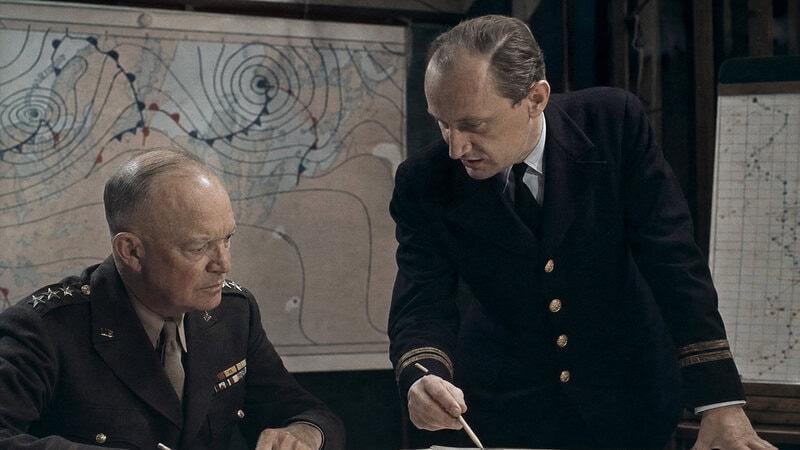

On the evening of June 4, 1944, the fate of the largest military operation in human history rested not with a general, an admiral, or a politician — but with a quietly spoken Scottish meteorologist standing before Eisenhower with a weather chart and a decision that could not wait. This is the story of how a precise, nerve-shredding battle against Atlantic weather systems shaped D-Day, hour by hour.
Overlord’s Meteorological Wish List
Long before a single soldier waded ashore in Normandy, the planners of Operation Overlord drew up what amounted to an almost laughably demanding meteorological checklist. They needed winds calm enough for landing craft to hold formation, a cloud ceiling high enough for Allied air power to operate effectively, a moon bright enough for paratroopers to navigate dark fields, and tides precise enough to expose the lethal steel obstacles the Germans had planted across the beaches without making the sea impassable. Every condition had to align simultaneously.
The tidal requirements alone were ferociously restrictive. The window in which beach obstacles would be exposed yet the water still navigable narrowed the entire calendar to just a handful of days each month. As the detailed history of weather forecasting for Operation Overlord makes clear, a single rogue Atlantic storm system could unravel months of preparation for the largest amphibious assault ever attempted — and the English Channel, notoriously volatile in early June, was perfectly capable of delivering one.
The Man Given the Job Nobody Wanted: James Stagg

Into this pressure cooker stepped Group Captain James Martin Stagg, a lean, precise Scotsman from Dalkeith, appointed as Eisenhower’s chief meteorologist in 1943. His task was not simply to read the skies — it was to referee a fractious disagreement between three competing Allied weather teams: one from the British Meteorological Office, one from the Admiralty, and one from the U.S. Army Air Forces. Each team used different forecasting methods, each arrived at different conclusions, and each believed it was right. Stagg had to synthesise their clashing predictions into a single authoritative briefing for the Supreme Commander.
The burden was almost incomprehensible. A forecast that delayed the invasion unnecessarily could squander strategic surprise and crush the morale of hundreds of thousands of men already coiled to strike. A forecast that sent them in under the wrong conditions could mean drowning, disaster, and slaughter on an unimaginable scale. As the Met Office’s account of the D-Day forecast makes plain, Stagg understood the weight of that responsibility with complete clarity.
June 5 Is Fixed as D-Day — and the Calendar Becomes a Trap

Allied Supreme Command fixed June 5, 1944, as the target date for the Normandy landings. The date sat at the intersection of tidal requirements, lunar phases, and the logistical realities of moving an army across the Channel. With it locked in, the entire Western Alliance lurched into motion: hundreds of thousands of troops moved to embarkation points, thousands of ships sorted themselves into convoy formations, and supply chains stretching back across Britain were set to a precise tempo.
Any delay beyond the June 5-7 window would push the invasion back by roughly two weeks to the next acceptable tidal period — a postponement with catastrophic consequences for morale, for secrecy, and for the broader strategic campaign. The calendar had become a trap, and the weather held the only key.
A Dangerous Disagreement Between Allied Forecasting Teams

As the final days of May gave way to June, the U.S. Army Air Forces meteorological team studied their charts and saw conditions they considered acceptable for June 5. Their methods — which tended to smooth trends across broader patterns — suggested fair enough weather for the invasion to proceed, and they pressed their case with conviction. With fleets already at sea and paratroopers suited up and waiting, the momentum toward action was enormous.
But the British Meteorological Office team was staring at something that deeply unsettled them: a vigorous low-pressure system churning in from the mid-Atlantic, deeper and faster-moving than the American analysis acknowledged. The disagreement between the Allied forecasting teams was not a polite academic debate — it was a live argument with catastrophic consequences attached, and the window to resolve it was closing by the hour.
The Storm Arrives: Stagg’s Grim Briefing on June 4

On the evening of June 4, 1944, Group Captain Stagg walked into the library at Southwick House — the grand Hampshire mansion serving as Allied naval headquarters — and delivered news that silenced the room. The British team had been right. A deep Atlantic depression was driving straight toward the English Channel, and it would make a June 5 landing catastrophically dangerous: gale-force winds and heavy seas that would capsize flat-bottomed landing craft, cloud so low that air support would be impossible, and conditions that would leave naval gunfire spotters effectively blind.
Eisenhower ordered a 24-hour postponement. The decision triggered one of the most dangerous maritime manoeuvres of the entire war — convoys that had already sailed had to be turned around in deteriorating seas and guided back to port without collision or disaster. As ECMWF’s account of the meteorological confirmation on 4 June records, the verification that the storm was real — and not a phantom in the models — was the pivot on which everything turned.
The Gap in the Storm: Stagg’s Forecast for June 6

Then, in the early hours of June 5, Stagg came back with something extraordinary. Hunched over data from weather stations and ships spread across the North Atlantic — an observational network the Germans did not possess — he and his team had identified a brief but genuine break in the storm system. For a window of roughly thirty-six hours beginning on the morning of June 6, the skies over the Channel would clear sufficiently, the winds would ease, and the seas would drop to a level that made the operation viable. It would not be comfortable. It would not be ideal. But Stagg judged it sufficient.
Eisenhower reportedly paced in silence for several long minutes. Then he spoke: the invasion would go. The window was narrow, the risk was real, and there was no guarantee — but Stagg had found the gap, and Eisenhower chose to drive the entire Allied force through it. The Royal Meteorological Society’s account of how the D-Day forecast made history captures both the audacity and the precision of that call.
The German Side: Rommel Goes Home

While Stagg was fighting over data in Hampshire, German meteorologists were reaching the opposite conclusion. Without access to the Allied network of Atlantic weather stations, they saw only the storm bearing down on the Channel and predicted continued bad weather through early June. An Allied invasion in such conditions, they concluded, was unlikely. The threat could wait.
Field Marshal Erwin Rommel, the principal architect of Germany’s Atlantic Wall defences, acted on that forecast. On June 5 he left his headquarters in France and drove to Germany to celebrate his wife’s birthday and to press Hitler for additional Panzer divisions. When the first Allied paratroopers descended through the breaking clouds in the small hours of June 6, Rommel was hundreds of miles from Normandy. Superior weather intelligence had become, quietly and decisively, a strategic weapon.
June 6, 1944: The Forecast Holds — Just Barely

The landings went ahead along fifty miles of heavily fortified French coastline, across five beach sectors named Utah, Omaha, Gold, Juno, and Sword. Stagg’s predicted break materialised — but calling the conditions comfortable would be generous. Strong winds kicked up rougher seas than the planners had hoped for, swamping some landing craft and throwing assault formations into disorder. The tide moved faster than anticipated, pushing men higher up beaches still dense with German obstacles and compressing the time available to clear lanes and secure footholds.
At Omaha Beach, the conditions contributed to a day of carnage that still stands as one of the bloodiest in American military history. And yet the foothold held. By nightfall on June 6, Allied forces were ashore and dug in across all five sectors. Stagg’s courage in committing to that narrow window had been vindicated in the most brutal possible test.
The Storm That Was Dodged: What June 5 Would Have Looked Like

Historians who have reconstructed the actual meteorological conditions over the Channel on June 5 have reached sobering conclusions. Overcast skies, winds gusting to Force 5 and 6, and seas that would have been catastrophic for the flat-bottomed landing craft carrying infantry toward shore: an invasion launched that day would likely have met disaster. Airborne troops scattered across dark countryside unable to assemble, landing craft foundering before reaching the beach, naval gunfire support operating blind — the conditions for a catastrophic Allied defeat were all in place on June 5.
The alternative scenario is darker still. Had the invasion been postponed entirely from the early-June window, the next acceptable tidal period would have fallen squarely within the great Channel storm of June 19-22 — the worst such storm in forty years, which wrecked one of the Mulberry artificial harbours the Allies had laboriously pre-fabricated and towed across the sea. The invasion might not merely have been delayed — it might have been destroyed before it truly began.
Legacy: The Forecast That Changed Modern Meteorology

James Stagg returned to relative obscurity after the war, but what he had accomplished in those exhausting, high-stakes days was not forgotten in the scientific community. His performance — synthesising rival teams, reading an Atlantic data picture of unprecedented complexity, and delivering a confident, actionable forecast to the most consequential audience in history — is studied in meteorological training to this day. He demonstrated that weather forecasting was not a support function or a courtesy offered to commanders in quiet moments, but a decisive operational variable capable of determining the outcome of a war.
The full drama of those hours continues to resonate. The National World War II Museum’s account of the pressure bearing down on the Allied meteorologists captures the human stakes at the heart of the story: the clashing forecasts, the narrow window, and the nerve required to call it in front of Eisenhower. The D-Day weather forecast remains, by broad consensus, perhaps one of the most important weather forecasts ever made — proof that reading the sky correctly, at exactly the right moment, can change the world.
From a precise meteorological checklist drawn up in the winter of 1943 to a single Scotsman’s reading of an Atlantic storm system on a June night in Hampshire, the story of D-Day’s weather is ultimately a story about the courage required to commit to a decision when the stakes are absolute — and to be proved right, just barely, by the dawn.

 English
 French
 Spanish
 Portuguese
 Deutsch
 Turkish
 Dutch
Dutch
 Italiano
 Russian
 Romaian
 Portuguese (Brazil)
 Greek
Greek