


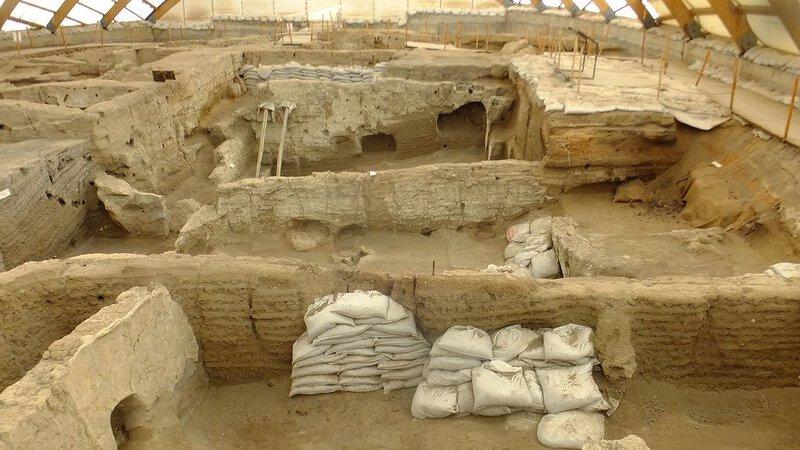

Imagine a child in Çatalhöyük, around 7500 BCE, curling onto a sleeping platform at dusk. Beneath the packed earth under her body lies her grandmother — flexed, wrapped, deliberately placed — and the family considers this not an act of horror but one of love, continuity, and practical wisdom. That arrangement, so alien to modern sensibility, would persist in one form or another for the next ten thousand years across cultures that never met and could not have compared notes.
The Living Room of the Dead

For a span of time that dwarfs all of recorded history, the dead did not leave the house. From the sun-baked mud-brick warrens of ancient Mesopotamia to the Neolithic settlements of Anatolia and the Levant, from pre-Columbian households in the Americas to early European farming communities, families buried their kin beneath the floors of the rooms where they cooked, slept, argued, and gave birth. The custom was so widespread, so stubbornly repeated across cultures with no contact with one another, that it begins to look less like a local tradition and more like a fundamental human response to mortality — one we have only recently, and perhaps incompletely, abandoned.
The richest archaeological window into this world sits in south-central Turkey, where the ancient settlement of Çatalhöyük has been excavated in extraordinary detail over several decades. The site reveals skeletons interred in a deliberately flexed position — knees drawn toward the chest, body compressed — and placed beneath the raised sleeping and working platforms that lined interior walls. These graves were not sealed and forgotten. Many show clear signs of having been carefully reopened as new family members died, so that generations could be layered together, the recent dead resting against those who had gone before. The floor of a Çatalhöyük home was effectively a family archive, written in bone.
It would be a mistake to treat under-floor burial as a single, uniform practice. Across cultures and millennia, the details varied enormously: the depth of the grave, the objects placed within it, the ceremonies surrounding interment, the question of which family members earned a place beneath the hearth and which did not. Communal burial sites and outdoor graves existed alongside home burial in many societies, and the eventual transition away from domestic burial was not a clean historical before-and-after. It was a long, uneven negotiation that played out differently across regions over many centuries. What united the broad family of customs was a single core logic: the dead belonged to the domestic world and were not to be exiled from it.
To understand why, you have to set aside the modern Western assumption that the dead are categorically gone — present, at best, as memory — and inhabit a different emotional and spiritual architecture entirely. Beliefs surrounding death and burial in the ancient world were often tied to broader spiritual systems, including ancestor worship, which reinforced community ties, and in many of those systems the dead were not absent. They had simply moved into a different register of existence, one that remained entangled with the living in ways that demanded ongoing maintenance and relationship.
Land, Loyalty, and the Logic of Ancestors

The most immediately practical reason for keeping the dead under the floor was also the most politically charged: buried ancestors were a form of title deed. In societies without written contracts or legal institutions capable of adjudicating competing claims, the question of who had the right to occupy a piece of ground was answered, in part, by who was buried in it. To have your grandmother’s bones beneath your hearthstone was to assert a claim that went literally into the earth — tangible, embodied, and difficult for a rival family or encroaching neighbour to dismiss. Ancient societies understood that graves marked family land and helped support land claims in ways that abstract assertions of ownership simply could not.
This logic was reinforced by ancestor veneration, a spiritual practice that treated the buried dead as active participants in family life rather than passive remains. In this framework, the dead could intercede with larger cosmic forces on behalf of their descendants — bringing rain for crops, blessing the birth of healthy children, protecting the household from illness and misfortune. But they could also punish neglect. An ancestor ignored was an ancestor angered, and an angered ancestor was a source of genuine dread. Keeping them close, feeding them, and speaking to them was therefore not mere sentiment. It was pragmatic devotion, the maintenance of a relationship upon which real-world outcomes were understood to depend.
The sensory reality of ancient domestic burial deepened this emotional texture in ways that are easy to overlook from a distance of millennia. When ancient Mesopotamians reopened the tombs beneath their floors to receive new family members, the smell that rose up was powerful and unmistakable — a visceral, olfactory encounter with whatever lay beneath, interpreted through the spiritual categories available to whoever experienced it. That smell was the presence of the ancestor made briefly, overwhelmingly real. It reinforced both the fear of the dead and the attachment to them, collapsing the distance between the living and the recently departed in a way that no abstract theological belief could replicate.
Shared graves beneath shared roofs also served a social function extending beyond any single household. When extended kin groups buried their dead in the same cluster of homes, they created a common story and a common debt — to the same ancestors, the same ground, the same accumulated past. This was the architecture of community cohesion: not just affection or proximity, but bones, and what bones meant.
What It Felt Like to Live This Way

Try to reconstruct the experiential texture of daily life in such a household. A mother grinds grain in the morning above the spot where her husband was buried two seasons ago. Children play across a floor that contains four generations of their family. A woman labours in childbirth within a few feet of where her own mother lies. None of this registered as gothic horror to the people living it. Horror requires the assumption that the dead are alien, dangerous, and categorically other — an assumption these cultures did not share. The membrane between the living and the dead was thin and navigable. The dead were relocated within the household, not expelled from it, and grief was shaped accordingly.
Archaeological evidence suggests a rich layer of ritual interaction with the buried dead: food offerings pressed into the soil above a grave, objects placed with the body to signal an ongoing relationship, the deliberate revisiting of interment sites in ways that resemble regular social maintenance more than occasional mourning. The Mesopotamian evidence is particularly revealing. Clay tablets and later written records hint at household rituals directed specifically at the buried dead — a domestic religion in which the floor itself functioned as a kind of altar and the family performed small daily acts of propitiation toward those beneath it.
The emotional grammar of grief in such a context would have been structurally different from what modern Western cultures experience. Loss was not the disappearance of a person from the social world. It was a change in their mode of presence — from visible to invisible, from speaking to silent, but not from here to gone. Whether that made grief easier to bear is impossible to say with confidence. What it did was keep the dead meaningfully woven into the texture of daily life in ways that the modern cemetery, with its spatial distance and professional intermediaries, does not.
Why Cemeteries Eventually Won

The shift away from home burial was driven by forces that were simultaneously practical, ideological, and political — and it did not happen all at once. Cities were the first pressure point. As populations grew and urban density increased, the logistics of burying the dead beneath domestic floors became genuinely difficult. Urban households had less floor space, shorter occupancy cycles, and more transient populations than the tight-knit multigenerational communities in which under-floor burial had originally flourished. The sheer scale of urban death — epidemics, military casualties, the ordinary mortality of large populations crowded together — demanded solutions that individual households could not provide.
Organised religion supplied the ideological framework for a new arrangement. As state religions and centralised priesthoods grew more powerful across the ancient world, they sought to regulate death ritual and, by extension, to transfer spiritual authority over the dead from the family to the institution. A cemetery adjacent to a temple or church was not merely a hygienic convenience. It was a theological statement: the dead now belonged to God, or the gods, and their fate was managed by credentialed specialists. The family’s intimate, domestic relationship with its buried ancestors became, at best, supplementary and, at worst, superstition to be actively discouraged.
The Roman Empire proved pivotal in the Western tradition. Roman law eventually prohibited burial within city limits — a civic-hygiene measure that became a template replicated across the vast territories Rome administered, nudging the Mediterranean world toward a spatial separation of the living and the dead that now feels to us entirely natural. But it was not natural. It was a legal and administrative choice, made for specific reasons in a specific historical moment, and then inherited largely unexamined by the cultures that followed.
Elsewhere, the suppression of home burial customs was far less gradual and far more violent. Across many regions — in the Americas, across Africa, and in parts of Asia — indigenous burial practices did not fade organically. They were dismantled. Colonial administrations and missionary movements actively condemned ancestor-veneration customs, reframing them as superstition, as hygiene hazards, as obstacles to civilisation. Communities were severed from burial traditions that had reinforced both land claims and cultural identity for millennia, often at precisely the moment when those land claims were being contested or seized outright. The grave, which had once anchored the family to the ground, was taken away at the same time as the ground itself.
What Was Lost — and What Lingered

The shift to cemeteries represented a genuine cultural rupture, not merely a logistical reorganisation. Death became professionalised, distanced, and managed by specialists — funeral directors, clergy, municipal authorities — in ways that removed the dead from the sensory texture of daily life. Whether this intensified grief or simply changed its character is a question worth sitting with seriously. What is clear is that the intimate, ongoing relationship between the living and the dead that domestic burial sustained was replaced by something more occasional, more mediated, and more spatially remote.
Yet the older logic never fully disappeared. It surfaces in Día de los Muertos altar-tending, in the ancestral shrine practices of West Africa and East Asia, in the persistence of family burial plots on private land, and in the emotional weight that people continue to place on ancestral homesteads long after families have dispersed. The grave-as-land-claim logic resurfaces in legal battles over indigenous burial sites, in the fierce attachment communities feel to ground where their people are buried, and in contemporary arguments about the right to inter family members on private property. The dead, it turns out, are still doing a version of the work they did ten thousand years ago — anchoring the living to a place, a story, a claim.
It is worth pausing, before we congratulate ourselves on having arrived at a more rational arrangement, to note that the current Western model — dead strangers sharing a municipal lawn, visited on specific occasions and otherwise left alone — is the historical anomaly. For most of human history, across most of the world, it would have seemed not merely strange but actively wrong to send your dead away.
The Floor Beneath Our Feet
Return, at the end, to that child in Çatalhöyük, asleep on the platform above her grandmother’s bones. The grandmother was not abandoned or forgotten. She was promoted — made permanent, woven into the architecture of the living, given a role that continued after her breath stopped. The floor was not a place of disposal. It was a place of honour in the most literal sense: the place where the person you honoured most was kept closest.
Ancient home burial was not primitive squeamishness in reverse, not a failure to grasp what death meant. It was a coherent and sophisticated response to the problem that every human culture must eventually solve: how to keep the dead meaningful to the living, how to turn loss into something that does not simply subtract from the world but adds to it — a presence, a protection, a story that continues to be told through the bodies of those who come after.
Every house built on old ground sits above someone’s story. For most of human history, the people inside the house knew exactly whose.

 English
 Arabic
 French
 Spanish
 Portuguese
 Deutsch
 Turkish
 Italiano
 Russian
 Romaian
 Portuguese (Brazil)
 Greek
Greek