


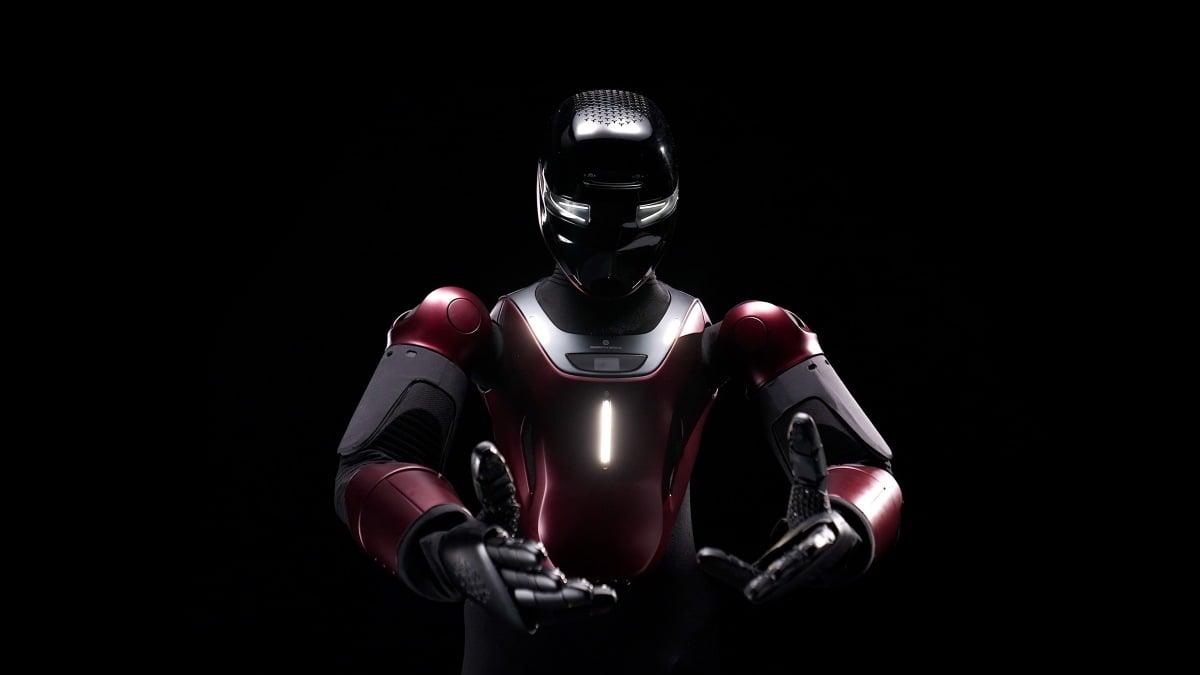
A new humanoid robot debuted this week with a sensor-laden layer of "smart skin" designed to feel exactly where and how hard it's being touched...for industrial safety, of course.
The robot, called Gene.01, comes from Generative Bionics and debuted at AMD's Advancing AI conference in San Francisco. CNET senior video producer Jesse Orrall got hands-on time with the machine, and Orrall described the texture of the smart skin as similar to a neoprene wetsuit. (Disclosure: Mashable and CNET are both owned by the same parent company, Ziff Davis.)
Around its frame, the bot is outfitted with "full-body multimodal skin" that can sense "touch, proximity, force and temperature," according to Generative Bionics.
Mashable Light Speed
Per CNET's reporting, the skin senses touch using two kinds of sensors working together. The first are touch sensors capable of detecting contact, as well as the precise location and amount of pressure applied. Orrall wrote that squeezing the robot's arm triggered a live rendering on a nearby screen, lighting up at the exact spot being touched and darkening as more pressure was applied.
The second sensor type handles proximity rather than direct contact. These are known in the industry as time-of-flight (ToF) sensors, which work by emitting invisible light and measuring how long it takes to reflect back — effectively letting the robot sense something (or someone) before actual contact occurs. Orrall reported that waving a hand near the sensors produced a cluster of dots on the display screen that tracked with the hand movement, fading out as the hand moved away.
The practicality of the design, according to CNET, is collision avoidance. The hope is that these features will make it safer for industrial robots to work in close proximity to humans, whether on a factory floor or elsewhere. Generative Bionics reportedly views Gene.01 as an early platform, with plans to customize the amount and placement of smart skin, as well as the robot's hands, or "end effectors," depending on a client's specific use case.
As CNET noted, sensing the world is only half the equation — the harder problem still ahead is teaching the robot to act on that sensory data in real-time, something Generative Bionics says it's continuing to develop.

 English
 Arabic
 French
 Spanish
 Portuguese
 Deutsch
 Turkish
 Dutch
Dutch
 Italiano
 Russian
 Romaian
 Portuguese (Brazil)