


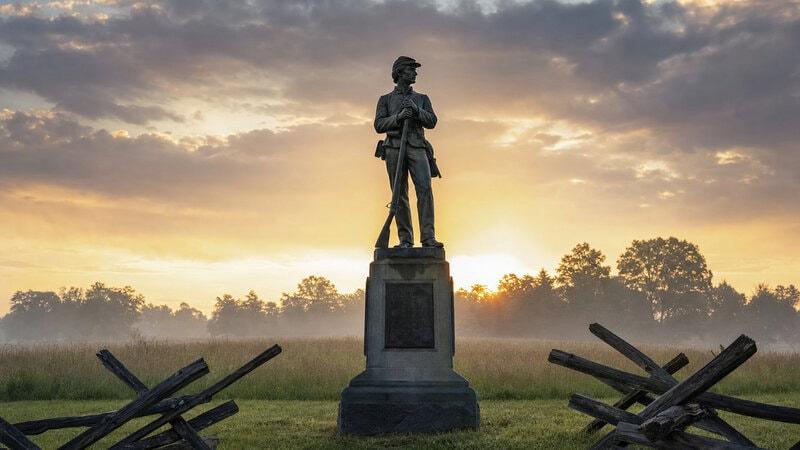

Somewhere beneath a strip mall parking lot in Virginia, or under a subdivision’s cul-de-sac in Tennessee, lies ground where men once fought and died to shape the nation — ground that is simply gone now, paved over and forgotten. The story of the American Battlefield Trust is the story of a generation that decided to stop the erasure before nothing remained to save.
The Crisis That Sparked a Movement: Postwar Sprawl Swallows Hallowed Ground

Through the middle decades of the twentieth century, the American landscape transformed at breathtaking speed. Suburbs radiated outward from every city, highways sliced through farmland and forest, and shopping centers rose on ground that had once absorbed cannon fire and the boots of charging infantry. Civil War and Revolutionary War battlefields — places where the fate of the republic had genuinely hung in the balance — were consumed by this expansion with barely a pause for consideration.
By the late 1980s, historians and preservationists had begun to sound an alarm that was equal parts grief and urgency. A 1993 study commissioned by Congress found that nearly 20 percent of principal Civil War battlefield land had already been lost to development, with another 30 percent under immediate threat. Without a dedicated, well-funded national organization willing to fight for the physical ground itself, these landscapes would simply cease to exist. That sense of emergency became the seedbed for a nonprofit movement that would eventually protect more than 55,000 acres of battlefield land — but the work began, as so many things do, with a clear-eyed recognition of how much had already been lost.
The American Battlefield Trust Takes Shape as the Nation’s Preservation Champion
The American Battlefield Trust grew from the merger of two earlier organizations — the Civil War Trust and the Association for the Preservation of Civil War Sites — eventually consolidating into its current form and name. Headquartered in Washington, D.C., and structured as a 501(c)(3) charitable nonprofit, it was built to become the foremost national voice for historic battlefield preservation in America. Its founding mission centered on Civil War sites — the conflict that had produced the greatest density of endangered ground — but was deliberately broad enough to encompass Revolutionary War and War of 1812 battlefields as well. For the first time, the cause had a single, coordinated champion rather than a scatter of local groups working in isolation.
The organizing principle was simple but radical in its implications: the land itself is a primary historical document. Preserving a deed or a diary matters, but so does preserving the ridge line a regiment defended, the creek crossing where a flank collapsed, the field where a charge was repulsed. For more than three decades, the Trust has operated on that conviction, treating every acquired acre as irreplaceable evidence of what actually happened on American soil.
A Federal Partnership Is Born: Land and Water Conservation Fund Grants Enter the Fight

One of the recurring turning points in the Trust’s history has been its collaboration with the National Park Service, which has awarded $7.4 million in Land and Water Conservation Fund grants specifically designated to protect historic battlefield lands. The infusion of federal money matters not just for its dollar amount but for the leverage it provides: federal grants allow the Trust to pursue land deals that private fundraising alone could not close, and they signal that protecting hallowed ground commands genuine support at the highest levels of American government.
The model that emerged from this partnership — nonprofit organizations identifying and negotiating land transactions while federal grants help seal them — proved durable and replicable. It allowed both sides to accomplish far more than either could have managed independently, and it established the Land and Water Conservation Fund as a recurring instrument in the long campaign to save what remained of America’s most consequential landscapes.
Congress Weighs In: The Battlefield Protection Bill Passes 403-13

In a political era not always known for consensus, the House of Representatives passed a battlefield protection bill by a vote of 403 to 13 — a margin so lopsided it stood as its own kind of historical statement. The near-unanimous result reflected both the moral gravity of the cause and the years of public education and advocacy the Trust had poured into building relationships across the aisle. Protecting the ground where Americans fought and died, it turned out, was one of the few issues that could make partisanship briefly irrelevant.
The legislation reinforced the legal and financial framework that allows the Trust and its federal partners to work in concert on acquiring and shielding endangered acreage. It also sent a message to local governments, developers, and private landowners that battlefield preservation was not a fringe concern but a national priority with the weight of near-unanimous congressional backing behind it.
55,000 Acres and Counting: The Scale of What Has Been Saved

The number that defines the Trust’s achievement is also the number that is hardest to visualize: more than 55,000 acres of battlefield land saved over more than three decades of sustained work. Behind that figure lies thousands of individual transactions — outright purchases, conservation easements, bargain sales, and complex multi-party agreements — each one representing a negotiation won, a piece of ground pulled back from the edge of development. The acres span famous killing fields like Gettysburg and Antietam alongside obscure skirmish sites that appear in almost no popular history book but that witnessed moments of genuine consequence.
What unites every one of those acres is permanence. Land protected by the Trust will not be subdivided, graded, or built upon. A generation made a decision — legally binding, financially backed, institutionally enforced — that certain ground belongs to memory and not to the market. That is what 55,000 acres actually means.
The Trust has also invested heavily in making saved land accessible and interpretable. Interactive maps, classroom curricula, and on-site signage programs turn protected acreage into active educational resources rather than simply fenced-off fields. Preservation, in the Trust’s model, is not an end in itself but the prerequisite for teaching.
Revolutionary War Preservation Expands the Mission: Hanging Rock, South Carolina

The Trust’s reach has never been limited to the Civil War, and one acquisition in South Carolina made that point with particular clarity. The organization purchased 160 acres of the Revolutionary War battlefield at Hanging Rock in Lancaster County — the site of a sharp 1780 Patriot militia engagement during the Southern Campaign, a theater of the Revolution that rarely receives the attention lavished on Lexington, Concord, or Valley Forge. The Southern Campaign was, in many respects, where British imperial ambitions in America were ground down to nothing, and Hanging Rock was part of that grinding process.
The acquisition illustrated a principle the Trust has held since its founding: no era of American battlefield history is expendable, and no engagement is too obscure to deserve protection if the ground retains its integrity. It was also a practical demonstration that Civil War battlefield preservation, while central to the mission, is only part of a larger national goal — to preserve the physical record of every conflict that shaped the country’s identity.
The Ongoing Battle: A President’s Reminder That the Work Is Far From Done

Success on the scale of 55,000 acres can create a dangerous sense of completion, and the Trust’s own leadership has been careful to resist it. The organization’s president has stated plainly that its preservation work is “far from done” — a frank acknowledgment that the forces driving development have not abated, that private land adjacent to documented battlefield sites remains under constant pressure, and that every year without action can be a year in which irreplaceable ground is lost forever. Thousands of acres identified as historically significant in federal studies remain unprotected, and willing sellers do not wait indefinitely.
Battlefield preservation, as the Trust has come to understand it, is not a campaign with a finish line. It is a permanent institutional commitment, one that must survive changes in administration, shifts in donor priorities, and the slow erosion of public memory that comes with the passage of time. The work is generational by definition — which is precisely why the organization exists.
June 2026: The Kiggans-Magaziner Bill Passes the House on the Eve of America’s 250th Birthday

In June 2026, with the 250th anniversary of American independence approaching on the calendar, the House of Representatives passed the Kiggans and Magaziner bill to preserve historic battlefields — a piece of legislation whose timing carried unmistakable symbolic weight. A nation preparing to mark a quarter-millennium of existence was simultaneously voting, by a wide bipartisan margin, to protect the physical places where that existence was won and preserved. The bill’s cross-party co-sponsorship echoed the lopsided margins of earlier battlefield legislation, a reminder that the politics of hallowed ground have a way of cutting through ordinary divisions.
Advocates framed the passage as both a gift to the Semiquincentennial and a promise to the Americans who will inherit these landscapes decades hence. For the Trust and its allies, it represented one of the most consequential legislative victories for battlefield preservation in years — proof that sustained public education and congressional relationship-building eventually produces results that matter on the ground, literally.
June 2026: Congress Reauthorizes the Battlefield Preservation Grant Program

In the same remarkable legislative window, Congress reauthorized the historic battlefield preservation grant program that has quietly underpinned dozens of land transactions across the country. Reauthorization was not a formality — it required the Trust and allied organizations to make the case, district by district, that the program delivered measurable returns on federal investment and that its reach was genuinely national. The argument prevailed, and the funding pipeline that connects federal dollars to endangered acres was kept open for another generation of preservation work.
With both the Kiggans-Magaziner bill passed and the grant program renewed, the American Battlefield Trust entered the nation’s 250th anniversary year carrying legislative momentum it had not seen in some time, along with the financial tools needed to press forward in the race to save what remains. The two actions together represented a rare alignment of political will and practical funding — precisely the combination that has allowed the Trust to move quickly when threatened land comes to market.
What the Trust’s Model Teaches About Preservation at Scale

Three decades of sustained work have produced not just acres but a replicable model worth examining. The Trust’s approach combines aggressive private fundraising with federal grant leverage, meticulous historical research to establish a site’s significance before negotiating its purchase, and a communications operation capable of turning battlefield history into broadly compelling public narrative. The organization’s outreach strategy has been studied as a case in nonprofit engagement, with particular attention to how it converts interest in American history — an interest that polls consistently show running deep across demographic lines — into donor relationships and political support.
The lesson the Trust offers to other preservation causes is straightforward: permanence requires institutions. Local passion and individual generosity are necessary but not sufficient. Protecting land at national scale demands legal instruments, federal partnerships, a professional staff, and a long enough time horizon to outlast any single political moment. The American Battlefield Trust built all of those things, and the 55,000 acres it has saved are the result.
From the first postwar parking lots that swallowed rifle pits to the June 2026 votes that renewed the federal commitment to protection, the arc of American battlefield preservation is a story still being written — one transaction, one acre, one Congress at a time.

 English
 Arabic
 French
 Spanish
 Portuguese
 Turkish
 Dutch
Dutch
 Italiano
 Russian
 Romaian
 Portuguese (Brazil)
 Greek
Greek