


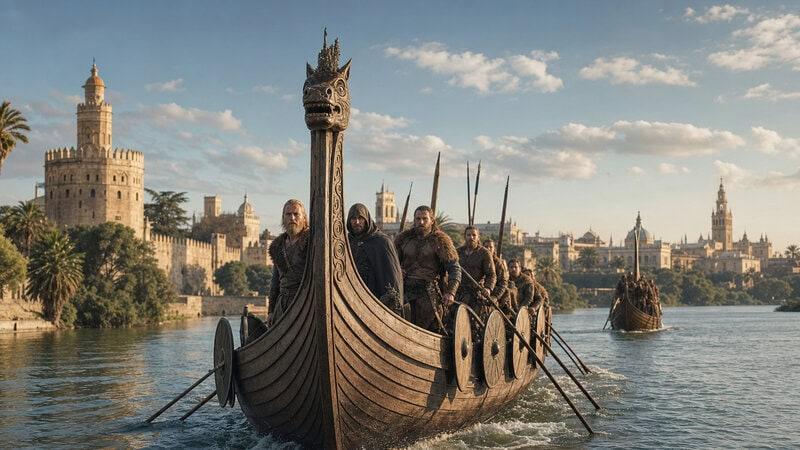

In the autumn of 844 AD, the citizens of Ishbiliya — the city the world would later call Seville — looked up from the banks of the Guadalquivir and saw something that should have been impossible: the curved prows of Norse longships, rowing steadily upriver, deep into the sunlit heart of al-Andalus. Smoke was already rising from the outskirts. The raiders had arrived.
Longships on the Guadalquivir

The Vikings occupy a specific place in the popular imagination — raiders of fog-wrapped monasteries, terrorizers of the British coast, settlers of frozen Iceland. What that imagination rarely pictures is a Norse fleet rowing through southern Spain under a blazing Andalusian sun, the olive groves and whitewashed settlements of the Umayyad Emirate spread out on either bank. Yet that is precisely what happened, at least twice, in the ninth century. The Norse came to Spain, and the encounter left marks on both civilizations that historians are still tracing.
Arab chroniclers who recorded these events had no equivalent for “Viking” as we use it today. They reached instead for something older and more charged: al-Majus. The term originally described Zoroastrian fire-worshippers — pagans outside the circle of the known Abrahamic world. Applied to the Norse, it carried a shudder of genuine dread. These were people from beyond the edge of the familiar, worshippers of alien gods, answerable to no caliph, no pope, no recognizable moral order. Whatever you called them, they were here, and they were burning things.
How did Norse warriors end up on a Spanish river? And what happened when they met one of the most formidable rulers of the medieval Islamic world?
Who Were the Vikings Raiding Spain?

By the 840s, Norse expansion had already redrawn the mental map of Europe. Viking fleets had ravaged the Irish coastline for decades, sacked monasteries in Francia, and struck deep into the British kingdoms. The Iberian Peninsula, sitting at the hinge between the Atlantic and the Mediterranean, was a logical next destination for fleets already operating out of bases in Frankish territory and the British Isles. The sea routes practically pointed south.
The raiders who struck Spain were almost certainly Danish or Norse war-bands — not a single unified force marching under one banner, but opportunistic groups drawn by rumor of wealth and the practical logic of following the coastline. And the wealth was real. Al-Andalus in 844 was not a struggling backwater. It was governed by Abd al-Rahman II, the Umayyad Emir of Córdoba, a ruler who presided over one of the most sophisticated courts in the medieval world — a place of libraries, physicians, poets, and considerable military power.
The Guadalquivir River was the key that unlocked the interior. Running from the heart of Andalusia out to the Atlantic, it was a natural highway deep into the emirate. Seville — Ishbiliya — sat on its banks, wealthy and, as 844 would prove, dangerously exposed to any fleet with the audacity to sail upriver. The Norse had audacity in quantities that the Andalusians had not yet learned to plan for.
The First Raid: 844 AD — Fire, Plunder, and a Decisive Defeat

The Norse assault on al-Andalus in 844 did not begin at Seville. It began, as Viking raids so often did, with a methodical working of the coastline. The fleet — Arab sources suggest it was substantial — first struck at Lisbon, then moved south through the Algarve and around to Cádiz, testing defenses, gathering intelligence, and accumulating plunder. Each successful strike was an invitation to go further. So they turned the prows of their longships toward the mouth of the Guadalquivir and began to row inland.
Seville fell quickly. The city was sacked, its population terrorized, its buildings looted. Arab chronicles record that the Norse held Ishbiliya for roughly a week — long enough to strip it of considerable portable wealth and to take captives. The raid exposed something Abd al-Rahman II could not ignore: the Atlantic flank of his emirate was open. His army was formidable on land, but his naval capacity had never needed to face an enemy that arrived from the sea, rowed up a river, and vanished before a proper response could be mounted.
The emir responded with striking speed and effectiveness. His forces regrouped and engaged the Norse fleet as it moved along the river, killing a significant number of raiders — Arab sources record casualty figures that should be treated with the caution due to any medieval chronicle, but the scale of the Andalusian counterattack was clearly consequential. Captives were taken. Some were executed; others were enslaved. Abd al-Rahman II then did something that reveals a theatrical political intelligence alongside his military competence: he had the bodies of slain Vikings hung from the palm trees of Seville. A warning. A statement. A piece of grim theater that announced, to any watching eyes, that al-Andalus had absorbed the shock and struck back harder.
Al-Andalus Fights Back: Warships, Watchtowers, and a Poet’s Embassy

A ruler less capable than Abd al-Rahman II might have treated 844 as a crisis survived and moved on. Instead, the emir treated it as information. The raids had revealed a structural weakness, and he set about fixing it systematically. He ordered the construction of a proper Andalusian fleet — warships, not river transports — and he established a network of watchtowers and warning beacons along the Atlantic coastline and the banks of the Guadalquivir. The next time strange sails appeared on the horizon, Seville would know before the longships reached the river mouth.
Arab sources also describe the deployment of fire-throwing devices against Norse ships in subsequent engagements — weapons that echo the Byzantine use of Greek fire and suggest that the Emirate was drawing on the full range of Mediterranean military technology to address what was essentially an Atlantic problem. That a sophisticated Islamic state was retrofitting Mediterranean naval warfare for the Norse threat tells you something important: the Vikings in Spain were not a footnote. They forced a major medieval power to rethink its coastal defenses from the ground up.
Perhaps the most unexpected response, though, was diplomatic. Abd al-Rahman II dispatched an envoy — identified in Arab sources as Al-Ghazal, a poet and courtier of the Córdoba court — on an embassy to the Norse lands. The precise destination of this mission remains contested among historians, and its practical outcomes are unclear. But the mission itself speaks volumes. Here was a Muslim court, steeped in the high culture of the Abrahamic world, sending a representative to treat with the al-Majus, to open a line of communication with the pagans of the sea. Whatever it produced, its very existence suggests the Emirate understood the Norse as a geopolitical reality to be managed, not merely a natural disaster to be endured.
The Second Raid: 859-861 AD — A Larger, Bolder Campaign

Roughly fifteen years after the first strikes, a larger Norse fleet returned to Iberian waters. Arab sources suggest more than sixty ships — a force considerably more ambitious than the original raiders. What is clear is that this second expedition was not a single raid so much as an extended campaign of plunder across an enormous geographic arc.
The fleet struck the Spanish coastline again, pushed through the Strait of Gibraltar into the Mediterranean, raided the Balearic Islands, probed the North African coast, and reached as far as what is now the southern coast of France and northern Italy. It was an extraordinary demonstration of Norse navigational range — the same cultural energy that would eventually reach Newfoundland was here being applied to the entire western Mediterranean basin.
In the Iberian theater specifically, the reinforced Andalusian fleet — the one Abd al-Rahman II had built in direct response to the 844 raids — inflicted serious damage. Arab chronicles describe naval engagements in which Norse ships were burned, possibly using incendiary weapons, and a significant number of vessels were captured. The second Norse foray into Iberian waters ended not in triumph but in costly attrition. The fleet eventually turned northward, battered and diminished, carrying plunder but having failed to establish any lasting foothold. Al-Andalus had held again, this time from a position of genuine naval strength rather than improvised response.
What the Arab Chronicles Tell Us — and What They Reveal About Fear

One of the most underappreciated aspects of the Viking presence in Spain is the quality of the sources that recorded it. Arab chroniclers — among them Ibn al-Qutiyya and, writing later, Ibn Khaldun — preserved detailed accounts of the Norse raids from the perspective of the Islamic world. This is a genuinely rare historical gift. Most Viking history comes filtered through the eyes of Christian monks or later Norse saga-writers. The Andalusian perspective offers something different: the view from a sophisticated, literate Islamic civilization encountering the Norse for the first time and struggling to fit them into a comprehensible framework.
The term al-Majus is the key to that struggle. Originally applied to Zoroastrians — fire-worshippers in the Arabic conception — it was repurposed for the Norse as a way of marking them as people entirely outside familiar religious categories. Not Jews, not Christians (who at least had a recognizable place in Islamic theology), not Muslims. Something stranger and more troubling: worshippers of gods that no Arabic-speaker had ever encountered, arriving from a direction from which no serious threat had previously come. The label carries cultural distance and barely contained fear in equal measure.
Christian sources from the Kingdom of Asturias in northern Spain add yet another layer. The northern Iberian Christian kingdoms were themselves in a long, grinding conflict with the Umayyad Emirate, and some sources hint at tentative attempts to find common cause with the Norse against their shared southern enemy. Whether any such alliance ever meaningfully materialized is uncertain, but the impulse reveals how thoroughly the Norse raids scrambled existing political alignments. On the Guadalquivir and the Atlantic coast of Iberia, three civilizations — Islamic, Christian, and Norse — were colliding in real time, each struggling to make sense of the others.
For readers curious about how the word itself crossed into Spanish, resources like SpanishDict’s translation of “Viking” and WordReference’s English-Spanish entry for Viking show how the term sits in the modern language. Discussion communities like this Reddit thread on Norse and Hispanic connections reflect how alive this curiosity remains among general readers today.
No Permanent Colonies — but Lasting Consequences
The Norse raids on the Iberian Peninsula did not produce permanent settlements the way the Viking presence transformed Normandy, England, or the river towns of Kievan Rus. No Viking colony took root on the Guadalquivir. No Norse earls governed Andalusian towns. By that narrow measure, the story of the Vikings in Spain might seem like a dramatic but ultimately inconsequential episode.
That reading misses the point. Abd al-Rahman II built a navy because of the Norse. Watchtowers went up on the Atlantic coast because of the Norse. A Muslim poet sailed to the lands of the al-Majus on a diplomatic mission that had no clear precedent in the Islamic world — because of the Norse. The raids reshaped Andalusian military policy, redirected state resources, and left a genuine imprint on the cultural memory of one of the medieval world’s most powerful civilizations. These are not the fingerprints of a sideshow.
The episode also serves as a powerful corrective to the northern-European tunnel vision that still tends to frame Viking history. The Norse world stretched from the coast of Newfoundland to the rivers of Ukraine, from the markets of Constantinople to the palm-lined banks of the Guadalquivir. Placing the Vikings only in Scandinavia, Britain, and Ireland is like reading a map with half the landmass removed. The Spanish word for Viking — vikingo — carries within it this whole forgotten geography, a small linguistic trace of an encounter that forced an entire civilization to rethink where danger could come from.
Modern Spain has begun rediscovering this chapter. Archaeological interest in Norse-era coastal sites has grown steadily, and popular historians have started giving the story the attention it deserves. It remains, however, underrepresented in mainstream accounts of the Viking Age — a gap that understates both the geographic reach of Norse activity and the sophistication of the Islamic world’s response to it.
Why This Story Deserves a Place in Viking History
Return, then, to that autumn scene on the Guadalquivir: the longships rowing upstream, the smoke rising over Ishbiliya, and then — weeks later — the bodies of Norse warriors hanging from the city’s palm trees by the emir’s deliberate order. An entire civilization, shaken out of comfortable certainty about where danger came from and what it looked like, forced to build warships and coastal towers and send a court poet into the unknown north.
The Vikings did not conquer Spain. They could not hold what they briefly seized, and they never returned in force after 861. But they forced al-Andalus to become something it had not been before: a state that looked west and north, that thought seriously about its Atlantic exposure, that treated the sea as a frontier requiring active defense. And in doing so, they earned a place in Spanish history that belongs in any honest account of the Viking Age — not as a footnote, but as a chapter that neither side ever quite forgot.

 English
 Arabic
 Spanish
 Portuguese
 Deutsch
 Turkish
 Dutch
Dutch
 Italiano
 Russian
 Romaian
 Portuguese (Brazil)
 Greek
Greek