


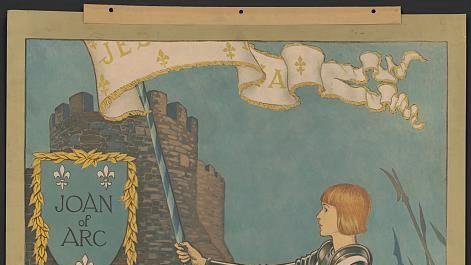

Three days after she signed a recantation she could not read, Joan of Arc was found in her cell wearing men’s clothes — and that single detail, a tunic and a pair of hose, became the legal mechanism that sent her to the flames. The voices, the visions, the saints: none of it was what finally killed her.
The Morning They Finally Had Her

Rouen, May 24, 1431. After months in chains, interrogated by turns and without adequate counsel, a nineteen-year-old girl stood before a crowd in the cemetery of Saint-Ouen and did what her judges had spent weeks trying to extract from her: she recanted. Whatever she understood of the document placed before her — and the evidence suggests she understood very little, since she could not read — she made her mark on it. In exchange, the death sentence was commuted to life imprisonment. The court had its victory on paper.
Then, three days later, the guards reported she was wearing men’s clothes again.
To modern eyes this looks like a footnote. To the court of Bishop Pierre Cauchon, it was everything. Under the rules governing heresy trials, a penitent who relapsed into condemned behavior faced automatic execution — no further argument required. The theological mountain the prosecution had tried to climb for months, the visions, the battlefield commands, the claim of divine authority, had proven almost impossible to convert into a criminal charge that would hold. A garment held just fine. Within a week, Joan of Arc was dead, burned in the Old Market Square of Rouen on May 30, 1431, condemned officially not for hearing voices but for wearing the wrong clothes after promising not to.
This is a story about how law, politics, and a piece of clothing became the instruments of execution when condemning a visionary girl proved harder than her enemies expected.
A Peasant Girl Who Rewrote Western History in Fifteen Months

To understand why her enemies needed her dead so urgently, it helps to understand what she had actually done to them. Joan of Arc was born around 1412 in Domrémy, a village in the duchy of Bar in northeast France, into a propertied peasant family — not noble, not destitute, but rooted in the solid agrarian world of the rural northeast. Her father, Jacques d’Arc, held a modest tenancy and served as a village official. The Hundred Years’ War between England and France had already ground on for generations by the time she was a child, and the English position in France was, by 1428, formidably strong. Henry V’s victory at Agincourt in 1415 and the subsequent Treaty of Troyes in 1420 had effectively disinherited the French Dauphin and named the English king heir to the French throne. The Dauphin Charles — uncrowned, contested, widely mocked as illegitimate by his own mother — held a rump kingdom south of the Loire while English and Burgundian forces dominated the north.
Joan’s claim, delivered first to local officials and eventually to Charles himself at Chinon in early 1429, was that saints — she named Michael, Catherine, and Margaret — had told her she was chosen by God to drive the English out of France and see Charles crowned king at Reims. It should have been easy to dismiss. She was a teenage girl with no military training, no title, and no political standing. Charles, who had every reason to be suspicious of religious enthusiasts, subjected her to weeks of theological examination before nonetheless giving her command of a relief force headed for the besieged city of Orléans in the spring of 1429.
What followed became one of the most startling reversals in medieval military history. The French relief of Orléans in May 1429 is marked by historians as the turning point of the Hundred Years’ War — the moment the English advance stalled and French momentum began to build. Joan did not hold supreme command in the conventional sense; experienced captains such as Jean de Dunois directed operations alongside her. But her presence transformed the morale of French forces that had been losing for a generation, and her battlefield conduct — she was wounded by an arrow at the fort of Les Tourelles and returned to fighting the same day — made her presence impossible to dismiss as ceremonial. By July, Charles VII was crowned at Reims with Joan standing beside him, holding her battle standard. Within fifteen months she had altered the trajectory of a war that had consumed most of a century.
She was captured by Burgundian forces outside Compiègne in May 1430, sold to the English, and her enemies were left with a problem that had no clean solution: what do you do with the girl who humiliated you?
The Trial That Was Never Really About God

The answer the English and their allies settled on was an ecclesiastical trial at Rouen, beginning in February 1431, overseen by Bishop Pierre Cauchon of Beauvais. Cauchon was a pro-English churchman whose career ambitions were visibly entangled with English dominance in France — he had been driven from his diocese by pro-French forces and depended on English patronage for his position. Contemporaries could see the conflict of interest plainly, and the nullification trial of 1456 would make it a matter of formal record. He needed the Church’s authority to condemn her. He did not need, and did not conduct, anything resembling an impartial inquiry.
The prosecution opened with some seventy articles of accusation, covering everything from her visions to her clothing to her battlefield conduct. Over weeks of grueling daily questioning — Joan had no legal counsel, was held in a military prison rather than an ecclesiastical one, and faced trained inquisitors alone — charge after charge collapsed. Her theology was orthodox. Her answers were shrewd, sometimes startlingly so for a girl with no formal education. She deflected traps with a directness that frustrated her examiners: when asked whether she knew she was in God’s grace, a question designed to produce either heresy or false humility, she answered that if she was not, she prayed God would put her there; and if she was, she prayed God would keep her there. The assessors reportedly fell silent. The original seventy charges were eventually condensed to a smaller set of accusations, and the one the court could actually make stick did not concern what she believed about God. It concerned what she wore.
English political pressure on Cauchon was relentless throughout. Letters survive showing the English administration’s active involvement in shaping the proceedings. This was not a dispassionate ecclesiastical proceeding that happened to reach a convenient conclusion. It was a political execution wearing church robes, and the men conducting it knew it — a fact the 1456 rehabilitation process would document with unusual candor.
Why Men’s Clothes Were the Lethal Charge

The legal backdrop matters here. Deuteronomy 22:5 explicitly forbade women from wearing men’s garments, and medieval canon law had absorbed and codified that prohibition. Cross-dressing was not a cultural curiosity to the medieval Church; it was a catalogued moral disorder with specific penitential consequences. Joan’s cross-dressing conviction sits inside a precise legal framework, not a vague sense of impropriety, and Cauchon’s court understood the mechanism exactly.
Joan had worn male dress — tunic, hose, boots — consistently from the time she left Domrémy. Her defenses were practical and spiritual simultaneously. Practically, she argued that male clothing offered protection against sexual assault while she traveled and later lived among soldiers, a concern that was entirely realistic given the conditions of medieval military camps and the documented reality that her guards had made attempts on her person. Spiritually, she maintained that her saints had directed her to dress as she did. The court rejected both defenses without serious engagement.
When she recanted on May 24, one of her explicit concessions was to return to women’s clothing. She did. Then, within days, she was found in men’s clothes again — and the court recorded this as a relapse into heresy, triggering a death sentence that could now proceed without further deliberation.
The disputed question that shadows everything that followed is this: Did guards deliberately remove or withhold her women’s clothing during those days, forcing her back into men’s dress and engineering the relapse the court needed? Testimony gathered at the 1456 nullification trial strongly suggested exactly that. One witness, Jean Massieu, who served as an officer of the court during the original trial, testified that her female clothing was taken away and male clothing left in its place, and that she put it on only after repeated requests for the return of her dress went unanswered. If the evidence is read on its own terms, Joan did not choose to relapse. She was maneuvered into the appearance of relapse by people who had already decided on the outcome and needed a technical trigger to set it in motion. The reason for her execution, under this reading, is less a consequence of her choices than of a trap deliberately set by the men who held her keys.
What the Church Actually Knew — and When It Knew It

The theologians of the University of Paris who endorsed the verdict were not uninformed bystanders lending distant approval. Their institutional blessing was solicited precisely because Cauchon required scholarly cover for a conclusion that had been reached before their consultation was requested. Several assessors who participated in the trial later testified at the 1456 retrial that they had felt coerced, that the proceedings had been irregular, and that doubts had existed inside the court at the time. These were not retrospective dissenters speaking safely from a distance decades later; some described specific pressures they experienced in the room, including threats from English officials.
The Church’s own nullification process, ordered by Pope Calixtus III and completed in 1456 under the presidency of the Archbishop of Reims, annulled every charge against Joan. The language of the annulment was striking in its specificity: the original verdict was declared the product of calumny, fraud, iniquity, contradiction, and manifest errors of fact and law. That is not the language of a finding that a well-meaning court made an honest mistake. It is a formal institutional admission that the original trial was corrupt, that the men running it knew it was corrupt, and that the Church was prepared to say so — twenty-five years after Joan burned in the Old Market Square.
The timing of both verdicts is instructive. Her condemnation in 1431 served English political interests at the height of their power in France. Her rehabilitation in 1456 served French political interests; Charles VII’s consolidation of power over all of France was well advanced by then, and a martyred heretic on the French side was a liability that a martyred saint could resolve. The Church moved in both directions as political winds dictated, which is perhaps the single most clarifying fact in the entire record of her case.
The Execution and the Myth It Created

On the morning of May 30, 1431, Joan of Arc was led to the stake in the Old Market Square of Rouen. She was nineteen years old. She asked for a cross to hold, and an English soldier fashioned one from two sticks. A crucifix was brought from a nearby church and held before her until the flames made it impossible. Her executioner, Geoffroy Thérage, later sought absolution, saying he greatly feared he was damned for what he had done.
The English made a significant tactical error in staging the execution publicly. Martyrdom operates on a logic that political executions rarely account for: it transforms the victim into a symbol more durable than any living person could have been. Within a generation, French chroniclers were building the narrative of the Maid of Orléans into something that transcended the specific, grimy details of a heresy conviction turned on a change of clothing. The legend that emerged proved irresistible across five centuries, attracting writers and dramatists from Christine de Pizan, who celebrated Joan during her own lifetime, to Shakespeare, Voltaire, Friedrich Schiller, Mark Twain, and George Bernard Shaw, and culminating in her canonization by the Catholic Church in 1920.
But legend has a way of smoothing away inconvenient specifics. Most popular retellings say, in some form, that she died for her visions — for claiming to hear God’s voice, for her faith, for her defiance of an unjust authority. This version is more dramatic and more comfortable, particularly for an institution that eventually made her a saint. It lets the Church off more lightly than the actual record supports. The real reason for her execution is simultaneously more mundane and more damning: she was condemned for wearing a tunic, after the men holding her prisoner appear to have ensured she had no alternative.
Why the Real Story Matters More Than the Legend
The clothing charge is worth sitting with precisely because it seems so small. Medieval institutions under political pressure — like institutions in any era — tend to reach for technical, legalistic instruments rather than confronting a genuine threat directly. The theological case against Joan was weak because her faith was orthodox and her answers were sharp. The legal case built around her dress was weaker still as a matter of moral seriousness, but it was specific, codified, and could be triggered mechanically once the groundwork was laid. That pattern — finding the technical charge that will hold when the real charge will not — is recognizable across centuries of institutional behavior, and Joan’s case remains one of its earliest and most thoroughly documented examples.
Her case also stands as a vivid illustration of how gender non-conformity could be criminalized the moment those in power required a charge that would stick. The cross-dressing conviction is not simply a medieval oddity, an artifact of a strange and distant world. It is a template: locate the behavior that transgresses a codified boundary, refuse the defendant’s stated explanations, and use the technical violation to accomplish what direct confrontation could not.
Her rehabilitation illustrates something equally worth noting: institutions can acknowledge injustice, but they tend to do so only when acknowledgment serves current interests. The same Church that burned her made her a saint — which is not simple hypocrisy so much as a frank demonstration of how power operates across time, using the same person for opposite purposes a generation apart.
In the end, the detail that makes the history live is the smallest one. Whatever happened to those women’s clothes in the days between May 24 and May 30, 1431 — left within reach or deliberately taken away — the distance between the object and the consequence, between a pair of hose and a young woman burned alive before a crowd in a public square, is the space across which the whole story falls. Joan of Arc did not die because France needed a legend. She died because a bishop needed a verdict, and a garment was easier to prove than a sin.

 Arabic
 French
 Spanish
 Portuguese
 Deutsch
 Turkish
 Dutch
Dutch
 Italiano
 Russian
 Romaian
 Portuguese (Brazil)
 Greek
Greek