


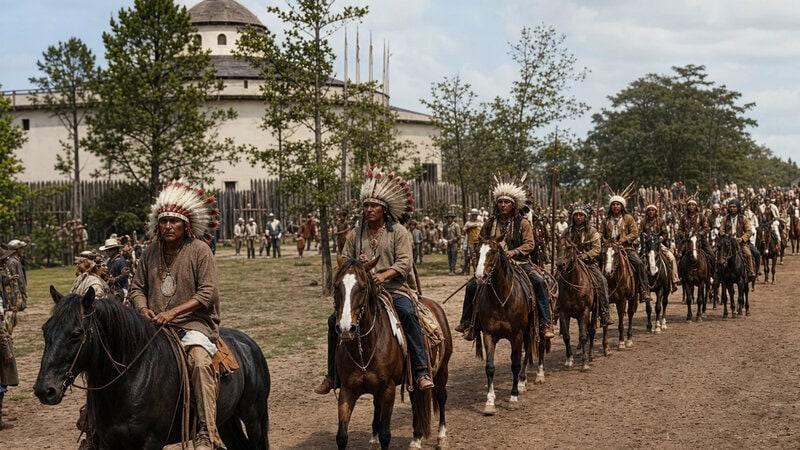

The story Americans learn about their earliest colonial past tends to begin with a handful of English ships, a muddy riverbank in Virginia, and the year 1607 — but that story arrives more than a century late to its own subject. Peel back the mythology and you find Spanish cities already weathering their second generation of storms, a ghost colony on the Carolina coast, and an even earlier settlement that most textbooks never mention at all. What follows corrects the most persistent myths, one by one, and replaces them with what the historical record actually shows.
Myth 1: Jamestown Was the First European Settlement in What Is Now the United States

On September 8, 1565 — 42 years before a single English colonist set foot in Virginia — the Spanish admiral Pedro Menéndez de Avilés waded ashore in northeastern Florida with roughly 800 soldiers, sailors, and settlers, planted a cross in the sand, and celebrated a Mass. The settlement he founded that afternoon was Saint Augustine, and it is still there today. When people discuss the colonial history of the United States, Saint Augustine is not a prelude — it is the opening chapter.
The city survived hurricanes, English raids, pirate attacks, and multiple changes of imperial flag without ever disappearing. That matters, because continuity is precisely what the word “first” is supposed to reward. Saint Augustine is the oldest continuously occupied European-founded settlement in what is now the United States, and it holds that title by more than four decades over Jamestown. Every account of first European settlement in North America that skips 1565 and jumps to 1607 is skipping the actual beginning.
Myth 2: Jamestown Was the First English Colony Attempted in North America

England had already tried — and catastrophically failed — before anyone hammered the first post into Jamestown’s palisade. The Roanoke Colony was planted on the Carolina Outer Banks in 1585, then resupplied and reinforced in 1587, making it England’s genuine first attempt at a permanent foothold on the continent. That second wave of settlers included Virginia Dare, the first English child born in the Americas. By 1590, when a supply ship finally returned after delays caused by the Anglo-Spanish War, every colonist had vanished, leaving behind only the word “CROATOAN” carved into a fence post and a mystery that historians are still untangling today.
Jamestown earns the title of first permanent English settlement precisely and only because Roanoke erased itself so completely. The two stories are inseparable: Roanoke’s failure is the shadow that Jamestown escaped. Calling Jamestown the first English colony in North America quietly buries the people who came before and the extraordinary, still-unexplained thing that happened to them.
Myth 3: The Pilgrims Were Among America’s Earliest European Arrivals

When the Mayflower dropped anchor off the Massachusetts coast in November 1620, Jamestown was already a 13-year-old, tobacco-growing, war-scarred town — and Saint Augustine was 55 years old, with a stone fort already under construction. The Pilgrims were not pioneers stepping into virgin colonial territory; they were late arrivals to a hemisphere that European powers had been carving up for well over a century. By 1620, Spain had founded dozens of missions across Florida and the Southwest, and the Caribbean had been reshaped by European colonization for more than a hundred years.
The outsized place the Pilgrims occupy in American cultural memory is substantially a product of 19th-century mythmaking, when writers and politicians reached back for a founding story that felt morally clean, Protestant, and appropriately humble. That narrative push quietly shouldered the older, messier, Catholic and Spanish chapters off the main stage of national history — and the distortion has proved remarkably durable ever since.
Myth 4: There Were No European Settlements on U.S. Soil Before the English Arrived

Spain had been operating across the American Southeast and Southwest for decades before any English ship made a serious attempt at North American colonization. Saint Augustine was founded in 1565; Santa Fe, New Mexico, followed in 1610; and a network of Franciscan missions stretched across Florida long before sustained English settlement took hold. Even further back, the Spanish Crown sponsored San Miguel de Guadalupe in present-day South Carolina in 1526 — a colonial attempt that predates Jamestown by 81 years, and one that failed not for lack of ambition but because of disease, the death of its leader, and an enslaved African revolt.
The persistent myth that European civilization in North America begins with the English is partly a legacy of the Black Legend — a Protestant propaganda tradition that depicted Spanish colonialism as uniquely barbaric and therefore culturally irrelevant to Anglo-American identity. It was an effective piece of historical framing, but it required erasing an enormous amount of actual history to work. The Spanish were not latecomers to the story of the first settlement in America; they were the opening act.
Myth 5: San Miguel de Guadalupe Is Too Obscure and Short-Lived to Count as a Real Settlement

In the summer of 1526, the Spanish lawyer and explorer Lucas Vázquez de Ayllón led approximately 600 colonists — men, women, priests, and enslaved Africans — to the Carolina coast and established San Miguel de Guadalupe. It was, by any functional definition, a colonial settlement: it had a governing structure, a church, and a population that intended to stay. Then catastrophe arrived in waves. Ayllón himself died within months. Disease tore through the survivors. And the enslaved Africans — among the first people of African descent to set foot on what is now continental U.S. soil — rose up, rebelled, and fled to nearby Indigenous communities, in what historians regard as the first recorded slave revolt in what is now the United States.
The colony collapsed and the survivors limped back to Hispaniola, which is why San Miguel de Guadalupe rarely appears in mainstream accounts of early American settlement. But a settlement’s brevity does not retroactively erase its existence. Historians have increasingly argued that San Miguel deserves recognition as the first European settlement attempt inside the present-day continental United States, predating even Saint Augustine by nearly four decades. Its obscurity is a verdict handed down by whose history gets taught — not by the historical record itself.
Myth 6: The 104 Colonists Who Arrived at Jamestown in 1607 Mark the Real Beginning of American History

Those 104 English men and boys who arrived at Jamestown in May 1607 were not stepping into an empty or uncontested world. Saint Augustine already had a fort, a church, a garrison, and more than four decades of colonial life behind it. Spanish missionaries had been active across Florida for years. And surrounding the marshy Virginia peninsula where the English built their palisade, the Powhatan Confederacy — a sophisticated political alliance numbering in the tens of thousands — had its own trade networks, diplomacy, agriculture, and history stretching back long before any European ship appeared on the horizon.
Framing 1607 as “the beginning of American history” is a perspective, not a fact. It is the beginning of the story from one very specific vantage point: English, Protestant, and Atlantic-facing. It compresses a full prior century of European colonial activity and thousands of years of Indigenous civilization into a backdrop. The history of Jamestown is genuinely important — but “important” and “first” are different claims, and only one of them holds up under scrutiny.
Myth 7: Saint Augustine Is a Minor Historical Footnote Compared to Jamestown

Saint Augustine has been continuously inhabited since 1565. It passed from Spanish to British control in 1763, returned to Spain in 1783, and eventually became part of the United States when Florida was admitted to the Union in 1845 — all without ever being abandoned or disappearing from the map. That unbroken thread of occupation makes it the oldest continuously occupied European-founded city in the United States by a margin of more than 40 years over Jamestown. Jamestown, by contrast, was eventually deserted; the colonial capital shifted to Williamsburg in 1699, the original site reverted to farmland, and it sat largely forgotten until archaeologists began excavating it in earnest during the 1990s.
The relative invisibility of Saint Augustine in American popular consciousness — in school curricula, national mythology, and casual conversation about the country’s origins — says far more about whose stories get amplified than about the settlement’s actual historical weight. A city that has stood continuously for more than 450 years is not a footnote. It is, if anything, the headline that the dominant narrative has been quietly working around for centuries.
Myth 8: The English Were the Pioneering Force in Colonizing North America

By the time England’s first serious colonists reached Roanoke in 1585, Spain had already colonized Puerto Rico (1508) and Cuba (1511) and had conducted sweeping explorations of the North American interior. Hernando de Soto’s expedition of 1539-1542 crossed through what is now Florida, Georgia, the Carolinas, Tennessee, Alabama, Mississippi, Arkansas, and Texas — an astonishing penetration of the continent accomplished decades before England had established so much as a foothold. Spain was not competing with England for North America during most of the 16th century; England simply was not in the race.
The idea that the English were colonization’s driving force in North America is an English-language editorial position that has been mistaken, through generations of repetition, for established fact. Jamestown’s founding was a significant event — England’s first enduring foothold on the continent — but it arrived into a colonial landscape Spain had been actively building for the better part of a century. Calling England the pioneer requires looking away from an enormous volume of prior activity conducted by people who simply wrote their records in a different language.
Myth 9: Jamestown’s 1607 Founding Is the Correct Starting Point for American Colonial History

1607 is an accurate starting point for exactly one thing: English colonial history in North America. European colonial history in the present-day United States begins in 1526, when San Miguel de Guadalupe was planted on the Carolina coast, and picks up decisively in 1565 with the founding of Saint Augustine — depending on whether one defines “colonial history” by intention or by staying power. The Spanish colonial footprint, moreover, is not merely a historical curiosity: Spanish colonial law, land-grant systems, and place names continue to shape the legal and cultural geography of Florida, Texas, California, New Mexico, Arizona, and Colorado. The foundational institutions of those states are Spanish, not English, in origin.
Defaulting to 1607 as Year One of American history is an editorial choice dressed up as a neutral fact, and it renders invisible a full century of European activity and several millennia of Indigenous civilization on the same soil. The question of why Jamestown is so often called the first colony is ultimately a question about power — about which stories a society decides are worth telling, and which ones it quietly agrees to forget.
The real history of the first settlements in America is older, more crowded, more violent, and more multilingual than the tidy English-first narrative allows. Recovering it requires only one thing: a willingness to count the cities that were already there.

 English
 Arabic
 French
 Spanish
 Portuguese
 Deutsch
 Turkish
 Dutch
Dutch
 Italiano
 Russian
 Romaian
 Greek
Greek