


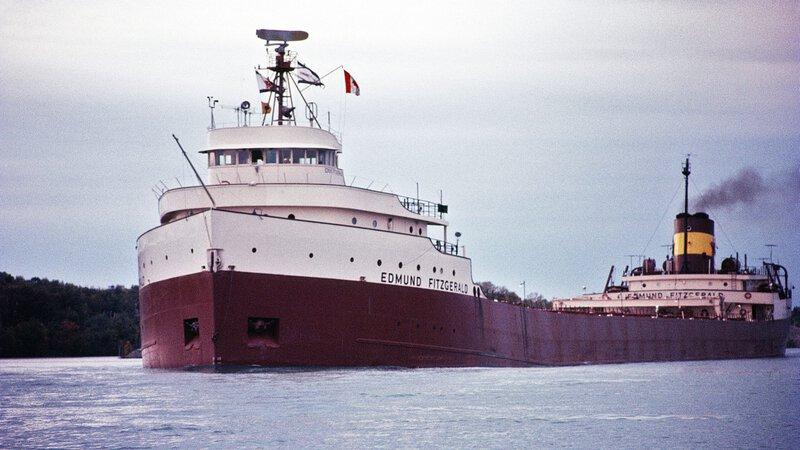

At 7:10 p.m. on November 10, 1975, Captain Ernest McSorley radioed the freighter Arthur M. Anderson through walls of black water and screaming wind and said four words that would echo through maritime history: “We are holding our own.” Then the signal went dead — and the Edmund Fitzgerald was gone.
A Giant Built to Rule the Lakes

Even before that November night swallowed her whole, the SS Edmund Fitzgerald was already a legend. Launched on June 7, 1958, at River Rouge, Michigan, and stretching 729 feet from bow to stern, she was the largest vessel on the Great Lakes at the time of her launch — a floating steel city that crews called “the Fitz” with something close to affection. She was built for a single, unglamorous purpose: hauling taconite iron ore pellets from the mines near Duluth, Minnesota, down to the steel mills in Detroit and Toledo. It was a workhorse run, a route the Fitzgerald had completed hundreds of times without anything more dramatic than a scheduling delay.
Twenty-nine men were aboard on her final voyage. They ranged from seasoned officers with decades of Great Lakes experience to young deckhands who had grown up near these waters and thought they understood them. Their families were waiting at home. The ship itself had never given any of them serious reason to doubt it. On a stretch of water sailors had long called the Graveyard of the Great Lakes, the Edmund Fitzgerald had earned something rare and dangerous: a reputation that bordered on invincibility.
November 10, 1975: The Storm That Rewrote the Record Books

The storm that found the Fitzgerald did not announce itself honestly. What meteorologists initially tracked as a manageable late-autumn weather system deepened with sudden, savage intensity as it swept across Lake Superior, growing into something that investigators would later describe as among the worst conditions ever recorded on the Great Lakes. By the time the full force arrived, winds were howling at hurricane strength around 100 miles per hour and waves were estimated up to 60 feet — not the long rolling swells of an ocean storm but short, steep, violent mountains of freshwater that gave a vessel almost no time to recover between blows.
McSorley had recognized the danger and was pushing toward shelter, aiming to reach Whitefish Bay where the land mass would break the wind. Along the way he radioed in damage reports — a lost fence railing, two vents knocked out, a list developing to starboard — each detail troubling, none individually catastrophic. He was doing what experienced captains do: assessing, adapting, pressing forward. The Arthur M. Anderson was trailing behind, close enough to maintain radar contact, and McSorley’s messages suggested a ship that was wounded but fighting. Then came those four final words. Then silence. Then nothing on the radar screen where the Fitzgerald had been.
Investigators would later estimate the Edmund Fitzgerald sank in a matter of minutes. No distress call was ever made. Whatever happened, it happened faster than the crew had any chance to respond, and 29 men went into water so cold and dark that Lake Superior, true to old sailor lore, has never given a single one of them back.
The Wreck: Found, But Silent
The search began almost immediately, with Coast Guard cutters and aircraft dispatched into the still-raging storm. They found debris. They found a lifeboat, empty. They did not find survivors, because there were none. On November 14, 1975, a U.S. Navy reconnaissance aircraft located the wreck, with pictures clearly showing the words Edmund Fitzgerald on the stern piece of the sunken ship. Subsequent searches confirmed that the Edmund Fitzgerald lay on the lake floor in roughly 530 feet of frigid water, broken into two main sections, bow and stern separated by the violence of whatever had ended her. The words Edmund Fitzgerald remained clearly readable on the hull — the lake had taken everything and preserved the name.
The Fitzgerald rested approximately 17 miles north-northwest of Whitefish Point, Michigan. The water was cold enough and dark enough to preserve the wreck in eerie, almost museum-like detail — hatches, equipment, even personal belongings scattered across the lake floor. Divers and remotely operated vehicles in later years mapped the site with precision. But precision is not the same as understanding, and the wreck, for all its terrible clarity, told investigators almost nothing about why.
Three Theories, Zero Certainty
The official U.S. Coast Guard investigation concluded that the most probable cause of the sinking was flooding through hatch covers that had not been properly secured. Under this theory, water gradually accumulated in the cargo hold over the hours of the storm, slowly robbing the ship of buoyancy until she could no longer stay afloat and plunged bow-first into the lake floor. The maritime industry pushed back hard against this finding, arguing it placed unfair blame on the crew and was not supported by physical evidence from the wreck site.
A rival theory, championed by many Lake Superior veterans, holds that the Fitzgerald struck one of the lake’s submerged shoals — shallow areas that McSorley’s altered course may have brought the ship dangerously close to. Under this scenario, the hull was torn open below the waterline in a wound invisible from the bridge, flooding the ship from beneath while the crew believed they were managing the situation above decks.
Then there is the phenomenon Lake Superior sailors call the “three sisters” — a documented pattern in which three unusually large waves strike a vessel in rapid succession, each arriving before the ship has fully recovered from the last. Such a sequence, in the extreme sea conditions of that night, could overwhelm a freighter before any human response was physically possible.
The maddening truth is that all three explanations are plausible. None can be definitively ruled out. Because the Edmund Fitzgerald sank so fast and left no survivors, no account exists of what those final minutes looked like from inside the ship. The official cause of the sinking remains, to this day, undetermined.
How a Wreck Became a Cultural Touchstone
In 1976, Canadian singer-songwriter Gordon Lightfoot released “The Wreck of the Edmund Fitzgerald,” a seven-minute ballad that reached number two on the Billboard Hot 100 and introduced millions of people to a disaster they had never heard of. The song did something that Coast Guard reports could not: it gave the loss a human weight, a sound, a melody that lodged in the memory and made the 29 men feel real rather than statistical. For a generation of listeners, the Edmund Fitzgerald is the song before it is the ship — which is either a strange kind of immortality or a strange kind of erasure, depending on how you look at it.
Every November 10, at the Mariners’ Church in Detroit, a bell tolls 29 times — once for each man who went down with the Fitzgerald. The ritual has continued for decades, a quiet, insistent reminder that these were not abstractions. They were people with names.
In 1995, divers recovered the Fitzgerald’s bell from the wreck and brought it to the surface. It now rests at the Great Lakes Shipwreck Museum at Whitefish Point, Michigan — not far, as the lake measures distance, from where the ship went down. In its place on the wreck, a memorial bell was installed, engraved with the name of every crew member. The ship, still lying in 530 feet of cold water, now carries their names back into the lake that took them.
What the Lake Still Keeps
Lake Superior is the largest of the Great Lakes by surface area and among the deepest and coldest by character. It is large enough to generate its own weather systems, to produce waves that rival open-ocean swells, and to absorb a 729-foot freighter and leave the surface looking, within hours, as though nothing had happened at all. The Edmund Fitzgerald wreck sits down there in the dark, mapped in extraordinary detail by modern sonar and remotely operated vehicles — and yet the specific sequence of events that triggered the initial catastrophic failure has never been conclusively established.
What makes the Edmund Fitzgerald sinking so stubbornly haunting is the combination of its modernity and its mystery. This was not a 19th-century wooden schooner lost in an era before radar. This was 1975. There was radio contact. There was another vessel close enough to track the Fitzgerald on radar in real time. And still, in the space of a few terrible minutes, a modern steel freighter and 29 human lives vanished so completely that nearly half a century of investigation has not produced a definitive answer.
The families of those 29 men received no remains, no final words, no resolution — only a name on a bell, a song on the radio every November, and a lake that has kept its secret with absolute, indifferent patience. The Edmund Fitzgerald is not just a maritime mystery. It is a reminder that even in an age of radar and radio, the Great Lakes can reach up on a November night and take everything, and give back nothing but questions.

 English
 Arabic
 French
 Spanish
 Portuguese
 Deutsch
 Turkish
 Italiano
 Russian
 Romaian
 Portuguese (Brazil)
 Greek
Greek