


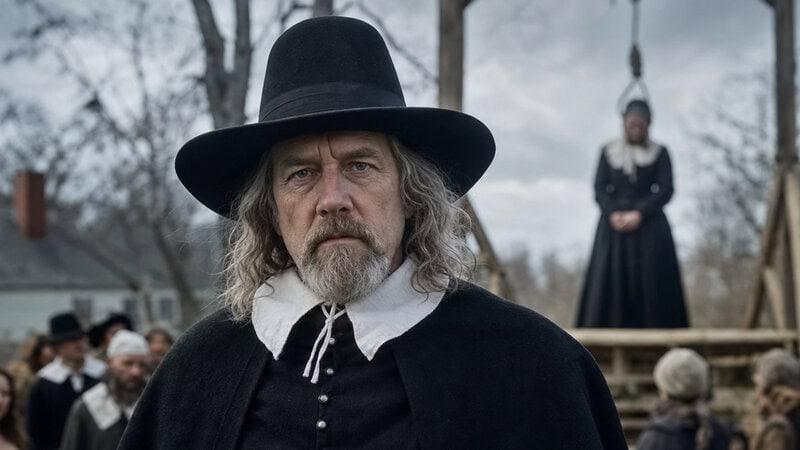

In a Massachusetts village in the winter of 1692, two children began to scream — and within months, nineteen people were dead, hanged on the word of witnesses who claimed to have been tormented by invisible spirits. The story of the Salem witch trials is not simply a tale of superstition gone wrong; it is a precise, datable catastrophe built on a legal standard so flawed that one of the judges who enforced it would spend the rest of his life in public penance. Understanding exactly how that catastrophe unfolded — step by institutional step — is the only way to understand why it has never stopped being relevant.
February 1692: Two Girls Fall Ill and a Puritan Village Starts Looking for Answers
It began with a nine-year-old’s convulsions. Betty Parris and her cousin Abigail Williams — both living in the household of the Reverend Samuel Parris in Salem Village, Massachusetts — began suffering fits, screaming, and contorting their bodies in ways that baffled every physician who examined them. The village doctor, William Griggs, offered the diagnosis that the community was already reaching on its own: the girls were under an “evil hand.” In a Puritan community where God and the Devil were understood to be active, present forces in daily life, the absence of a medical explanation pointed, almost inevitably, toward the supernatural.
Reverend Parris accepted the verdict his congregation had already reached: witchcraft was at work. Modern historians have been considerably less certain. Theories proposed over the centuries to explain what really happened include ergot fungus poisoning — a mold that grows on rye grain and can cause hallucinations and violent convulsions — as well as encephalitis, post-traumatic stress rooted in the violent instability of frontier Massachusetts, and outright deliberate fraud. The full range of causes may never be definitively settled, but the community’s certainty in 1692 allowed no such ambiguity. That certainty was the first institutional failure — and it cascaded from there.
Late February 1692: The First Three Accused Are Named — and One Confesses

When the girls were pressed to name the source of their torment, they named three women on the margins of Salem Village society: Sarah Good, a homeless beggar widely regarded as disagreeable; Sarah Osborne, an elderly woman who had stopped attending church and was enmeshed in a property dispute with the Parris family’s supporters; and Tituba, an enslaved woman from Barbados who worked in the Parris household. The choice of targets was not random — all three were social outcasts whose marginalization made them easy to believe guilty and difficult to defend.
Good and Osborne denied everything. Tituba did not. Under what was almost certainly intense coercion — possibly including physical pressure from Parris himself, though this remains disputed — she gave authorities exactly what they were looking for: a vivid, sprawling confession in which she described signing the Devil’s book alongside other witches whose names she had not yet revealed. Whether Tituba was attempting to protect herself, telling interrogators what they clearly wanted to hear, or operating under genuine duress, the strategic effect of her confession was the same.
That confession was the accelerant. By transforming the accusation from a contained local matter into a conspiracy of unknown size, Tituba’s testimony ensured that the questioning would not stop at three. Sarah Osborne would die in prison in May 1692 before she ever stood trial — the first of several accused who perished while awaiting a court that moved far too slowly for the jails filling around it.
Spring 1692: ‘Spectral Evidence’ Becomes the Courtroom’s Most Dangerous Tool
As the accusations multiplied through the spring, the legal framework that would doom the accused took shape around a concept called spectral evidence. Under this standard, a witness could testify that the specter — the spirit or apparition — of the accused had visited them in dreams or visions and caused them physical suffering. The defendant had no way to disprove it. You cannot cross-examine a hallucination, and you cannot produce an alibi against a spirit.
The theological logic underpinning spectral evidence was, within its own terms, internally coherent: Puritan doctrine held that the Devil could not assume an innocent person’s shape without that person’s consent. Therefore, if your specter appeared to torment someone, you must have invited it to do so. The influential Puritan minister Cotton Mather publicly endorsed this reasoning, lending it the weight of religious authority even as a fellow minister, Thomas Brattle, would later write a scathing letter condemning the trials’ methods. The trap was structurally perfect — accusation and guilt were, by definition, the same thing, and every denial by the accused could be read as further evidence of cunning deception.
It is worth noting that even within the Puritan theological tradition, spectral evidence was contested. Increase Mather — Cotton Mather’s own father and one of the most prominent ministers in Massachusetts — would eventually argue in his 1693 treatise Cases of Conscience that it was better for ten guilty witches to escape than for one innocent person to be condemned. That caution arrived too late for the nineteen who had already hanged.
June 1692: The Court of Oyer and Terminer Opens — and Immediately Sentences Its First Victim

By early summer, the jails were overflowing with the accused. Governor William Phips, newly arrived from England with a fresh colonial charter, responded by establishing a special tribunal — the Court of Oyer and Terminer, from the Anglo-French phrase meaning “to hear and determine” — designed to process the backlog. He appointed nine judges, with Lieutenant Governor William Stoughton serving as chief judge. Stoughton was not a trained lawyer; he was a Puritan hardliner, and he ran the court accordingly.
The tribunal’s first defendant was Bridget Bishop, a twice-married tavern keeper who had weathered witchcraft rumors for years before the court finally caught up with her. She was convicted largely on spectral testimony, along with physical evidence of dubious value — rag dolls with pins stuck in them, allegedly found in her cellar walls during a search. She was hanged on June 10, 1692, on the hill that would come to be known as Gallows Hill.
Bishop’s execution was not an aberration; it was a template. The court had demonstrated that spectral evidence alone was sufficient to send a person to the gallows, and the machinery of prosecution — the accusers, the judges, the theological framework — was now fully operational. The formal period of prosecutions had begun, and it would not stop for months.
July-September 1692: The Gallows Hill Executions Reach Their Deadliest Peak

Nineteen people in total were hanged during the Salem witch trials, and the great majority of those deaths were concentrated in the brutal three-month stretch between July and September of 1692. Five were hanged on a single day — August 19 — including George Burroughs, a former minister of Salem Village whose presence on the condemned list was particularly significant. As a man, a minister, and someone with genuine community standing, Burroughs represented a dangerous expansion of the profile of the accused beyond the usual social margins.
Standing on the scaffold, Burroughs recited the Lord’s Prayer without a single stumble. This mattered: witches, common belief held, were incapable of performing that feat. The crowd was visibly shaken, and there were calls to spare him. Cotton Mather, mounted on horseback at the execution site, addressed the crowd and argued that the Devil was capable of transforming himself into an angel of light — that Burroughs’s perfect recitation was itself suspicious. Burroughs hanged.
The most singular death of the entire crisis came on September 19, when Giles Corey — an elderly farmer who had refused to enter any plea, thereby denying the court jurisdiction over him — was pressed to death beneath heavy stones over the course of two days. Under English law, a defendant who refused to plead could be subjected to peine forte et dure, a process of pressing designed to compel a plea. Corey never gave one. It remains the only execution of its kind in American colonial history. According to tradition, when the sheriff demanded a plea, Corey’s only response was to ask for more weight.
October 1692: Governor Phips Dissolves the Court After the Accusations Reach the Powerful

The machinery of accusation had always depended on the social distance between the accused and those with the power to stop it. That distance collapsed in the autumn of 1692. The circle of suspicion had widened to include people of genuine standing — among them the wife of Nathaniel Saltonstall, who had resigned from the court in protest, and, by some contemporaneous accounts, Lady Mary Phips, the governor’s own wife. Whether Lady Phips was formally accused or merely named in informal accusations remains a matter of some historical debate, but the political pressure on the governor was now unmistakable.
Phips moved quickly. In October, he issued an order barring spectral evidence from serving as the primary proof in any witch trial — a ruling that effectively dismantled the prosecution’s central weapon and implicitly acknowledged that the court had been operating on a fatally compromised standard. He then dissolved the Court of Oyer and Terminer entirely. In its place, a Superior Court of Judicature was established under stricter evidentiary rules, and it acquitted or reprieved nearly every defendant still awaiting judgment. The court that had sent nineteen people to the gallows was gone, but the damage it had done was not.
May 1693: The Last Prisoners Are Released and the Formal Trials End

In May 1693, Governor Phips issued a general pardon, and the last of the accused still held in Massachusetts jails walked free — some of them after more than a year of imprisonment without trial. The scale of what had happened was staggering. More than 200 people had been accused during the approximately fifteen months of the crisis. Beyond the nineteen hanged, at least five more had died in prison while awaiting hearings that came too late, including Sarah Osborne and an infant born to a jailed mother.
Freedom, when it came, carried no compensation. Survivors returned to farms that had fallen apart in their absence, to communities that still regarded them with suspicion, and to legal reputations that remained officially blighted by the taint of accusation. The pardon ended the imprisonment; it did nothing to restore what had been taken. For many families, the economic ruin proved permanent. The social stigma attached to surviving accusation was, in some cases, nearly as destructive as conviction.
1697: Judge Samuel Sewall Stands in Church and Publicly Begs Forgiveness

Five years after Gallows Hill, on January 14, 1697 — a day Massachusetts had set aside for public fasting and reflection on the trials — Samuel Sewall did something almost without precedent among the powerful: he stood up to be judged. One of the nine judges who had served on the Court of Oyer and Terminer, Sewall handed a written statement to his minister, Samuel Willard, and then stood in silence before his South Church congregation in Boston as the words were read aloud. The statement accepted personal blame and shame for the sentences carried out under that court. He asked God, and his neighbors, for forgiveness.
The public apology Sewall offered was unique among his fellow judges — no other member of the court made a personal, public reckoning of that kind. He went further still, observing a private day of fasting and prayer on the anniversary of the trials every year for the rest of his life. Chief Judge William Stoughton, by contrast — the man most directly responsible for the aggressive conduct of the prosecution, and the judge who had refused to reprieve defendants even when Governor Phips intervened — never apologized, never expressed public doubt, and continued to serve as a respected figure in Massachusetts public life until his death in 1701. The contrast between the two men remains one of the sharpest moral illustrations the episode produced.
1702-1711: The Massachusetts Assembly Declares the Trials Unlawful and Pays Reparations

The colonial government moved toward accountability slowly and incompletely. In 1702, the General Court of Massachusetts officially declared the 1692 trials unlawful — the nearest the legislature came to calling them what critics, survivors, and the bereaved had long argued they were. Nine years later, in 1711, the assembly passed a bill formally reversing the attainders — the legal judgments of guilt — against twenty-two of the condemned and awarded £578 12s in reparations to survivors and heirs. The sum was a gesture of acknowledgment, not restitution; it could not repay years of lost labor, lost land, or lost life.
The legal disgrace of attainder proved remarkably durable even after that partial reversal. Ann Pudeator and five other victims were not formally exonerated by the state of Massachusetts until 1957. The final names on the condemned list were not officially cleared until 2001, more than three centuries after the hangings. The trials had cast a legal shadow that outlasted everyone who had lived through them.
The Long Legacy: How Salem’s Spectral Evidence Shaped American Legal Thought
Salem did not merely haunt American culture — it educated American law. The trials became a foundational cautionary tale about the catastrophic consequences of convicting on intangible, unfalsifiable testimony. The specific failure of spectral evidence — that it inverted the burden of proof, demanding that defendants disprove something they could not even see or touch — helped reinforce the opposite principle in Anglo-American jurisprudence: guilt must be proven by the prosecution through demonstrable evidence, not assumed from a defendant’s inability to refute an accusation that exists only in another person’s testimony about a dream.
The phrase “spectral evidence” entered the broader cultural and legal vocabulary as shorthand for any charge that cannot be tested or answered — and it has been invoked in twentieth-century analyses of McCarthyism, in psychological research on the unreliability of eyewitness testimony, and in debates over how courts should treat coerced confessions. Arthur Miller’s 1953 play The Crucible, written explicitly as an allegory for McCarthyite persecution, ensured that the trials remained a living reference point in American political discourse rather than simply a historical curiosity. The mechanism Miller identified — that an accusation made in the right atmosphere of fear carries the presumptive force of proof — is the mechanism that Salem demonstrated first.
What happened in Salem between 1692 and 1693 was not an accident of ignorance. It was a failure of institutions — courts, clergy, and a governor who had the power to stop it and, for the most part, chose not to act until the accusations reached people who mattered to them. The trials endure as a warning that the machinery of justice, once pointed in the wrong direction, does not correct itself. It requires someone with standing, and the moral courage to spend that standing, to reverse it — and in Salem, that person arrived far too late for nineteen of the people who needed them.

 Arabic
 French
 Spanish
 Portuguese
 Deutsch
 Turkish
 Dutch
Dutch
 Italiano
 Russian
 Romaian
 Portuguese (Brazil)
 Greek
Greek