


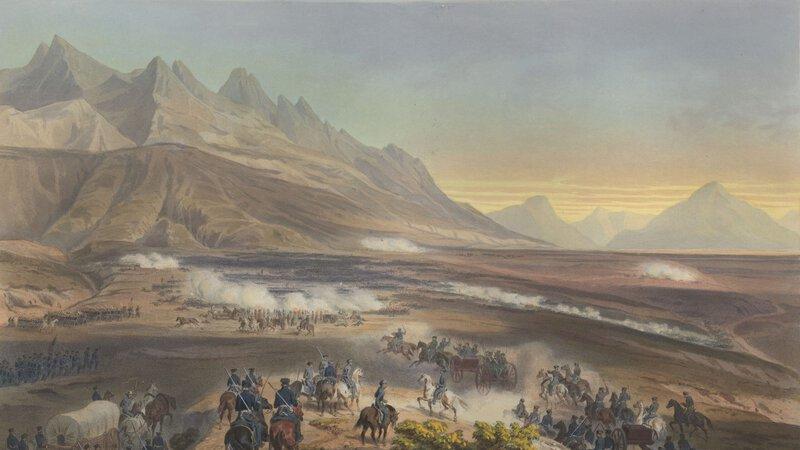

In his memoirs, written as he was dying of throat cancer and racing to finish before the end, Ulysses S. Grant called the Mexican-American War “one of the most unjust ever waged by a stronger against a weaker nation.” The confession carries a particular weight: Grant had fought in that war as a young lieutenant, watched men die on both sides of it, and would spend the rest of his life convinced that the Civil War — the bloodiest conflict in American history — was God’s punishment for what his country had done to Mexico.
A War That Shaped a Generation of Commanders

Grant was not alone in his unease, or in his debt to that conflict. Robert E. Lee served in the same war as a celebrated engineer officer, scouting routes through volcanic rock and swamp that allowed General Winfield Scott’s army to outflank Mexican defenses again and again. The war sharpened both men — their eye for terrain, their nerve under fire, their instinct for when to strike and when to wait. When they finally faced each other across the killing fields of the Civil War, from the Wilderness to Appomattox, they were applying lessons learned together in Mexico.
The irony is almost unbearable. A war that Grant condemned as an act of national aggression became the training ground for America’s most consequential military generation. And the stakes of that war were enormous. By the time the guns fell silent in 1848, the United States had absorbed what is now California, Nevada, Utah, Arizona, New Mexico, and portions of Colorado and Wyoming — a transformation of the map so vast it reshaped the continent and, as it turned out, the nation’s soul. Understanding the history of the Mexican-American War means understanding how the America we recognize today was forged, and at what cost.
The Spark: Texas, Annexation, and a Border Nobody Agreed On

The roots of the conflict stretch back to 1836, when Texas declared independence from Mexico following the Battle of San Jacinto. Mexico never formally recognized the breakaway Republic of Texas, treating it as a rebellious province rather than a sovereign nation. For nearly a decade, Texas existed in an uneasy limbo — independent on paper, contested in practice. When the United States annexed Texas in 1845, it did not just absorb a new state. It inherited a poisonous border dispute that had been waiting to explode.
The question was deceptively simple and politically volcanic: where exactly did Texas end and Mexico begin? The United States claimed the Rio Grande as the boundary. Mexico insisted the true border was the Nueces River, roughly 150 miles to the north. That strip of disputed scrubland between the two rivers would become the match that lit the war.
President James K. Polk, an aggressive expansionist who had campaigned partly on territorial ambitions and had his eye firmly on California, ordered General Zachary Taylor to march troops into that disputed zone. From Mexico’s perspective, this was not a border patrol — it was an invasion. On April 25, 1846, Mexican cavalry crossed the Rio Grande and skirmished with Taylor’s patrol. Polk rushed to Congress with the message that “American blood had been shed on American soil.”
A freshman congressman from Illinois named Abraham Lincoln publicly demanded that Polk identify the exact spot where the alleged attack had occurred — his so-called “spot resolutions” — charging that the entire premise was a manufactured justification for a war of conquest. Lincoln was largely ignored. The war resolution passed by wide margins in both chambers.
Two Fronts, One Ambition: How the War Was Actually Fought

The Mexican-American War unfolded across a theater of operations so large it strains the imagination. Zachary Taylor pushed south into northern Mexico, winning hard-fought battles at Monterrey and Buena Vista that made him a national hero and, eventually, a president. Meanwhile, a separate column under Colonel Stephen Kearny marched west across the desert to seize Santa Fe, then pressed on to California, where naval forces and the controversial explorer John C. Frémont had already helped ignite the Bear Flag Revolt — a ragged uprising that handed the United States a foothold on the Pacific coast before the formal war had fully found its footing.
But the campaign that decided the war was Winfield Scott’s audacious amphibious landing at Veracruz in March 1847. Scott put nearly 13,000 men ashore on the Gulf Coast — the largest American amphibious operation to that point in history — and then drove inland along a route that deliberately echoed Hernán Cortés’s sixteenth-century march of conquest. His engineers, Lee chief among them, found passages through the mountains that Mexican commanders believed impassable. Scott’s army fought its way through Cerro Gordo, Contreras, and Churubusco before reaching the gates of Mexico City itself.
The final major battle came at Chapultepec Castle, a military academy perched on a rocky hill at the edge of the capital. The young Mexican cadets who defended it became the Niños Héroes — national martyrs whose memory Mexico still honors every September 13th. Historical accounts differ on the precise details of their last stand, but their courage in defense of the castle passed quickly into legend. Chapultepec fell on September 13, 1847. Days later, Scott’s forces marched into the Plaza de la Constitución.
The roster of officers who served in that campaign reads like a preview of catastrophe. Grant, Lee, George McClellan, Thomas Jackson, Jefferson Davis, Pierre G.T. Beauregard, George Meade — the officers who refined their craft in Mexico would face each other across a divided continent within fifteen years. Scott himself became the architect of the Union’s early strategic thinking. The war was, in retrospect, an extraordinarily violent officer training program for the conflict that would nearly destroy the republic.
The Price of Victory: $15 Million and Half a Continent

The Treaty of Guadalupe Hidalgo, signed on February 2, 1848, brought the fighting to a formal close. Under its terms, the United States paid Mexico $15 million — and assumed American citizens’ existing financial claims against the Mexican government — in exchange for an almost incomprehensible transfer of land. The Mexican Cession of 1848 encompassed approximately 525,000 square miles: the future states of California, Nevada, and Utah, most of Arizona, and large portions of New Mexico, Colorado, and Wyoming.
Combined with the Texas annexation, the war added territory equal to roughly one-third of the present-day continental United States — the single largest land acquisition since Thomas Jefferson purchased Louisiana from Napoleon in 1803. In less than two years of fighting, the United States had become a two-ocean nation stretching from the Atlantic to the Pacific.
The treaty also included a significant promise: Mexican citizens living in the newly ceded territories would receive the full rights of American citizenship, their property and culture protected under law. It was a solemn guarantee. It would be systematically broken within a generation, as Mexican landowners found their titles challenged in unfamiliar courts, their communities marginalized, and their legal rights honored more in word than in deed.
What Mexico Lost — and Never Forgot

Mexico entered the war already deeply fractured. The country cycled through multiple presidents during the conflict, its political class consumed by factional warfare even as foreign armies marched toward the capital. The defeat deepened a wound that had never fully healed. More than half the country’s territory was gone — ceded to the same expansionist neighbor whose settlers had flooded into Texas, destabilized its government, and provided the pretext for war.
The cruelest twist came almost immediately after the ink dried on the treaty. In January 1848 — weeks before the peace was formally signed — a carpenter named James Marshall found gold at Sutter’s Mill in the Sierra Nevada foothills. The California Gold Rush of 1849 transformed the West with staggering speed, drawing hundreds of thousands of fortune-seekers from around the world and generating economic momentum that helped define American prosperity for decades. The territory Mexico had just ceded was sitting on one of the richest gold deposits in the world.
For the Mexican communities who had lived in California, New Mexico, and the other ceded territories, the transition was disorienting and often brutal. Overnight, they were legally American citizens in lands their families had farmed and ranched for generations — yet they found themselves treated as foreigners, their language suspect, their land titles vulnerable, their political voice marginal. The precedent set for contested belonging would echo through the Chicano civil rights movement a century later, when Mexican-Americans fighting for equality in the American Southwest were, in essence, demanding that the promises of 1848 finally be honored.
In Mexico, the conflict is taught not as the Mexican-American War but as la invasión estadounidense — the American invasion. That framing is not mere propaganda. It is a description of how the war looked, and still looks, from the other side of the Rio Grande.
The War That Made the Civil War Inevitable

Almost before the victory celebrations had ended, the new territory tore the country apart along the fault line it had tried for decades to ignore. In 1846, Pennsylvania congressman David Wilmot introduced a provision that would ban slavery from any land acquired from Mexico. The Wilmot Proviso passed the House of Representatives twice. It died in the Senate both times. The pattern revealed something unavoidable: the nation was too divided on slavery to agree on what to do with its own conquest.
The Compromise of 1850 attempted to paper over the crisis. California entered the Union as a free state. The remaining Mexican Cession territories were left to “popular sovereignty” — letting settlers vote on whether to permit slavery — a formula that sounded democratic and proved catastrophic, producing the guerrilla violence of “Bleeding Kansas” within a few years. The compromise bought time. It did not buy peace.
Grant, in his memoirs, was explicit: the Civil War was in his view a direct consequence — even a divine punishment — for the Mexican-American War. A nation that had taken land through aggression was then condemned to fight, at staggering cost in blood, over the moral terms of that seizure. The generals who had learned to move armies through mountain passes and breach fortified cities in Mexico turned those skills on each other at Antietam, Fredericksburg, and Cold Harbor. The war with Mexico was, in every practical sense, a rehearsal for American fratricide.
The Longer Shadow: Foreign Policy and Unresolved Promises
Scholars and critics of American foreign policy have long noted that the Mexican-American War established a template that would reappear in later conflicts: a disputed incident on contested ground, used to justify war; a swift military victory; a peace treaty that locked in territorial and strategic gains. The pattern surfaced again in 1898, when the explosion of the USS Maine in Havana Harbor became the catalyst for a war that handed the United States Cuba, Puerto Rico, and the Philippines.
The domestic consequences proved equally durable. Primary sources and scholarship on the Mexican-American War consistently show that the conflict accelerated manifest destiny from a political ideology into a hard territorial fact, stretching American sovereignty to the Pacific and making the republic, for the first time, a continental power in the fullest sense. Every border crossing between the United States and Mexico, every Spanish place name from San Francisco to Tucson to Sacramento, is a quiet artifact of what happened between 1846 and 1848.
The legal promises embedded in the Treaty of Guadalupe Hidalgo regarding land rights and citizenship for former Mexican nationals generated litigation and political conflict that persisted for well over a century. Land grant disputes in New Mexico and California were still being contested in federal courts decades after the war ended. The treaty’s guarantees became a touchstone for Chicano activists in the 1960s and 1970s, who argued that the United States had never fully honored the obligations it had accepted as part of the price of conquest.
The Map We Live On Today
Perhaps the most haunting legacy belongs to the men who fought the war and never stopped reckoning with it. Grant accepted Lee’s surrender at Appomattox Court House on April 9, 1865 — one of the most consequential moments in American history. Both men had been shaped, technically and morally, by the same earlier conflict. Grant believed the two wars were inseparable: that the wound of the Civil War had been opened on a contested riverbank in Texas in April 1846, the moment a nation chose the appetite for land over the harder discipline of principle.
He spent his final months writing it all down, racing his illness to finish his memoirs, determined that Americans would understand what expansion had cost — and where the reckoning had really begun. The Mexican-American War’s military and political legacy did not end at Appomattox, or at the signing table in Guadalupe Hidalgo. It persists in state lines drawn across former ranchos, in the demographics and politics of the American Southwest, and in the ongoing argument — now nearly two centuries old — over what the United States owes to the people and the nation it displaced to build the country we know today.

 English
 Arabic
 French
 Spanish
 Portuguese
 Deutsch
 Turkish
 Dutch
Dutch
 Russian
 Romaian
 Portuguese (Brazil)
 Greek
Greek