


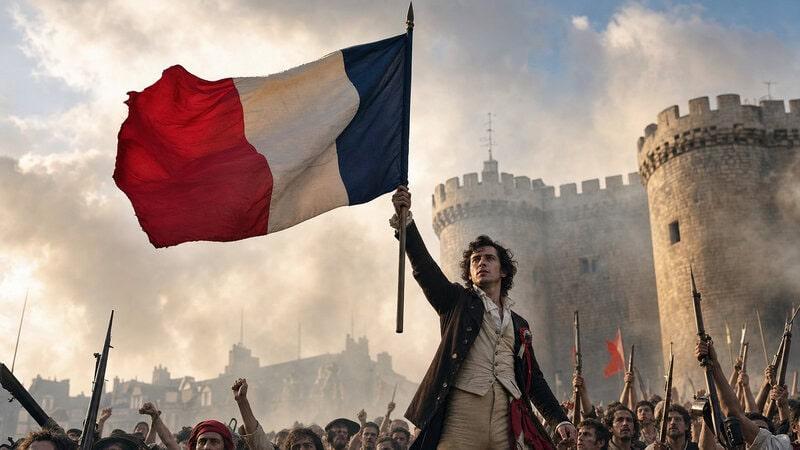

On the night of July 17, 1789, Paris was still smoldering. The Bastille had fallen three days earlier, the king’s troops had melted back from the city gates, and a new and terrifying question hung over every courtyard and café: what, exactly, had just been born? The answer came not from a committee or a manifesto, but from a hasty pinning of colored ribbons — an improvised gesture that would lock three stripes of cloth into history for the next two and a half centuries.
The Night a Flag Was Born in Crisis

When the Marquis de Lafayette and the newly installed mayor of Paris, Jean-Sylvain Bailly, met with a shaken King Louis XVI in the days after the Bastille’s fall, the city needed a symbol fast. What emerged from that charged encounter was a cockade — a rosette of ribbon pinned to a hat — combining the blue and red of the Paris city militia with the white of the Bourbon royal house. It was not a design session. It was a political emergency, and the choice of colors was less a statement of principle than a desperate bid to keep the king and the city from flying apart entirely.
The cockade spread through Paris almost overnight. Citizens pinned it to their coats, soldiers tucked it into their hats, and within days it had become the visible badge of the Revolution. What looks today like an inevitable national symbol was, in those first weeks, a chaotic experiment in cloth and dye — three colors that might easily have been arranged differently, or replaced altogether, if the political winds had shifted even slightly.
What the Colors Actually Meant — and to Whom

To understand why the French tricolor carries the weight it does, you have to understand what each stripe said to the people who first saw it. Blue and red were the ancient livery colors of Paris, worn by the city’s own militia guards — colors that announced, unmistakably, that this belonged to the people of the capital, not to the court at Versailles. They were the colors of the city, and in 1789, the city was the Revolution.
White was something else entirely. For centuries it had been the color of the Bourbon dynasty, the hue of the king’s standard and his naval ensign. Its inclusion in the cockade was not an aesthetic choice — it was a political bargain. By placing the royal white between the Parisian blue and red, Lafayette and Bailly were, in effect, proposing a compromise: the monarchy would remain, but it would be hemmed in, sandwiched between the sovereign people on either side.
That negotiation is why France’s flag meaning runs so much deeper than decoration. Each stripe was a conversation between the old world and the new, between a king who still sat on his throne and a city that had just stormed its most infamous prison. The cockade, scaled up and made to fly over armies and assemblies, became the flag — but it never lost that original tension stitched into its fabric.
The Messy Early Versions Nobody Remembers

The tricolor we recognize today — three equal vertical bands of blue, white, and red — was not the first version, or even the most common version, in the early years of the Revolution. Between 1789 and 1794, the revolutionary French flag was less a single design than a turbulent category, and what flew over regiments and assemblies varied enormously depending on who was doing the flying and what point they wanted to make.
Some early flags used horizontal bands rather than vertical ones — a format equally common across Europe at the time and just as natural to contemporary eyes. Others placed the colors in different sequences, or allowed white such a dominant presence that the result looked alarmingly close to the old royal standard. Individual regiments and militias improvised freely, and the result was a patchwork of revolutionary symbolism that reflected, in its very incoherence, the instability of the Revolution itself.
Every faction wanted the cloth to say something different. The more radical revolutionaries wanted to minimize or eliminate the white entirely, erasing the monarchist reading. Moderates argued that white was now neutral, that it simply stood between two civic colors. The vertical stripe format that ultimately survived was not self-evident — it won out through a combination of practical circumstance and political attrition, not because anyone sat down and decided it was obviously correct.
1794: The Republic Locks It In

The chaos resolved itself, as so much of the Revolution did, through a decisive act of institutional force. In 1794, the National Convention officially codified the tricolor: blue at the hoist, white in the center, red at the fly. The decree was brief and bureaucratic in its language, but what it accomplished was fixing the design that would endure for more than two centuries.
The timing carries its own grim irony. By 1794, Louis XVI had been dead for more than a year, guillotined in January 1793. The white stripe that had been placed in the cockade as a gesture toward the monarchy now floated over a republic that had executed its king. Its monarchist reading had been stripped away by force of circumstance, and in its place the three colors were reinterpreted as the values of the new order: Liberty, Equality, Fraternity. A symbol born from royal compromise was officially adopted after that compromise had been violently dissolved.
The Ideas Sewn Into the Fabric

What made the French tricolor genuinely new in the world was not its colors or even its arrangement, but the claim being made about what a flag could mean. Revolutionary orators and pamphlets consciously loaded the tricolor with the values of the Enlightenment — popular sovereignty, civic equality, the idea that government derived its legitimacy from the people rather than from God or dynasty. The flag became an emblem of the Republic’s founding principles, a portable, visible argument that the old order was finished.
Soldiers were told, explicitly and repeatedly, that they fought for the flag’s meaning — for liberty and the nation — rather than for a king’s honor or a landlord’s command. This was a psychological shift of enormous consequence. It changed how armies motivated themselves, how officers explained sacrifice to their men, and ultimately how wars in the modern world would be fought and understood. The tricolor was propaganda in the fullest and most serious sense: a piece of cloth that carried an entire theory of legitimate power.
- Blue — one of the two historic livery colors of Paris, associated in revolutionary readings with liberty
- White — originally the Bourbon royal color, reinterpreted after the monarchy’s fall as standing for equality under the republic
- Red — the second livery color of Paris’s militia, linked in revolutionary rhetoric to fraternity and civic sacrifice
It is worth noting that these associations — liberty, equality, fraternity — were applied to the stripes retrospectively and inconsistently; no single authoritative decree assigned one value to each color. The flag’s power lay less in a fixed code than in its openness to whatever the Republic needed it to say.
How the French Tricolor Rewrote the World’s Flags

Within decades of the Convention’s 1794 decree, the French tricolor’s basic grammar had become a global template. Italy, Ireland, Belgium, Romania, and dozens of other nations adopted vertical or horizontal tricolor formats directly inspired by the French model. The logic spread partly through Napoleon’s armies, which carried the tricolor across the continent, and partly through the force of the underlying idea — that a republic deserved a flag as proud and legible as any monarch’s standard.
The influence was not always direct imitation. Sometimes it was the grammar that traveled: three colors, strong geometry, stripes that announced a political principle rather than a bloodline or a religion. The French tricolor’s reach into the world’s vexillological imagination is difficult to overstate. When people across Europe began asking what France’s flag stood for, they were really asking what kind of country France claimed to be — and the answer inspired adaptation from Dublin to Bucharest.
Even flags that bear no obvious visual resemblance to France’s often owe their basic design logic to the Paris model. The idea that a flag should stand for principles rather than persons, for a nation rather than a ruler, is so deeply embedded in modern flag design that it is easy to forget it had to be invented somewhere, by someone, under pressure, in the summer of 1789.
The Flag That Outlasted the Revolution
The tricolor’s durability was tested almost immediately. When the Bourbon monarchy was restored in 1814 and again after Napoleon’s final defeat in 1815, the returning royalists swept away the tricolor and reinstated the all-white Bourbon standard, as if erasing the flag could erase what it stood for. They were wrong. The July Revolution of 1830 brought the tricolor back within days of the fighting, and this time it did not come down again.
What the Restoration had accidentally demonstrated was how completely the tricolor had become identified with France itself, rather than with any particular regime. Through republic, empire, restored monarchy, and republic again, the three stripes were the flag that every faction fought to claim. Bonapartists flew it. Republicans died for it. Even conservatives who had no love for the Revolution’s excesses found themselves unable to govern a France that was flying a white flag once more.
Today the tricolor flies from every mairie and French embassy in the world, its proportions essentially unchanged from the Convention’s 1794 decree, making it one of the most continuously used national flag designs on earth. The stripes are equal in width, the colors are fixed, and the order — blue at the hoist, white at the center, red at the fly — is exactly what the National Convention settled on during the most violent chapter of the Revolution.
A piece of cloth stitched together in political panic on a July night, improvised from militia livery and royal tradition and the urgent need to stop a city from tearing itself apart — that cloth is still flying. It is still telling the world, in the only language a flag knows, what France believes about itself: that it belongs to its people, that principles matter more than dynasties, and that sometimes the most permanent things are made in the most desperate hours.

 English
 Arabic
 French
 Portuguese
 Deutsch
 Turkish
 Dutch
Dutch
 Italiano
 Russian
 Romaian
 Portuguese (Brazil)
 Greek
Greek