


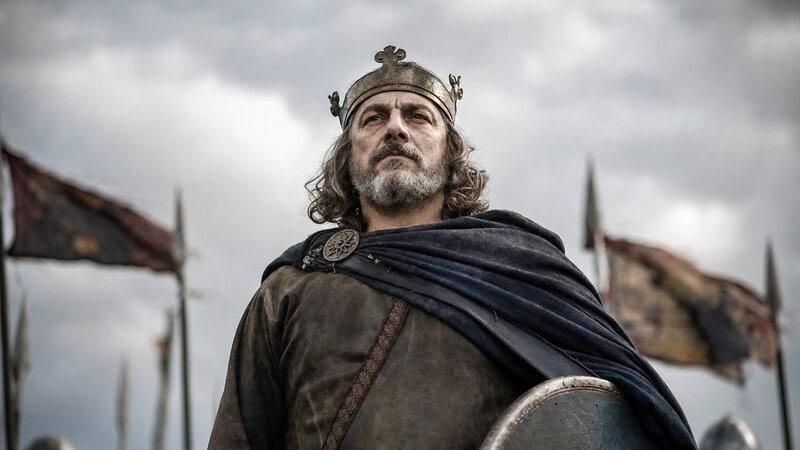

In the autumn of 829 AD, the kings of Anglo-Saxon England did something they had never done before: they knelt. At a place called Dore, on the borderland between Mercia and Northumbria, one after another they bent their necks to a single man from Wessex — a king who had spent his youth as a powerless exile and his middle age as a methodical conqueror. His name was Ecgberht, and in that moment, something that would one day be called England flickered into existence.
The Man Behind the Character — and Where the Show Goes Wrong
Millions of viewers met this king as Linus Roache’s silver-tongued, philosophically restless Ecbert in the History Channel’s Vikings — a man who read Roman manuscripts by candlelight, debated the nature of gods with Norse raiders, and wrestled with his own conscience in a way that felt bracingly modern. It was compelling television. It was also, in almost every meaningful detail, a softened version of one of the most ruthless political operators the early medieval world produced.
The show borrowed Ecgberht’s name, his kingdom, and his towering ambition. Then it filed down every sharp edge. The real Ecgberht of Wessex was not a philosopher-king tormented by doubt. He was a patient, cold-eyed strategist who dismantled rival dynasties with the same calm efficiency a craftsman brings to a long project. His story hits harder than the fiction — because he actually won, and the cost of winning was one he never appears to have lost sleep over.
Was King Ecbert a Real Person? Yes — and His Claim to Greatness Is Unambiguous

For anyone who encountered Ecbert through the drama and wondered whether he was invented, the answer is unambiguous: Ecgberht was entirely real, meticulously documented in the Anglo-Saxon Chronicle, and consequential enough that historians still argue about how to measure his importance. He was King of Wessex from 802 until his death in 839 — a reign of thirty-seven years that reshaped the political geography of Britain more thoroughly than any ruler before him had managed.
His bloodline gave him a running start. His father was King Ealhmund of Kent, which handed the young Ecgberht a dynastic claim to the south-east of England before he had proven himself in battle — a piece of leverage the Vikings show almost entirely glosses over. Kingship in the ninth century was not simply seized by the strongest warrior; it was argued through lineage, and Ecgberht arrived with a strong argument already written into his ancestry.
What he did with that inheritance is what sets him apart. Historians credit Ecgberht as the first monarch to establish a stable and extensive dominion over all of Anglo-Saxon England — a feat that predecessors like Offa of Mercia had approached but never made permanent. The Vikings show at least gets one thing right: it frames Wessex as the preeminent English kingdom, which accurately reflects the historical reality of Ecgberht’s achievement, even if the drama compresses and rearranges the timeline around him.
Exile, Survival, and the Education of a Future Conqueror

Long before Ragnar Lothbrok sailed into any harbour, the young Ecgberht was living in someone else’s court, stripped of his kingdom and dependent on the goodwill of a foreign ruler. Driven into exile — most likely to the court of Charlemagne in Francia — he spent years absorbing something no other Anglo-Saxon ruler of his generation had access to: direct exposure to the organisational sophistication of the Frankish military machine, and the statecraft of a continental empire at its peak.
The Vikings version of Ecbert hints at this cosmopolitan depth, framing it as a personal quirk — an intellectual curiosity that sets him apart from blunter men around him. The history reveals it as something harder and more deliberate. Those years in exile were not a detour; they were the forge. When Ecgberht returned to seize Wessex in 802, he was not arriving as a romantic figure reclaiming what was rightfully his. He was a patient predator who had studied everything his enemies did not know, and waited for the precise moment to use it.
There is something the television drama never quite captures about that quality of waiting — the discipline of a man who understood that timing was as lethal as any army.
The Ruthless Campaign the Show Never Told You About

The pivot point of Ecgberht’s reign came in 825, at the Battle of Ellandun. The Mercians — who had dominated English politics for generations, bullying smaller kingdoms into submission and treating Wessex as a manageable rival — met the West Saxon army on a field that would end their era of supremacy. Ecgberht shattered them.
What followed was not celebration. It was a coordinated campaign of breathtaking speed. Ecgberht immediately dispatched his son Æthelwulf south and east, and in what amounted to a single season of warfare, Kent, Sussex, Surrey, and Essex were absorbed into the West Saxon orbit. Mercia, the power that had cast a shadow over England for a century, was effectively broken. Ecgberht offered no pause, no negotiation, no mercy to rival dynasties who might one day reassert themselves. He understood that an enemy allowed to recover is an enemy who will return.
By 829 he had marched north and received the submission of Northumbria. The Welsh kingdoms acknowledged him as overlord. The Anglo-Saxon Chronicle awarded him the title Bretwalda — wide-ruler — a designation that placed him in the company of the greatest kings the island had produced. The TV Ecbert schemes in candlelit chambers and philosophises over wine; the real Ecgberht marched, and when he marched he did not stop until there was nothing left to conquer.
You can read more about the full sweep of Ecgberht’s conquests and their lasting significance, but the bare chronology alone is remarkable: six kingdoms folded in roughly four years of sustained pressure, each one absorbed before the previous conquest had time to destabilise.
How Vikings Shaped — and Distorted — His Legacy

Linus Roache’s performance is one of the genuine pleasures of Vikings. He plays Ecbert as a man ahead of his time — curious about Norse culture, haunted by Roman civilisation, capable of enormous warmth and equally enormous treachery. The character works as drama precisely because those contradictions feel human. The problem is that they bear only a loose resemblance to the historical king.
The show invents, for instance, Ecbert’s secret massacre of a Viking farming colony — a storyline that is dramatically powerful and entirely without historical basis. It transforms Ecgberht’s relationship with Scandinavian raiders into something philosophical, even intimate. In reality, that relationship was considerably more straightforward. In 838, a Viking fleet allied with Cornish rebels in an attempt to break West Saxon power from the west. Ecgberht rode to meet them at Hingston Down and crushed both forces. There was no ambivalence in it and no lingering guilt recorded afterward.
The distortion matters because it involves a trade: the show exchanges Ecgberht’s actual achievement — the systematic, cold-blooded unification of England through dynastic calculation and military force — for a more palatable modern anti-hero arc. The real king is harder to sympathise with and far more interesting to understand. His ruthlessness was not a flaw he struggled against. It was the mechanism of everything he built.
A Further Problem: the Show’s Timeline Is Broken
There is an additional historical difficulty worth understanding clearly, because it affects how viewers interpret the entire series. The Great Heathen Army that dominates the later seasons of Vikings — the massive Scandinavian force that arrived to terrorise England and very nearly ended Anglo-Saxon civilisation — landed in 865 AD. Ecgberht had been dead for twenty-six years by then. He never faced that existential crisis. The show’s dramatic architecture, which places him in close proximity to events he could not possibly have witnessed, is one of the most significant liberties the series takes with its timeline, and it fundamentally misrepresents the historical sequence.
What Ecgberht actually faced was the opening wave of Danish coastal raids — the preliminary pressure that preceded the catastrophic storm of 865. His response was to build the political and military infrastructure that made a coherent defence of England conceivable. The unified kingship he established, however fragile it proved in the years immediately after his death, gave his grandson Alfred something to rebuild from when the Great Army finally arrived. Without Ecgberht’s groundwork, the story of Alfred the Great looks very different — perhaps it does not exist at all.
What He Left Behind — and Why It Mattered
Ecgberht’s unification did not hold cleanly. Mercia reasserted a degree of independence after his death in 839, and the neat map of English submission he had drawn crinkled at its edges almost immediately. But the idea of a single English kingship — the political imagination of a unified island — survived and proved permanent. He died the most powerful ruler the Anglo-Saxon world had yet produced, and the shape he gave England outlasted him by centuries.
That is the detail the show consistently underplays. The fictional Ecbert is memorable because he is conflicted — because the writers gave him a conscience and a capacity for self-examination that makes him sympathetic to a modern audience. The historical Ecgberht of Wessex is memorable for an almost opposite reason: he was not conflicted, and his freedom from conflict was precisely what made him effective. He identified what needed to be done and he did it, across thirty-seven years and six conquered kingdoms, without the hesitation that the drama so carefully manufactures for him.
Why the Real Ecgberht Deserves His Own Story
The Vikings version of Ecbert is good television. The historical Ecgberht of Wessex is a better story — a dynastic exile who returned to swallow six kingdoms in four years of sustained campaigning, armed with patience, continental education, and an absolute willingness to destroy any rival who stood in his way. There is no scene in the show that matches the quiet enormity of those kings kneeling at Dore: the moment a single man bent the whole island to his will through a combination of bloodline, brilliant timing, and remorseless ambition.
His ruthlessness was not incidental to his greatness. It was the engine of it. Sanitising it for modern drama — softening him into a conflicted intellectual, burdening him with a conscience that history gives no evidence he possessed — misrepresents how power actually worked in the ninth century, and what it actually cost to forge something as improbable as England from the wreckage of seven competing kingdoms.
For anyone who found King Ecbert the most compelling character in the room, the real history offers something rarer than fiction: a man who actually pulled it off. The primary sources, when you read between them, reveal a king who was stranger, harder, and more consequential than any screenwriter has yet dared to show.

 English
 Arabic
 French
 Spanish
 Portuguese
 Deutsch
 Turkish
 Italiano
 Russian
 Romaian
 Portuguese (Brazil)
 Greek
Greek