


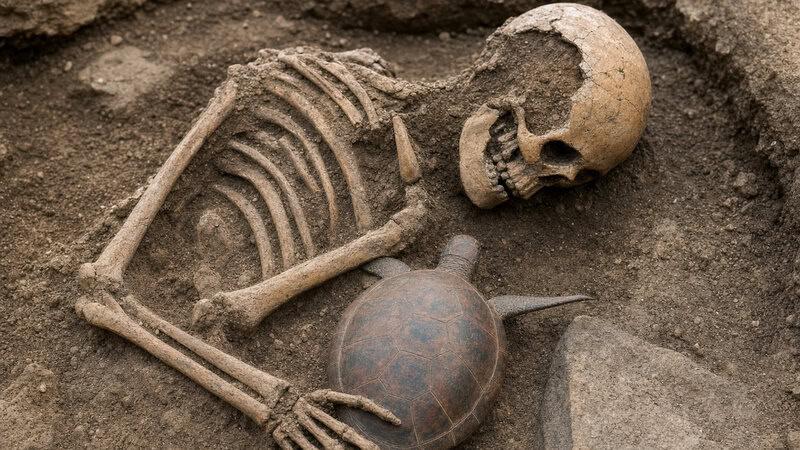

The brushes moved slowly, the way they always do when something important is emerging from the earth. And then, unmistakably, there were fingers — the curved bones of a human hand, still arranged around a ceramic vessel shaped like a sea turtle, just as they had been placed nearly three thousand years ago.
The Hand That Refused to Let Go

In an excavation trench in Antiguo Cuscatlán, El Salvador, archaeologists uncovered one of the most quietly arresting images that pre-Columbian research has produced in years: a skeleton lying face-down in ancient soil, its hands curled around a beautifully crafted ceramic turtle vessel, the grip intact after roughly 2,800 years. This is not an artifact resting in a glass museum case with a typed label beside it. This is a person, mid-gesture, frozen at the moment of burial around 850 BC, holding something that clearly mattered enough to take along to whatever came next.
The paradox at the heart of this discovery is a strange and moving one. We do not know who this person was — not their name, not their age, not the language they spoke or the community that gathered to bury them. And yet we know exactly what they were holding. We know how their body was positioned in the earth. We know what plants were laid in the pit beside them. In the silence where biography should be, a gesture speaks instead, and archaeologists are still working to understand what it says. The discovery, reported by Live Science, has drawn attention from researchers across the field — and for good reason.
Antiguo Cuscatlán: Where the Ancient World Surfaced

Antiguo Cuscatlán is not a remote jungle clearing or a wind-swept highland plateau. It is a busy municipality in the greater San Salvador metropolitan area — a place of traffic and commerce and modern life pressing in on all sides. That makes the emergence of a burial this old feel all the more remarkable, the deep past rising through the noise of the present like a hand breaking the surface of still water.
El Salvador’s Ministry of Culture announced the recovery of the remains as a methodical, officially supervised archaeological undertaking rather than an accidental construction-site stumble. That distinction matters. Careful excavation means careful documentation — every bone position recorded, every associated object logged, every organic fragment bagged and catalogued before the context that gives it meaning can be lost.
El Salvador tends to be overshadowed in the popular imagination by its larger neighbors. When people think of ancient Mesoamerica, they think of Chichen Itza, of Tikal rising above the Guatemalan canopy, of the colossal Olmec heads photographed in textbooks. El Salvador sits squarely within the same cultural corridor that produced all of those wonders, yet it receives a fraction of the archaeological attention — and, by extension, a fraction of the public fascination. Discoveries like this one are beginning to change that calculus.
To place the burial’s date in human terms: 850 BC is a world before Rome existed as a republic. It is a world in which the Hebrew Bible was still being written and compiled. To the northwest of what is now El Salvador, Olmec civilization — one of Mesoamerica’s foundational cultures — was still flourishing, its influence rippling outward through trade routes and shared symbolic vocabularies. The person buried in Antiguo Cuscatlán lived and died in that world, part of a cultural landscape far more connected and complex than older narratives of isolated societies ever acknowledged.
Face Down in the Earth: What Posture Tells Archaeologists

The skeleton was found in a prone position — face down, chest toward the soil. To a non-specialist, that detail might seem minor, a quirk of how a body ended up in the ground. To archaeologists, it is a primary data point, because intentional burials are almost never accidental in their arrangements. Someone positioned this body deliberately. The question is what that deliberateness was meant to express.
Prone burials appear across Mesoamerica and across many ancient cultures worldwide, and they carry a wide range of interpretive possibilities. In some contexts, face-down positioning has been associated with ideas of transformation — the body oriented toward the underworld, toward the earth itself, in a posture of entry rather than repose. In others, it has been linked to specific ritual or social roles, to the identity of the deceased as a particular kind of community member or practitioner. Some researchers connect prone burial to the symbolism of seeds planted in soil, the body conceived as generative rather than simply inert.
None of those readings can be confirmed here. Without written records from this time and place — and none exist — the prone position is an eloquent question mark rather than a legible sentence. But that ambiguity is itself meaningful. It tells us we are dealing with a community that had a deliberate ritual logic around death, one complex enough to make intentional choices about body orientation. Combined with what was found in those hands, the posture suggests a carefully composed scene — a set of decisions made by grieving or officiating people who knew exactly what they were doing and why.
The Turtle Vessel: Object at the Center of Everything

The ceramic vessel is the discovery’s gravitational center. Shaped to evoke a sea turtle — its rounded carapace forming the body of the container, its form immediately recognizable even after millennia in the soil — it was found cradled in the skeleton’s hands in what appears to be a deliberate embrace. The craftsmanship places it within the Usulután ceramic tradition, a distinguished pre-Hispanic pottery style characterized by a distinctive resist-painting technique that produces pale, wavy patterns against a darker background. Usulután-style ceramics are named after a region of El Salvador, and they have been found distributed across a remarkably broad Mesoamerican zone, suggesting both the quality of the tradition and the reach of the trade networks that carried its products.
This is not everyday pottery. Usulután ceramics represent a level of craft specialization that implies dedicated makers, specialized knowledge, and communities organized enough to support that specialization. The presence of such a vessel in a burial, held in the hands of the deceased, signals that this was an object of significance — not a utilitarian jar repurposed for the grave, but something chosen, perhaps something that belonged to this person in life, perhaps something made or acquired specifically for this moment.
The sea turtle itself carries enormous symbolic weight in ancient Mesoamerican thought. Turtles appear in creation narratives across multiple cultures of the region, associated with the earth floating on primordial waters and with the surface from which life emerges. The turtle’s shell was a potent image — the world’s foundation, the boundary between water and land, between the living world and whatever lies beneath it. As the Tico Times notes in its coverage of the find, the symbolic dimensions of the vessel connect this burial to a much wider web of ancient Mesoamerican belief.
Was the vessel a ritual offering, placed in the hands as a gift to accompany the dead? A personal possession of profound meaning, something the buried person had carried through life? A container that once held something organic, long since dissolved? Or — and this may be the most honest answer — all three at once, in ways that ancient minds did not necessarily separate as modern categories might? The clutching gesture is its own kind of statement. Someone decided that this person and this turtle vessel should not be parted. After 2,800 years, they have not been.
Cassava Branches and the Archaeology of the Everyday Sacred

Alongside the skeleton and the ceramic vessel, the burial pit contained remnants of cassava branches — something easy to overlook but equally telling. Plant materials are among the most fragile categories of archaeological evidence. Organic matter breaks down. Roots, leaves, and wood are consumed by soil chemistry and time in ways that ceramic and bone resist. The survival of cassava remnants across 2,800 years is, in the quiet vocabulary of fieldwork, an extraordinary stroke of preservation — and it gives researchers a window they would not otherwise have.
Cassava was a foundational crop across ancient Central America, a source of sustenance so reliable and so central to daily life that its cultural meanings ran far deeper than nutrition. In many traditions across the region, plants associated with sustenance also carried spiritual resonance — with fertility, with the cycle of planting and harvest, with death understood not as an ending but as a form of going into the ground from which new life eventually emerges. Cassava, in this context, is not just food. It is a symbol of continuation.
The combination of the ceramic turtle vessel and the cassava branches suggests a burial that was carefully, intentionally composed. Someone — the community, a specialist, the family of the deceased — assembled these elements with purpose, creating an arrangement meant to send this person into whatever followed death with specific provisions: a symbolic container shaped like the creature that held up the world, and branches from the plant that had sustained life in this place for generations. Reporting from the Philippine Daily Inquirer’s global desk underscores how widely the discovery has resonated, precisely because these human universals — caring for the dead, sending them forward with meaning — cross every cultural boundary.
What This Burial Tells Us About Pre-Columbian El Salvador

Step back from the details and the broader significance comes into focus. A burial this carefully constructed, featuring high-quality Usulután ceramics and a deliberate ritual assemblage of objects and organic material, speaks to a community at 850 BC that was already operating with developed spiritual practices, craft specialization, and a level of social organization sophisticated enough to support all of the above. This was not a simple or isolated society. It was a community embedded in the larger Mesoamerican world, participating in the trade networks, the symbolic vocabularies, and the ritual traditions of its time.
The era of 850 BC in Mesoamerica was one of long-distance exchange and cultural transmission. Ceramic styles like Usulután did not spread across hundreds of miles by accident — they traveled along routes maintained by traders, travelers, and diplomatic relationships between communities. The person buried in Antiguo Cuscatlán was part of that world, shaped by it, perhaps a participant in it in ways researchers cannot yet fully trace.
What remains unknown is a long and humbling list. The individual’s identity — their name, their gender as the community understood it, their age, their role in the social fabric — remains unconfirmed pending further analysis of the remains. The name of the community that buried them, the language they spoke, the specific beliefs that animated the ritual choices made at their graveside: all of this is silence waiting for future excavation and scholarship to begin filling in.
But El Salvador’s archaeological momentum is building. Discoveries now documented across major science outlets are reframing the country not as a peripheral zone at the edge of Mesoamerican history, but as an active, complex participant in that history’s deepest roots — a place where the ancient world is still surfacing, still insisting on being known.
Three Thousand Years Later, the Grip Still Means Something
Return, in the end, to the image that started everything. The trench. The brushes. The bones of a hand arranged around a ceramic turtle, the gesture preserved through nearly thirty centuries of darkness and soil and the slow pressure of time. Footage capturing the discovery gives some sense of what it must have felt like to stand at the edge of that trench and understand what you were looking at — a moment of contact across an almost incomprehensible span of years.
Archaeology, at its best, does not merely recover objects. It recovers intention. It finds, in the arrangements of things and bodies and organic material left in the ground, the traces of choices made by people who cared — about the person they were burying, about what that person would carry forward, about the meaning of death and what, if anything, comes after it. Someone chose this vessel. Someone chose this position. Someone laid cassava branches in the pit. Each of those choices was an act of love, or ritual, or both, performed by people who had reasons we can only partially imagine.
We will likely never know this person’s name. We will not know the word they used for the sea turtle, or the prayer — if there was a prayer — spoken over the grave as it was filled in. But we know they were buried with care. We know they were buried with meaning. We know they were buried holding a sea turtle vessel that has not left their hands in 2,800 years. That is its own kind of knowledge, incomplete and irreplaceable in equal measure.
As El Salvador’s Ministry of Culture continues its analysis of the remains and associated materials, researchers and observers following the story may yet learn more — about who this person was, what their community believed, and what the turtle vessel meant to the hands that held it. Until then, the grip endures, patient as the earth itself, waiting to give up the rest of its story.

 English
 Arabic
 Spanish
 Portuguese
 Deutsch
 Turkish
 Dutch
Dutch
 Italiano
 Russian
 Romaian
 Portuguese (Brazil)
 Greek
Greek