


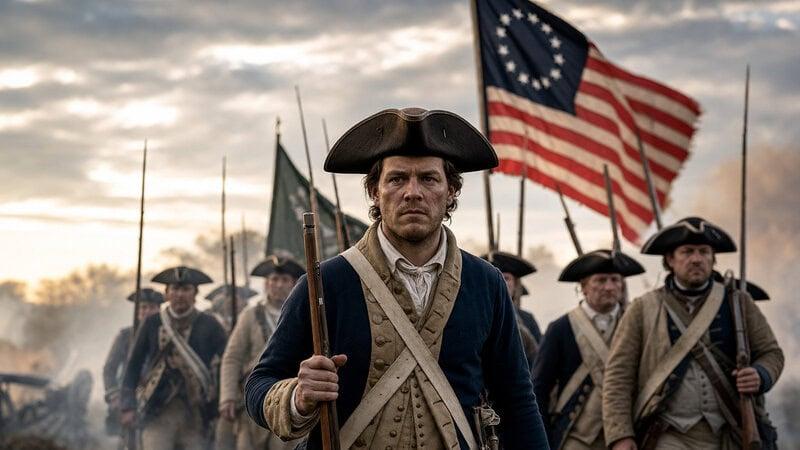

The story most Americans learn about the Revolutionary War fits neatly into a few dramatic scenes: a shot at Lexington, a freezing night at Valley Forge, a surrender at Yorktown. But the real history is stranger, bloodier, and far more complicated — full of internal divisions, global entanglements, and a commanding general who lost more battles than he won. Here are ten myths about the Revolutionary War that deserve a serious second look.
1. The Revolution Started in 1775

On the morning of April 19, 1775, militiamen and British Redcoats exchanged fire on Lexington Green, and within hours the Massachusetts countryside was in arms. It is a gripping opening scene — but it is the opening of the military war, not the revolution itself. The political struggle had been smoldering for a full decade before that first musket cracked. The Stamp Act crisis of 1765 unleashed organized colonial resistance, boycotts, and proto-revolutionary committees long before anyone loaded a flintlock in anger. The Boston Massacre in 1770, the colonial backlash against the Tea Act in 1773, and the formation of the First Continental Congress in 1774 were all chapters in a revolution already well underway.
Framing 1775 as “the beginning” also obscures how long the war itself ran. The conflict stretched from April 19, 1775 to September 3, 1783 — more than eight years of sustained fighting, far longer than the brief, decisive campaign most people picture. A struggle that consumed the better part of a decade deserves more than a single dramatic starting gun.
2. All Colonists Wanted Independence

When George Washington looked out at the population he was fighting for, he did not see a unified nation rising as one. Historians estimate that roughly one-third of colonists were active Loyalists who supported the British Crown, one-third were Patriots, and the remaining third were doing their best to stay out of the conflict entirely. That division made the Revolution as much a civil war as a war against a foreign power — neighbor against neighbor, family against family — and Washington was acutely aware that the internal threat could be as dangerous as British regulars on the battlefield. He pushed throughout the war for policies to monitor, suppress, and ultimately exile those he regarded as enemies within.
The human cost of that division was enormous. After the war ended, approximately 60,000 Loyalists were forced to flee — to Canada, Britain, or the Caribbean — in one of the largest forced migrations in early American history. As detailed in the broader history of the American Revolutionary War, Loyalists were not a fringe group of cranks. They were merchants, farmers, clergy, and judges who had made a different calculation about where safety and legitimacy lay, and who paid for it with everything they owned.
3. The War Was Fought Almost Entirely in the Thirteen Colonies

Most popular accounts of the Revolutionary War are resolutely local — Concord, Saratoga, Yorktown — but Britain was a global empire, and when France, Spain, and the Netherlands entered the conflict against her, the war exploded across the map. Fighting extended to the Caribbean, West Africa, India, and the waters of the English Channel. This was not a colonial skirmish; it was a world war, and Britain found itself stretched dangerously thin on multiple fronts simultaneously. That strategic overextension is a core reason the Crown ultimately chose to negotiate rather than fight on.
The global dimension shaped the war’s decisive moment directly. The French naval victory at the Battle of the Chesapeake in September 1781 — fought off the Virginia capes — cut off General Cornwallis’s army at Yorktown and made his surrender inevitable. Without French sea power, the endgame of the American Revolution looks very different. The Revolutionary War’s international alliances were not a sideshow; they were the hinge on which independence turned.
4. The Revolution Was a Sudden, Spontaneous Uprising

There is a romantic version of the Revolution in which ordinary colonists, pushed past endurance, grabbed their muskets and marched. The reality was slower, more deliberate, and in many ways more impressive. Colonial assemblies, pamphlets, and intercolonial networks had spent years debating sovereignty, taxation without representation, and natural rights before a shot was fired. Britain’s own wavering policies — taxing, then repealing, then taxing again — fueled a slow-building conviction that the relationship with Parliament was fundamentally and irrevocably broken.
Even Thomas Paine’s electrifying Common Sense, published in January 1776, did not ignite rebellion from nothing. It crystallized and popularized arguments that colonial writers and lawyers had been making since the 1760s. The decade-long timeline of escalating tension makes clear that by the time the first shots were fired at Lexington and Concord, the ideological groundwork for independence had already been laid, brick by careful brick, for ten years.
5. Valley Forge Was a Battle

Ask most Americans what happened at Valley Forge and they will describe a terrible fight. It was terrible — but there was no battle. Valley Forge, from December 1777 through June 1778, was a winter encampment where Washington’s Continental Army endured starvation, exposure, and disease on frozen Pennsylvania hillsides, losing roughly 2,000 soldiers without a single major military engagement. The men were not dying in combat; they were dying of typhus, dysentery, and the cold.
What actually changed the war at Valley Forge was organizational. Prussian drillmaster Friedrich von Steuben arrived at the camp and spent the winter transforming a ragged, inconsistently trained force into an army capable of maneuvering and standing against British regulars in open battle. The army that marched out of Valley Forge in the spring of 1778 was measurably more professional than the one that had stumbled in. Its mythologized status as a symbol of patriotic suffering has paradoxically overshadowed the 165 principal engagements fought across the eight-year conflict — most of which go unmentioned in standard accounts of the war.
6. Yorktown Was the Last Battle of the War

When Cornwallis surrendered his army at Yorktown on October 19, 1781, a British band reportedly played “The World Turned Upside Down,” and in North America large-scale land combat was effectively over. But the war was not. Legally and militarily, the conflict continued for nearly two more years. Naval skirmishes, Caribbean campaigns, and fighting in India persisted well past Yorktown, and the Treaty of Paris was not signed until September 3, 1783 — almost two full years after the famous surrender.
Washington understood this better than almost anyone. He refused to fully disband the Continental Army during those intervening years, wary of a British reversal that his long, grinding experience told him was always possible. The man who had watched seemingly secure positions crumble at Long Island and White Plains was not about to declare victory and send his soldiers home while British troops still occupied New York City. His caution was a final expression of the strategic patience that had kept the Revolution alive through its darkest hours.
7. The Revolution Was Purely a Military Struggle
Battles matter, but the American Revolution was simultaneously a political, legal, ideological, and social upheaval. Declarations, constitutions, and pamphlets were weapons as consequential as muskets — and in some ways more durable. While Washington’s army fought in the field, the Continental Congress functioned as a parallel government, negotiating foreign alliances, issuing currency, and debating the legal architecture of a nation that did not yet fully exist. The political and military struggles were not sequential; they ran in parallel, feeding and sustaining each other throughout the conflict.
The long-term significance of that dual character is hard to overstate. Historians widely describe the American Revolution as the first successful modern colonial war of independence — a template that inspired subsequent independence movements from Latin America to Asia across the following two centuries. Understanding it as purely a military conflict misses the reason it echoed so far and so long: it was a proof of concept for self-governance, not just a battlefield victory.
8. All British Colonies in the Americas Joined the Revolution
Thirteen colonies rebelled — but Britain held far more than thirteen colonies in the Americas, and the others did not follow. Canada, Nova Scotia, Jamaica, Barbados, and other British holdings stayed out of the conflict, with some actively assisting the Crown. The reasons varied: economic dependence on Britain, large Loyalist populations, fear of what an expansionist American republic might mean for them, and fundamentally different relationships with imperial authority than the thirteen colonies had developed over the preceding decades.
Quebec was not merely a passive bystander — it was a target. Patriot military campaigns pushed north in 1775 and 1776, hoping to bring Canada into the rebellion and deny Britain a northern base of operations. The invasion failed badly, Canada remained British, and that failure shaped the continent’s political geography permanently. The story of which colonies joined the Revolution and which did not is a powerful reminder that independence was never the inevitable choice of all colonists — it was one outcome among several that were genuinely in play.
9. The Battle of Bunker Hill Was a British Defeat
Britain won the Battle of Bunker Hill on June 17, 1775 — they took the hill. But the cost was so catastrophic that “victory” barely describes it. Out of roughly 2,200 British troops engaged, more than 1,000 became casualties, a loss rate exceeding 40 percent. For context, that proportion of troops lost would horrify commanders in almost any era of warfare. The colonial militiamen, fighting from earthworks and under strict orders to conserve ammunition, inflicted punishment that shocked British officers and reverberated back to London.
The battle also carries a geographical footnote that has confused people ever since: the fighting took place mostly on nearby Breed’s Hill, not Bunker Hill — a mix-up that has persisted in popular memory for 250 years. More consequentially, the pyrrhic nature of the British “victory” delivered an early and sobering message to the Crown: suppressing this rebellion was going to cost far more than anyone in Whitehall had anticipated. That psychological jolt, dressed up as a success, was one of the first signs that the realities of the Revolutionary War on the ground would repeatedly defy official optimism on both sides of the Atlantic.
10. George Washington Was a Brilliant, Undefeated General
Washington lost more battles than he won. Long Island, Kip’s Bay, White Plains, Brandywine, Germantown — the list of defeats is long and sometimes humiliating. His most celebrated strokes, the crossing of the Delaware and the surprise attack at Trenton on December 26, 1776, were not the moves of a general operating from a position of strength. They were acts of calculated desperation: the Continental Army was on the verge of dissolution, enlistments were expiring, and Washington needed a dramatic win to halt mass desertions before the revolution simply evaporated.
His true genius was not tactical brilliance but strategic endurance. Washington’s defining achievement was keeping a fractious, underfunded, and politically divided army in the field long enough for French intervention and British war-weariness to tip the balance. It was a strategy of exhaustion rather than conquest — one that required a cold-eyed realism about his own limitations that is, in its own way, more impressive than a string of battlefield triumphs would have been. The general who knew he could not win by winning, only by refusing to lose, is a far more interesting figure than the marble statue mythology gave us.
The Revolutionary War was messier, longer, and more global than the tidy narrative most of us inherited. From the Loyalists driven into exile to the French sailors whose cannons sealed Cornwallis’s fate, the forces that produced American independence were sprawling, contingent, and often desperate. Grasping that full complexity — rather than the highlight reel — makes the improbable fact of American independence all the more remarkable.

 English
 Arabic
 Spanish
 Portuguese
 Deutsch
 Turkish
 Dutch
Dutch
 Italiano
 Russian
 Romaian
 Portuguese (Brazil)
 Greek
Greek