


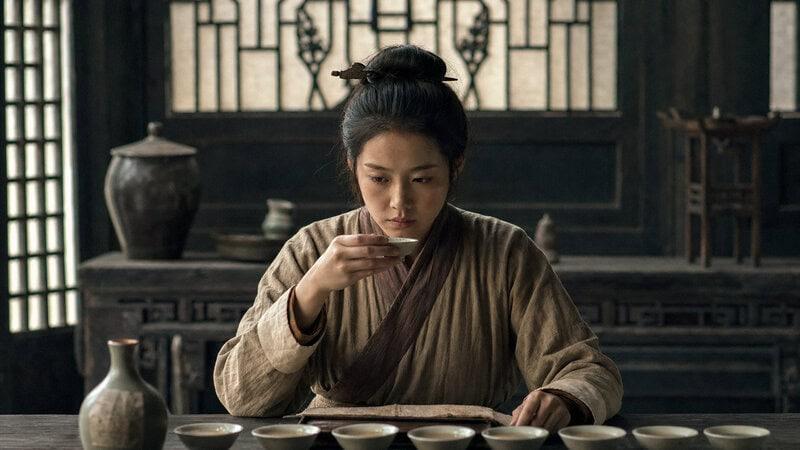

She lifts the cup slowly, watching the surface of the wine for the faint shimmer that sometimes betrays an arsenic compound dissolved within it. Her lips are already slightly numb — not from fear, but from the trace of powder she tasted an hour ago to calibrate her own sensitivity. She is not a noblewoman. She is not a physician. She is a servant, purchased and delivered to the palace like a bolt of silk, and the knowledge in her hands is the only thing keeping her alive.
The Girl Who Chose the Poison Cup

That figure — a young woman navigating the razor-thin line between useful and dangerous in an imperial court — sits at the heart of The Apothecary Diaries, the manga-turned-anime series that began airing in 2023 and quietly became one of the most discussed historical dramas of its season. Its heroine, Maomao, is the daughter of an apothecary who grew up among the healers and herbalists of the red-light district, absorbing a pharmacist’s education in place of a conventional childhood. Kidnapped and sold into servitude at the emperor’s palace, she keeps her head down and her expertise hidden — until a string of mysterious illnesses among the imperial consorts forces her hand. Her knowledge catches the eye of a handsome court official who begins tasking her with exactly the work she was born to do: tasting food for poison before it kills someone important.
Maomao can feel like an invention — a girl too clever, too driven by curiosity, too satisfyingly competent to belong to any real historical moment. But the world the series constructs around her is not a fantasy. Female healers sidelined into servitude, poison as a political instrument, specialized knowledge as a form of personal currency: these are not dramatic conveniences. They are features of a history stranger and darker than the story itself. Peel back the fictional backdrop and you find real women who held medicine and poison in the same hands, who built expertise directly from danger, and who were almost entirely written out of the record that survives.
The World Maomao Borrows From: Tang Dynasty Medicine at Its Peak

The Apothecary Diaries is set in a fictional empire, but its creators have been open about their primary source material: Tang Dynasty China, which ruled from 618 to 907 CE and represented one of the most medically sophisticated civilizations of the medieval world. The Tang imperial court was not merely wealthy — it was institutionally invested in medicine in a way that had no clear equivalent in contemporary Europe. The court maintained a formal medical bureaucracy called the Tai Yi Shu, the Imperial Medical Office, which trained, ranked, and salaried physicians, pharmacists, and herbalists as agents of the state.
The dynasty’s most significant achievement in this field came in 659 CE, when the court commissioned the Xinxiu Bencao — a pharmacopoeia cataloguing around 850 medicinal substances, produced under imperial order and distributed as an official reference text. It was the first state-sponsored pharmacopoeia in world history, predating comparable European documents by centuries. Its entries covered not just remedies but dosages, preparation methods, and contraindications — precisely the framework of knowledge that Maomao deploys in her investigations.
When the series shows Maomao calculating lethal thresholds or identifying a toxic compound by taste and symptom, it is drawing on a culture that genuinely systematized that knowledge. Her obsessive pharmacological precision is not a character quirk invented for dramatic effect. It is an echo of an actual intellectual tradition, one the Tang court paid scholars to codify and preserve.
Women in the Medicine Cabinet: Healers the History Books Almost Forgot

The official record of Tang medicine is populated by male physicians and male scholars. But the practical reality of medicine inside the imperial palace was considerably more complicated. The inner court — the hòugōng, the women’s quarters — was a space where male physicians faced severe restrictions on access. A male doctor examining an imperial consort did so under elaborate constraints, sometimes prohibited from direct physical contact entirely. This created a structural need that history filled with women.
Court records and medical texts from the Tang and Song dynasties document practitioners known as yī pó — medicine women — who served the female population of the inner palace. They were not peripheral figures. They managed the health of the most politically significant women in the empire, in a space where illness and death carried enormous dynastic consequences. Their expertise was real. Their formal status was not.
The red-light districts where Maomao’s father practiced are also historically authentic nodes of informal medical knowledge. These were communities that the official medical system largely ignored, and they generated their own networks of practitioners — midwives, herbalists, apothecaries — who served populations the court physicians would not treat. Women were often central to these networks, and the knowledge they carried was frequently transmitted through family lines: fathers to daughters, mothers to daughters-in-law, in exactly the pattern the series depicts with Maomao and her adoptive father.
Almost none of these women left first-person accounts. Their expertise surfaces mostly at the edges of texts written by men, or in legal records — cases where a woman’s pharmaceutical knowledge suddenly made her a suspect rather than a healer. The history of female medicine in imperial China is, to a significant degree, a history being reconstructed from documents that were never intended to preserve it.
Poison Tasters: The Real Job That Was Exactly as Deadly as It Sounds

The practice of imperial food-tasting — yǎn shí — was a formalized institution in the Chinese court, documented from the Han Dynasty onward and refined through the Tang period. Before the emperor ate or drank, designated tasters sampled each dish and vessel. It was a role that carried proximity to power and an ever-present risk of death, performed by servants who had no meaningful choice in the matter.
The poison of choice in palace intrigue was arsenic — specifically arsenic trioxide, known in Chinese sources by names that translate roughly to hearthstone powder or white powder. Its particular cruelty as a political weapon was its subtlety. Chronic low-dose exposure produced symptoms that mimicked natural illness: fatigue, hair loss, peripheral nerve damage, progressive organ failure. An acute lethal dose produced a death that could plausibly be recorded as sudden illness, which was exactly how such deaths were often recorded. Court documents from the Tang and later dynasties reference palace servants who died of sudden illness with a regularity that, read against the political context, is difficult to attribute entirely to chance.
Some tasters, over time, developed what amounted to embodied pharmacological literacy: a metallic taste on the palate, numbness of the lips, a specific burning sensation in the throat that served as an early warning of contamination. This is the detection mechanism Maomao uses throughout the series, and it is not a fictional invention. It is an accurate description of what chronic low-level arsenic exposure produces in a human body — knowledge that real poison-tasters would have accumulated at serious cost to their own health.
The Inner Palace Economy: Servitude, Survival, and Secret Expertise

Maomao’s kidnapping and forced entry into palace service reflects a documented feature of Tang and later imperial court life. The inner palace was staffed by women acquired through purchase, tribute arrangements, and sometimes outright seizure. Young women from skilled-trade families — those who could read, practice medicine, or perform music — were valued above ordinary domestic servants. The palace was, among other things, a market for human expertise, and it acquired that expertise through means that left the expertise-holder with no rights over her own knowledge or labor.
Inside the hòugōng, hierarchy was rigid and largely fixed by birth and the favor of the emperor. But specialized knowledge — medicine, literacy, administrative competence — offered a path through that hierarchy that birth alone could not provide. A woman who could solve a problem no one else could solve made herself indispensable to people with power, and indispensability was one of the very few currencies available to her. This is the economic logic underlying Maomao’s situation, and it is historically coherent in its essentials.
The eunuch power brokers who appear throughout the series — including the head eunuch who becomes Maomao’s unlikely ally — are also historically grounded. Tang dynasty eunuchs controlled access to the emperor and accumulated significant political influence over time, and they frequently allied themselves with skilled servants whose abilities enhanced the eunuchs’ own standing at court. The alliance between a knowledgeable servant and a powerful court eunuch was not a narrative convenience. It was a recognizable structural feature of palace life across multiple dynasties.
Survival in that environment required what Maomao practices consistently throughout the series: performing ignorance in public while exercising expertise in private. This calculated self-concealment — knowing precisely when to let others underestimate you — was a strategy that real women in comparable positions employed to protect knowledge that the court might otherwise appropriate or turn against them.
How Accurate Is The Apothecary Diaries, Really?

The series earns genuine marks for historical grounding in its pharmacological details. Lead-based cosmetics causing illness, mercury compounds used in medicines that were simultaneously curative and toxic, the foundational pharmacological principle that substance and poison are matters of dose rather than kind — all of these are documented features of Tang-era pharmaceutical culture. The mystery plots involving tampered pregnancies and unexplained infant deaths in the imperial nursery track closely with cases documented in Tang and Ming dynasty court records, lending the storylines an unsettling plausibility that goes beyond dramatic invention.
Where the series compresses or romanticizes is in Maomao’s mobility and the speed of her advancement. Real female medical practitioners in the Tang inner court rarely achieved the kind of rapid, openly acknowledged influence the series grants its heroine within a relatively short narrative timeframe. Her ascent to trusted advisor reflects the needs of serialized storytelling more than the grinding reality of historical social advancement, where such shifts unfolded over years and were rarely acknowledged publicly at all. The series also softens the violence of the servitude system it depicts — the legal and physical helplessness of palace servants was more absolute than the story fully conveys, and the purchase and sale of people was unremarkable rather than exceptional.
The fictional country framing is a deliberate creative choice that grants the authors freedom to construct the world they need without being accountable to specific dynastic records. But for readers drawn to the real history underlying the drama, the Tang Dynasty source material rewards direct exploration. The Apothecary Diaries television series is, at its core, an invitation into a historical world that most Western audiences have never encountered — and that invitation is more historically honest than most genre entertainment manages to be.
What Maomao’s Story Is Really Asking Us to Remember
There is a category of person that formal history has always struggled to record: the expert without credentials, the practitioner without a title, the woman whose knowledge was essential and whose name was not considered worth preserving. Imperial China produced thousands of them. They managed the health of the most politically significant women in one of the world’s great empires. They tasted poison so that powerful men would not have to. They transmitted pharmaceutical knowledge across generations through channels — family conversation, apprenticeship, lived practice — that left no paper trail any later archivist would think to file.
Recent scholarship in Chinese medical history has begun reconstructing these lineages from materials that survive at the margins: legal case files, household manuals, marginal annotations in medical texts, records of court proceedings that mention a woman’s knowledge only because that knowledge became legally inconvenient. The field is growing steadily. The picture it reveals is of a medical tradition far more female in its everyday practice than the official histories suggest — a tradition in which the boundary between healer and suspect was crossed easily and often without warning.
The poison cup that Maomao lifts is a symbol the series handles with more historical weight than it might first appear to carry. It represents the danger that women were asked to absorb on behalf of power — literally, in the case of poison-tasters — and it represents the expertise they built from that very danger. The knowledge was real. The risk was real. The invisibility that followed was imposed, not chosen.
The Apothecary Diaries is animated entertainment built around a satisfying mystery structure and a heroine easy to root for. But its best impulse is the same one that drives good history: to look carefully at a person everyone else overlooked, and take seriously what she actually knew. If you want to return to the series at your own pace — pausing on the details that reward attention — the Blu-ray release gives you that option in full.

 English
 Arabic
 French
 Spanish
 Portuguese
 Deutsch
 Turkish
 Italiano
 Russian
 Romaian
 Portuguese (Brazil)
 Greek
Greek