


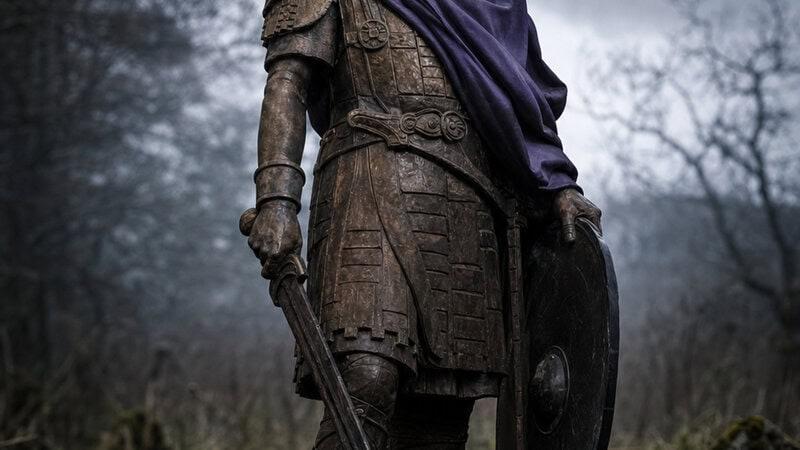

On a June morning in 793, the monks of Lindisfarne had no warning. The sound came first — hulls grinding against the Northumbrian shore — and then the armed men were among them, moving through corridors lit by candles, tearing apart the most sacred Christian site in northern Britain with efficient, terrifying speed. It was the opening act of a drama that would consume England for nearly three centuries and ultimately forge a nation from the collision of two worlds.
A Monastery on Fire, a Kingdom About to Change Forever

The raid on the island monastery of Lindisfarne in 793 was not the first time Norsemen had appeared on British shores — scattered references in the Anglo-Saxon Chronicle suggest earlier, smaller contacts along the southern coast — but it was the first Viking attack on England tied to a precise date and a named target, and the shock it sent through Christendom was immediate and profound. St. Cuthbert’s monastery was not just a place of prayer. It was one of the most revered sites in the entire Christian world: a repository of learning, sacred relics including the Lindisfarne Gospels, and manuscripts that represented generations of painstaking scholarship. When it burned, people noticed as far away as the court of Charlemagne.
Alcuin of York, the most celebrated scholar of the Carolingian age and a man who knew the monastery well, wrote to King Æthelred of Northumbria in anguish that “never before has such terror appeared in Britain as we have now suffered from a pagan race.” His words were not mere rhetoric. The idea that God’s most holy places could be plundered in broad daylight, that men from across the North Sea could sail in and strip a monastery bare before anyone could respond, was a theological crisis as much as a military one. If Lindisfarne was not safe, nothing was.
For roughly the next seven decades, however, that first raid set the pattern rather than broke it. Viking parties — primarily Danes attacking from the east and south, Norwegians pressing on the north and west — struck fast along the coasts and river valleys of England, seized what could be seized, and vanished before local lords could muster a coherent response. Monasteries were repeatedly targeted precisely because they concentrated wealth, kept no armed garrison, and were frequently sited on navigable water. It was effective and it was terrifying, but it was not conquest. What came next would be something far more existential.
From Raiders to Conquerors: The Great Heathen Army Arrives

In 865, the nature of the threat changed completely. A large force of Danish Vikings landed in East Anglia — not a raiding party looking for quick plunder, but an invasion force that intended to stay, to fight, and to rule. Anglo-Saxon chroniclers gave it a name that still echoes through the sources: the Great Heathen Army. Its leaders included Halfdan Ragnarsson and Ivar the Boneless, figures who appear in both the chronicles and later Norse saga tradition. Whatever their precise motives — and historians continue to debate whether revenge for earlier English actions against Danish leaders played a part — their strategic ambition was unmistakable.
The army’s momentum was staggering. Moving on horseback, a mode of campaign that distinguished it from earlier seaborne raiders, it struck north and seized York in 866, a city that had been the Roman capital of northern Britain and remained one of the most important urban centres on the island. Northumbria, riven by internal dynastic conflict, could not resist. Then the army turned on Mercia, extracting tribute and installing a client king. Then it moved against East Anglia. In 869, King Edmund of East Anglia was killed — in a manner so brutal, according to near-contemporary accounts, that he was venerated almost immediately as a martyr and saint, his cult centred on the place now called Bury St Edmunds.
By the early 870s, the arithmetic was grim. Three of England’s four great Anglo-Saxon kingdoms — Northumbria, Mercia, and East Anglia — had effectively crumbled under the army’s advance. Only Wessex, in the south and west, still held. And even Wessex had paid tribute to buy temporary peace. The question was no longer whether the Vikings could conquer England, but whether any English king had the will and the means to stop them. The full arc of Viking activity across Britain had shifted, decisively and apparently permanently, from raiding to something that looked unmistakably like occupation and colonisation.
The King in the Swamp

The answer to that question arrived in the most unlikely of forms: a fugitive, sheltering in the Somerset marshes in the bitter winter of 878.
A midwinter surprise assault by the Viking leader Guthrum had driven Alfred, King of Wessex, from his own palace at Chippenham. Alfred — the man history would call Alfred the Great, the only English monarch ever awarded that distinction — was a wanted man, sheltering in the wetlands around the Isle of Athelney with a small band of followers, cut off from his kingdom and his resources. It was the lowest point of his reign, and by any conventional measure, it should have been the end of him.
This is the moment that spawned one of England’s most enduring legends: Alfred, sheltering in a peasant woman’s hut, is asked to watch her cakes baking on the fire. Lost in thought about his shattered kingdom, he lets them burn and receives a thorough scolding for his distraction. The story does not appear in the earliest sources — it surfaces first in a later medieval life of St Neot — and almost certainly grew in the telling over centuries of retelling. But it is rooted in something verifiable and important. There was a king in a bog, humbled and cold and running out of time, and the story of the burned cakes preserves that humiliation in amber, making Alfred human in a way that straightforward military chronicle cannot.
What the legend obscures, however, is what Alfred was actually doing in the swamp. He was not simply hiding. He used the marshlands of Athelney as a natural fortress that no Viking army could easily penetrate — the waterways were his walls. From there, he sent out scouts and messengers, maintained contact with loyal thegns across Wessex, and spent those weeks methodically rebuilding the military capacity to strike back. The swamp was not the end of Alfred’s story. It was his planning room.
Edington, and the Treaty That Drew a Line Across England

In May 878, Alfred emerged from the marshes. He sent word to the warriors of Somerset, Wiltshire, and Hampshire to muster at a landmark called Egbert’s Stone — its precise location is still debated by historians — and they came. The fyrd, the Anglo-Saxon militia of free landholders, rallied to a king many had believed lost. It is one of history’s great comebacks: a ruler re-emerging from near-oblivion, gathering an army from the ruins of a kingdom, and marching to meet the force that had shattered three others.
At the Battle of Edington — identified by most modern scholars with Edington in Wiltshire — Alfred’s forces met Guthrum’s Viking army and defeated them decisively. Alfred pursued the retreating Vikings back to their fortified camp and besieged them there for two weeks, until hunger and thirst forced a complete surrender. The Great Heathen Army, the force that had toppled three Anglo-Saxon kingdoms in less than a decade, had run out of road.
The settlement that followed was as significant as the battle itself. Under the Treaty of Wedmore and the more detailed subsequent Treaty of Alfred and Guthrum, England was formally partitioned. To the north and east — broadly along a line running from the River Lea to the upper Thames and then along Watling Street — lay the Danelaw, territory where Viking law, custom, and settlement would hold sway. To the south and west, Wessex and allied territories remained under Anglo-Saxon rule. Critically, Guthrum agreed to accept Christian baptism, with Alfred standing as his godfather: a political and symbolic act that tied the Viking leader into the framework of Christian kingship and made future open warfare theologically awkward.
Alfred then did something that revealed the depth of his strategic intelligence beyond the battlefield: he built. Across Wessex, he constructed a systematic network of fortified towns called burhs — some newly founded, some developed from existing settlements — positioned so that no place in the kingdom was more than about twenty miles from one. He reorganised his navy to intercept Viking fleets before they could land. He reformed the fyrd so that half the available force could remain in the field on rotation while the other half managed farms and estates, solving the chronic problem of armies that dissolved when the harvest beckoned. He also invested heavily in literacy, law, and scholarship — translating key texts into Old English, establishing a court culture that could sustain an administration. Alfred transformed Wessex from a kingdom that reacted to Viking invasions into one structurally capable of preventing them.
Alfred’s Heirs Push Back: England Becomes England

Alfred died in 899, but the work he had begun did not stop with him. His son Edward the Elder and his daughter Æthelflæd — ruling Mercia as the Lady of the Mercians after her husband’s death — proved themselves commanders of real ability. Æthelflæd in particular is a figure who deserves more prominence in general histories than she typically receives: she directed campaigns, constructed burhs, and negotiated with Welsh kings and Scots, operating as an autonomous ruler in all but formal title. Together, Edward and Æthelflæd methodically recaptured Viking-held midland towns throughout the first two decades of the tenth century, pushing the boundary of Anglo-Saxon control steadily northward.
By the reign of Alfred’s grandson Æthelstan, the political map of England had been substantially remade. In 937, Æthelstan defeated a combined force of Vikings and Scots at the Battle of Brunanburh — a victory which gave him great prestige both in the British Isles and beyond. The precise location of Brunanburh remains unresolved, one of the more tantalising open questions of early English history, but its political consequences were not in doubt. Æthelstan was, in a meaningful and widely recognised sense, the first king of a unified England.
The victory was celebrated in an Old English poem inserted directly into the Anglo-Saxon Chronicle — one of the earliest substantial poems surviving in the English language, electric with martial pride and the intoxication of hard-won triumph. These events were not merely military history. They were the forge in which English identity, the English language, and English statehood were hammered into something durable. The question of when did Vikings invade England has no single clean answer, because it is a two-century arc: the shock of Lindisfarne in 793, the existential crisis of the Great Heathen Army in 865, the near-annihilation and remarkable comeback of 878, and the grinding campaigns of reconquest across the early 900s. But even that arc had one more chapter.
One Last Wave: Æthelred, Cnut, and the Return of the Danes

The Viking threat did not end with Æthelstan. From the 980s onward, renewed Danish raiding under leaders including Sweyn Forkbeard placed enormous pressure on England under King Æthelred II — a reign so blighted by military failure and poor counsel that later generations christened him “the Unready,” a loose translation of the Old English unræd, meaning badly advised or lacking in counsel. Æthelred’s government responded partly by paying massive tributes — the danegeld — sums documented in the sources that run into tens of thousands of pounds of silver and represent one of the largest extraction exercises in early medieval European history.
In 1013, Sweyn Forkbeard launched a full invasion, drove Æthelred into exile in Normandy, and was accepted as king across most of England before dying suddenly in February 1014. His son Cnut fought a prolonged campaign against Æthelred’s son Edmund Ironside, ultimately agreeing to partition the kingdom, before Edmund’s death in late 1016 left Cnut sole ruler of England. Cnut reigned until 1035, governing England not as an occupying warlord but as a Christian king deeply embedded in the existing structures of English administration — issuing law codes, patronising the church, and presenting himself as heir to the tradition of Alfred and Æthelstan rather than destroyer of it. His reign represents the paradox of the Viking age in miniature: conquest that preserved and ultimately reinforced what it had set out to overwhelm.
Harald Hardrada and the Final Viking Invasion
In the summer of 1066 — the most famous year in English history, the year that pivots between one England and another — a Norwegian king named Harald Hardrada sailed up the River Humber and marched his men into Yorkshire, pressing a claim to the English throne he derived from agreements between earlier Scandinavian rulers. It was the final Viking invasion of England, more than two and a half centuries after the monks of Lindisfarne first heard the sound of hulls on sand.
King Harold Godwinson of England responded with one of the most remarkable feats of rapid movement in medieval military history, force-marching his army north at a pace that caught Hardrada’s men completely off guard. At Stamford Bridge in Yorkshire on 25 September 1066, Harold caught the Viking force resting without their armour on a warm autumn day and destroyed them utterly. Harald Hardrada was killed. Of the great fleet that had sailed so confidently to conquer England, the Anglo-Saxon Chronicle records that only a fraction of the original ships were needed to carry the survivors home. The last Norse king to attempt a full invasion of England had found nothing but defeat.
The bitter irony arrived almost immediately. Harold had barely finished at Stamford Bridge when riders brought news from the south: William, Duke of Normandy — himself a descendant of Viking settlers, his duchy named for the Norsemen who had carved it from the kingdom of France in 911 — had landed on the Sussex coast. Harold marched his exhausted army back south and met his death at the Battle of Hastings on 14 October 1066. The Norman Conquest that followed was, in its own strange and indirect way, a final echo of the Viking age: the last, oblique consequence of those longships on the Northumbrian horizon in 793.
What the Vikings Left Behind
The Norsemen who raided and invaded England across those three centuries ultimately failed to conquer it outright and permanently — but in failing, they changed it in ways that have never been undone. Hundreds of English place names carry Viking origins: settlements ending in -by (farmstead or village), -thorpe (outlying settlement), and -thwaite (meadow or clearing) mark the landscape where Danes and Norwegians settled, farmed, raised families, and stayed. The distribution of these names across Yorkshire, Lincolnshire, Norfolk, and the East Midlands maps the Danelaw with remarkable precision. The word “law” itself derives from Old Norse lög. “Window,” “knife,” “husband,” “egg,” “sky,” “gate,” and hundreds of other everyday English words entered the language through sustained contact between Old English and Old Norse speakers living alongside each other — a linguistic integration so complete that modern English grammar was simplified partly as a result.
The legal and administrative traditions of the Danelaw left traces in English common law that persisted long after the Viking political presence had ended. The concept of the jury system, though its origins are complex and debated, is among the institutional inheritances some historians trace partly to Scandinavian legal custom. Trade routes established by Viking merchants between England and Scandinavia, and onward into the Baltic and beyond, connected England to commercial networks that enriched it materially as well as culturally.
And running through all of it, inescapably, is Alfred — the scholar-king who rebuilt a shattered kingdom from a swamp, who met the greatest military threat his world had produced and found a way not just to survive it but to systematically dismantle its capacity to recur. The administrative and military innovations he forged under existential pressure became the institutional skeleton of the English state. His burghal system, his reorganised military, his patronage of literacy and law, his insistence on governing through written codes rather than bare force — all of it emerged from the crucible of the Viking invasions, shaped by the very pressure it was designed to resist.
The Vikings who invaded Britain helped, in their brutal and largely unintentional way, to create the England that outlasted them. The king who stopped the first and most dangerous wave did so after hiding in a bog, letting someone’s cakes burn, and refusing — when every rational calculation suggested otherwise — to accept that it was over. Sometimes that is what history turns on: not grand inevitability, not structural forces alone, but one man’s decision, in a freezing marsh, to stay in the fight.

 English
 Arabic
 French
 Spanish
 Portuguese
 Deutsch
 Turkish
 Dutch
Dutch
 Italiano
 Russian
 Romaian
 Greek
Greek