


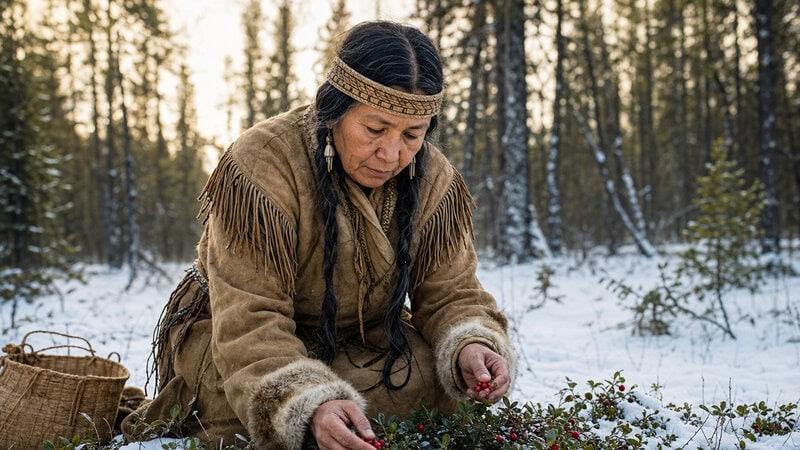

In the deep freeze of a northern woodland winter, long before any European had mapped those forests, a healer knelt in the snow beside a plant that refused to die. Its leathery leaves stayed dark and glossy even under ice, and clustered along its low, creeping stems hung small, hard, red berries — astringent on the tongue, almost medicinal in their bitterness — waiting to be harvested by hands that had known exactly what to do with them for generations beyond counting.
A Name That Covers Three Continents

The word “hogberry” is not one plant’s name. It is three different plants’ name, applied across three different geographies, and the confusion between them turns out to be more than a minor botanical curiosity. It is a window into the way Indigenous plant knowledge gets misidentified, renamed, and quietly absorbed into traditions that forget to credit their sources. Understanding what “hogberry” actually means requires a brief tour across hemispheres — and the tour is worth taking before anything else.
In the forests of northeastern North America and the Great Lakes country, early European settlers applied the name “hogberry” to bearberry, the low-creeping evergreen shrub known to botanists as Arctostaphylos uva-ursi. The name came from a practical observation: hogs and bears alike rooted eagerly for its small red fruit. That is the plant at the center of this story, and the one that carries the longest and most consequential history.
In Jamaica and across the Caribbean, “hogberry” refers to something entirely different. Byrsonima crassifolia — also called nance, nanche, and yaca — is a flowering plant native to the Caribbean, Central America, and tropical Latin America, producing small, sweet-sour yellow fruits prized as food for centuries. Nance carries its own deep history of Indigenous food and folk medicine use across Central America, a parallel tradition of plant knowledge that preceded Western botanical documentation by generations. The fruit ferments, feeds communities, and carries cultural memory in ways that never quite survived the journey into European scientific literature.
Then there is a third plant wearing a variation of the same name. Margaritaria nobilis, known as bastard hogberry, is a tree native to Mexico, Central and South America, and the West Indies. Its fruit ripens into a brilliant, iridescent color that looks almost artificial against tropical foliage. The U.S. Fish & Wildlife Service formally lists Margaritaria nobilis under the common name “bastard hogberry”, anchoring it in official taxonomy even as most people have never encountered the tree or its shimmering fruit.
Three plants, one folk name, three entirely different geographies and stories. The consequences of that compression run deeper than a labeling quirk. Indigenous plant knowledge has always been particularly vulnerable to this kind of misidentification: when colonial administrators and naturalists documented plants without rigorous attention to local names and local contexts, entire traditions of healing were compressed into a single wrong label and filed away. What survived was usually the plant. What was lost was the knowledge of what to do with it.
The Plant That Outlived Empires: Bearberry’s Deep History

Set the tropical hogberries aside for now and return to the snow, and to Arctostaphylos uva-ursi. Run a finger along one of its leaves: thick, waxy, spatula-shaped, with a surface that feels almost artificial in its durability. Bite one of the red berries and brace for what follows — mealy, dry, powerfully astringent, with none of the sweetness of a blueberry or a strawberry. This is not food engineered for casual snacking. It is a plant built for survival in environments that would kill most vegetation, and it carries its chemistry accordingly.
Bearberry grows in a circumpolar band across North America, northern Europe, and Asia — an enormous range that produced a striking convergence. Dozens of Indigenous cultures, separated by vast distances and with no shared communication, independently identified this plant and independently developed medicinal applications for it. That kind of convergence is not coincidence. It is the record of a plant that works, observed carefully by people skilled enough to recognize what they were seeing.
The ethnobotanical record is substantial. Bearberry leaves — dried, preserved, and in some cases still identifiable — have been recovered from archaeological contexts associated with Indigenous peoples of the Great Lakes and Plains regions. Field surveys conducted by ethnobotanists in the late nineteenth and early twentieth centuries documented its use across a wide spread of nations: the Ojibwe, Blackfoot, Cree, Navajo, Potawatomi, and many others, each with their own preparations and protocols refined over generations. Conservative reading of that record places continuous, intentional human medicinal use well before European contact — and the actual timeline almost certainly extends further, into a past that left no written document at all.
Survival Medicine: What Indigenous Healers Actually Knew

The primary medicinal use was consistent enough across unconnected cultures to amount to something like independent validation. It was the leaves — not the berries — that healers prized. Dried and brewed into a strong, dark tea, bearberry leaf preparations were used across multiple Indigenous nations to treat what we would now recognize as urinary tract infections, kidney inflammation, and related conditions. The application was specific, the preparation was deliberate, and the results were reliable enough that the knowledge survived for centuries in oral tradition even when colonial authorities were actively working to suppress Indigenous healing practices.
Among the Ojibwe, bearberry carried additional significance as a key ingredient in kinnikinnick — a ceremonial smoking mixture whose name, in some regions, has become nearly synonymous with the plant itself. The word kinnikinnick is Algonquian and refers to a blend rather than a single plant, but bearberry leaves were often central to it. Among Plains nations, the plant was carried in medicine bundles, administered during long winter journeys, and understood to be genuinely life-sustaining when no other treatment was available. That is what “survival medicine” means in its most literal sense: not folk remedy, not superstition, but a pharmacologically active treatment that kept people alive in conditions that offered no alternatives.
And pharmacologically active it is. What Indigenous healers understood through generations of careful observation, laboratory analysis has since confirmed. Bearberry leaves contain arbutin, a glycoside compound that the body converts to hydroquinone in alkaline urine. Hydroquinone has documented antimicrobial properties — it genuinely inhibits the growth of bacteria most commonly responsible for urinary tract infections. Centuries of Indigenous practice, it turns out, was prescribing an effective treatment for the right condition. The mechanism was not described in the language of modern biochemistry, but the medicine worked. The knowledge was real.
When colonial policies moved through the eighteenth and nineteenth centuries to suppress Indigenous healing traditions — undermining healers’ authority, banning ceremonies, forcing assimilation through residential schools — this accumulated pharmacological knowledge came dangerously close to extinction. It survived largely in oral tradition passed quietly between generations, and in the field notebooks of a small number of early ethnobotanists who had the presence of mind to document what they were being told before the speakers were gone.
When Europe Finally Noticed: Late Recognition and Missing Attribution

European medicine did eventually arrive at bearberry. It simply arrived late, and took credit it had not earned. Scottish physicians began publishing accounts of bearberry’s effectiveness against kidney and bladder conditions around 1763, documenting a therapeutic use that was, in every meaningful sense, borrowed from Indigenous practice without attribution. The plant entered European pharmacopeias in the late eighteenth century dressed as a discovery from the northern wilderness. The Ojibwe, Cree, and dozens of other nations who had been refining its preparation for generations were not cited.
This pattern — Indigenous knowledge absorbed into European science without acknowledgment — repeated itself across botanical medicine so consistently that it became structural rather than incidental. It was not always malicious in intent. Many early naturalists genuinely believed they were describing nature rather than translating someone else’s intellectual tradition. The effect, however, was the same: the knowledge was extracted, the source was erased, and the people who had developed it received nothing in return.
The arc of commercial development since then has been long and economically significant. Arbutin was isolated by chemists in the nineteenth century. Its antimicrobial mechanism was mapped in the twentieth. Today bearberry extract appears in herbal supplement formulations marketed for urinary health and — in a development that would have been entirely unrecognizable to the healer in the snow — in cosmetic products that use hydroquinone derivatives as skin-lightening agents. The commercial journey of this plant has generated substantial economic value. The share of that value returned to the nations whose ancestors did the original research remains, in most cases, essentially nothing.
The Modern Reckoning: Reclaiming Indigenous Plant Knowledge

Something is shifting, though the shift is neither fast nor certain. Across North America, researchers are partnering with Indigenous communities to document medicinal plant knowledge while living oral tradition holders can still transmit it directly — a project conducted with varying degrees of genuine reciprocity, but conducted nonetheless. Bearberry appears consistently in those collaborations as one of the most medicinally significant plants in the northern Indigenous pharmacopeia.
The stakes extend beyond historical justice. As antibiotic resistance grows into one of the defining medical challenges of this century, plant compounds with long safety records in human populations are attracting serious pharmaceutical research interest. A medicine refined across many generations, administered to real patients in real conditions over centuries, offers a kind of longitudinal safety data that no clinical trial can replicate in a comparable timeframe. The people doing that refining were not running randomized controlled studies, but they were doing something functionally analogous: observing outcomes, adjusting preparations, and transmitting results faithfully across generations. That record has urgent, concrete, contemporary value.
Indigenous scholars and advocates are clear-eyed about what that value demands. Any pharmaceutical or commercial benefit derived from bearberry and similar plants, they argue, should involve meaningful benefit-sharing agreements with the nations whose ancestors developed the knowledge. The principle is straightforward. The practice remains far from standard. The Convention on Biological Diversity established frameworks for exactly this kind of agreement decades ago, and implementation has been inconsistent enough to constitute its own ongoing problem.
The broader pattern bearberry represents runs across the entire hemisphere. From the tropical nance — Byrsonima crassifolia, the hogberry of Jamaica and the Caribbean — to the iridescent-fruited bastard hogberry of Mexico and the West Indies, to the Arctic bearberry of the northern woodlands, Indigenous peoples across the Americas developed sophisticated plant pharmacopeias through centuries of rigorous observation. Western medicine is only now beginning to engage with that tradition as a body of knowledge rather than a reservoir of raw materials to be extracted without acknowledgment.
Why This Story Matters Now

Return one more time to the image that opened this story: the healer kneeling in the snow, harvesting small red berries from a plant that refused to submit to winter. She was not practicing primitive folk magic or following superstition in the absence of better options. She was applying a tested, effective, pharmacologically active medicine that her tradition had refined across many generations, in conditions rigorous enough to eliminate what did not work and preserve what did. The snow was real. The cold was real. The patients were real. The medicine worked.
The naming tangle — hogberry as nance, hogberry as bastard hogberry, hogberry as bearberry — is not merely a quirk of vernacular botany. It is a demonstration of how easily Indigenous plant knowledge slips through the cracks of colonial documentation: misidentified into obscurity, or absorbed into a tradition that forgets to acknowledge its debts. Every misapplied name is a small erasure. Enough small erasures, and what remains is a continent’s worth of healing knowledge attributed to no one in particular, owned by everyone in general, and shared with almost none of the people from whom it actually came.
The bearberry plant itself has not changed. It still grows in the same circumpolar band it has always occupied, still pushes its leathery leaves through late-winter snow in the same northern forests where healers harvested it long before European contact. Its chemistry is identical. Its preparations, when done correctly, still work. What has changed — what is, cautiously and imperfectly, continuing to change — is the willingness of the wider world to acknowledge the people who first understood it, and to recognize that the knowledge was never truly lost so much as it was set aside without permission. Recovering it is not nostalgia. It is, in the most practical and pressing sense, medicine.

 English
 Arabic
 French
 Portuguese
 Deutsch
 Turkish
 Dutch
Dutch
 Italiano
 Russian
 Romaian
 Portuguese (Brazil)
 Greek
Greek