


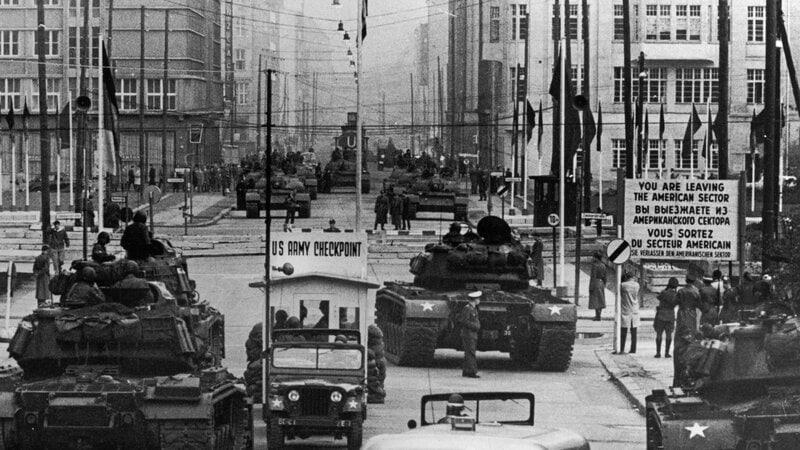

At two o’clock on the morning of October 27, 1961, ten American M48 Patton tanks sat idling on Friedrichstraße, their gun barrels leveled at ten Soviet T-54s parked just 75 yards away. Nobody had orders to fire. Nobody had orders to retreat. And somewhere between those two facts, the world quietly held its breath.
Why Berlin Was the Cold War’s Most Dangerous Corner

To understand why tanks ended up growling at each other on a Berlin street corner, you have to understand what Berlin had become in the years after World War II. The city had been carved into four occupation zones — American, British, French, and Soviet — and by 1961, West Berlin existed as a democratic island sitting deep inside communist East Germany. It was an arrangement that worked, barely, so long as people could move between East and West with relative freedom.
That freedom was bleeding the German Democratic Republic dry. Before the summer of 1961, nearly 3.5 million East Germans had slipped westward through Berlin — engineers, physicians, teachers, scientists. The GDR was being hollowed out from within, and its leadership was desperate. The solution came suddenly and brutally: on the night of August 12-13, 1961, East German workers began unrolling barbed wire across the city. That wire would harden, over the following weeks and years, into the Berlin Wall — a barrier that would separate East and West Berlin from 1961 to 1989, until its fall in November of that year.
Among the handful of official crossing points built into this new barrier, one became the most symbolically charged of all. Checkpoint Charlie — the Western Bloc’s name for the best-known Berlin Wall crossing point between East Berlin and West Berlin, known officially as Checkpoint C — sat at the corner of Friedrichstraße and Zimmerstraße in the Mitte district. It served as the designated passage for Allied military personnel, foreign nationals, and diplomats moving between West and East Berlin. From the moment the Wall went up, it was the place where two worlds met face to face.
A Wooden Shed at the Edge of Everything

In those first months, Checkpoint Charlie was almost deliberately unimpressive: a small wooden guardhouse, a striped barrier pole, American military police in white helmets stamping their feet against the autumn cold. The minimalism was intentional. Constructing anything permanent would imply that the Western Allies accepted the Wall as a legitimate structure — a concession they refused to make, either physically or legally.
The legal question was the real flashpoint. The United States maintained that Allied officers held an unconditional right to cross into East Berlin without presenting identity papers to East German border guards. The reasoning was precise: the Allies recognized Soviet authority in East Berlin, not East German authority. Submitting to GDR document checks would amount to recognizing the sovereignty of a state the West did not officially acknowledge. Through the autumn of 1961, East German guards — backed, everyone understood, by Moscow — had been pressing that challenge with increasing boldness.
The confrontation did not erupt in a vacuum. It was the culmination of a months-long Berlin Crisis in which Soviet Premier Nikita Khrushchev had threatened to sign a separate peace treaty with East Germany, potentially transferring control of the access routes into West Berlin to the GDR and strangling the Western presence there altogether. The city had been living on a knife’s edge since August, and every diplomat in the world knew it.
The Spark: A Diplomat, a Barrier, and a General Who Didn’t Flinch

The specific incident that lit the fuse came on October 22, 1961. E. Allan Lightner, the senior U.S. diplomat in West Berlin, attempted to drive through Checkpoint Charlie into East Berlin — a routine crossing his position entitled him to make. East German guards stopped him and demanded identification papers. Lightner refused. He was turned back.
It was a small moment with enormous implications. General Lucius D. Clay, President Kennedy’s personal representative in Berlin and the architect of the 1948-49 Berlin Airlift that had defied a previous Soviet blockade, was not a man inclined to absorb such a challenge quietly. He ordered U.S. military jeeps to escort Allied civilian vehicles through the checkpoint — a pointed demonstration that American rights of movement would be exercised, guards or no guards. Then, on October 25, he raised the stakes considerably by moving American M48 Patton tanks to the perimeter of Checkpoint Charlie.
The Soviet response came within hours. T-54 tanks rolled out of their East Berlin garrison and took up positions 75 yards from the American armor — barrel to barrel, engine to engine — on one of the most closely watched street corners on earth. The standoff that would define a generation’s understanding of Cold War brinkmanship had begun.
Sixteen Hours That Lasted Sixteen Days: The Anatomy of a Standoff
The daily reality of that confrontation was surreal in the way only Cold War Berlin could manage. West Berliners pressed against apartment windows along Friedrichstraße. Journalists filed dispatches from positions where they could smell tank exhaust. The world’s most dangerous staring contest was playing out in a neighborhood where people still had to go to work in the morning.
Behind the public theater of tanks and gun barrels, a very different drama was unfolding. President Kennedy, who privately worried that General Clay’s assertive posture risked sliding into a confrontation nobody could walk back from, opened a back channel to Khrushchev through intermediaries. The message carried through those conversations was delicate and specific: if the Soviets pulled their tanks back first, the Americans would follow within 20 minutes. It was an offer of de-escalation wrapped in the language of face-saving choreography — neither side backing down, both sides stepping back.
On October 28, 1961, the choreography played out exactly as scripted. Soviet tanks began reversing away from Checkpoint Charlie, disappearing back into East Berlin. Within the promised 20 minutes, the American tanks did the same. The most dangerous confrontation of the Cold War dissolved without a single shot fired, without a single casualty, and without any formal agreement that either government would ever acknowledge in public.
What the standoff had exposed, however, was impossible to set aside. Checkpoint Charlie was not merely a crossing point. It was the place where superpower prestige, nuclear deterrence, and the fate of a divided city were compressed into one gap in a freshly built wall on a Berlin street corner — and where the distance between a standoff and a catastrophe had been measured in yards.
Escapes, Spies, and the Long Second Act

The withdrawal of the tanks in late October 1961 did not end Checkpoint Charlie’s story — it barely began it. Through the following decades, the checkpoint became a recurring stage for the Cold War’s most human dramas. East German citizens engineered elaborate and frequently deadly escape attempts: in modified car trunks, in the cavities of specially built vehicles, on forged documents, and in at least one case in a homemade hot-air balloon that crossed elsewhere along the border. At least 140 people died attempting to cross the Berlin Wall over its existence, according to researchers at the Berlin Wall Memorial. Checkpoint Charlie was often the nerve center through which survivor accounts and failed attempts filtered into Western consciousness.
The checkpoint also became synonymous with Cold War espionage. In February 1962, Checkpoint Charlie served as the Allied processing point connected to one of the era’s most celebrated spy exchanges — the swap of Soviet intelligence officer Rudolf Abel for U-2 reconnaissance pilot Francis Gary Powers, though the actual exchange took place at the Glienicke Bridge on the city’s western outskirts. The distinction matters: Checkpoint Charlie was where Allied officials processed the handover on the eastern approach, illustrating how the crossing point functioned as an administrative hub for the shadow world of Cold War intelligence work — the kind of transaction that could only happen in Berlin, in this particular corridor between two irreconcilable worlds.
For 28 years, the grim routine of the checkpoint continued — the document checks, the searchlights, the guards with mirrors on poles inspecting the undersides of vehicles — until the night of November 9, 1989, when crowds surged through crossing points across the city and the Wall’s purpose evaporated almost before anyone fully understood what was happening. The Cold War theater of Checkpoint Charlie came to an end not with tanks but with jubilant strangers embracing on a street corner.
What Remains Today

The corner of Friedrichstraße and Zimmerstraße today hosts a replica of the original guardhouse, an open-air exhibition tracing the history of the crossing and the Wall, and the Mauermuseum — Haus am Checkpoint Charlie, a private museum that has documented escape attempts and Cold War history since 1963, making it one of the longest continuously operating Cold War memorial institutions in the world. Millions of visitors arrive each year to stand where the tanks once idled. The site draws both reverence and ongoing debate: critics argue that its heavily commercialized surroundings — souvenir stalls, actors in Cold War-era uniforms charging for photographs — sit uneasily alongside the gravity of what happened there, and Berlin authorities have long discussed how to reconfigure the area into a more considered memorial landscape.
That tension is itself historically honest. Checkpoint Charlie was never a clean or dignified place. It was improvised, pressurized, and perpetually on the verge of something terrible. A little chaos in how the world remembers it is not entirely inappropriate.
Why That October Night Still Matters
The Checkpoint Charlie standoff of 1961 is sometimes reduced to a footnote in Cold War timelines, squeezed between the Wall’s construction and the Cuban Missile Crisis that would erupt almost exactly a year later. That reduction undersells what happened on Friedrichstraße. The standoff was a case study, rare and vivid, in how nuclear-armed rivals can de-escalate — not through capitulation, but through the careful, secret construction of an off-ramp that lets both sides step back while telling their own people they never blinked.
The mechanics of that de-escalation deserve attention. Kennedy and Khrushchev did not resolve the underlying dispute — the question of Allied rights in East Berlin was never formally settled, and both sides simply stopped pressing it to the breaking point. What they managed instead was the gap between a crisis and a war. They bought time, and time turned out to be what the Cold War ultimately required: enough of it for the system to exhaust itself from within, for the Wall to fall not under tank fire but under the weight of its own absurdity.
Behind the geopolitics were ordinary Berliners who had woken up one August morning to find their city cut in two by barbed wire. They were the ones living in the shadow of that wall, the ones watching tanks park outside their windows, the ones who understood with a directness that no diplomat in Washington or Moscow could quite match exactly how thin the line was between a standoff and a catastrophe.
Checkpoint Charlie was never just a crossing point. It was an idea — the place where the two great ideological systems of the twentieth century stood nose to nose and, in that October darkness, chose not to pull the trigger. The engines eventually went quiet. The tanks reversed into the dark, and Friedrichstraße stood empty in the cold. It is easy, from a distance of more than six decades, to assume that outcome was inevitable. It was not. It was a decision — made by exhausted men on back channels — and that is precisely what makes it worth remembering.

 English
 Arabic
 French
 Spanish
 Deutsch
 Turkish
 Dutch
Dutch
 Italiano
 Russian
 Romaian
 Portuguese (Brazil)
 Greek
Greek