


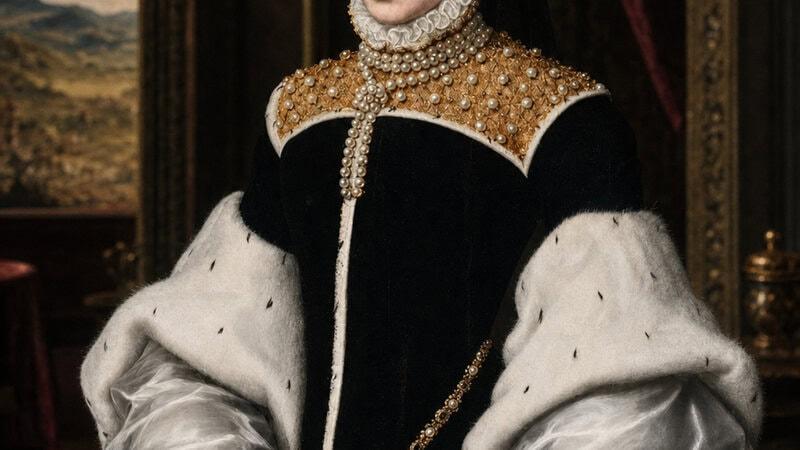

For six centuries, the Habsburg dynasty played a game no other royal house matched: instead of conquering Europe at swordpoint, they married into it — one strategic union at a time. But the same genius that built their empire carried a quiet poison, and by the end, the family’s obsession with keeping power inside the bloodline had begun to hollow out the dynasty from within.
1273 — A Minor Count Wins an Emperor’s Crown

In the autumn of 1273, the princes of the Holy Roman Empire gathered to elect a new emperor and chose Rudolf of Habsburg, a Swiss nobleman of middling reputation, precisely because they expected him to be manageable. He was not. Within a few years Rudolf had seized the Duchy of Austria by force, driving out his Bohemian rival Ottokar II and planting his family’s banner over territory they would hold for more than six centuries. The German princes had wanted a puppet; they got a patriarch.
The lesson Rudolf drew from his improbable elevation was one he passed to every generation that followed: armies are expensive and unreliable, but titles and territory last forever — and both can be acquired through a well-arranged wedding. It was a philosophy that would one day make the Habsburgs the most powerful family in the Western world, and eventually help destroy them.
1282 — Austria Becomes the Habsburg Heartland

Nine years after his election, Rudolf made his most consequential decision as a father rather than as an emperor. In 1282 he formally invested his sons Albert and Rudolf II with the Duchy of Austria, converting a military conquest into a hereditary birthright. Austria became the dynastic engine room from which the family would radiate outward across the continent for the next six and a half centuries.
The court at Vienna grew into a gravitational center unlike any other in Europe — a place where ambassadors came to negotiate, princes came to seek favor, and dynastic marriages were arranged with the cool precision of a merchant balancing ledgers. As historians have long observed, the Habsburg monarchy never officially called itself an empire during its early centuries, even as it functioned as one; it was always, formally, a collection of crowns held by a single extraordinarily persistent family.
1496 — The Marriage That Built an Empire Overnight

If Rudolf’s seizure of Austria was the dynasty’s foundation stone, the marriage of Philip “the Handsome” to Joanna of Castile in 1496 was the moment the building suddenly shot skyward. In a single union, the Habsburg patrimony fused with the Spanish crown, the kingdoms of Naples and Sicily, and the torrents of silver and gold pouring in from the Americas. No army in Europe could have achieved what one wedding accomplished.
Their son Charles inherited the entire staggering package — Holy Roman Emperor as Charles V and King of Spain as Charles I — ruler of more European territory than anyone since Charlemagne. The motto widely attributed to his grandfather Maximilian I captured the dynasty’s self-understanding precisely: Bella gerant alii, tu felix Austria nube — let others wage war; you, happy Austria, marry. It was not modesty. It was a boast.
1516-1556 — Charles V Holds the World Together, Barely

At his peak, Charles V presided over an empire that stretched around the globe — Spain, the Holy Roman Empire, the Habsburg Netherlands, Naples, and the rapidly expanding colonies of the Americas. His courtiers said the sun never set on his domains, and for once the courtiers were not exaggerating. But governing it all from a single throne proved functionally impossible, and Charles spent his reign in a state of near-constant crisis, shuttling between territories, fighting Ottoman pressure from Suleiman the Magnificent in the east and Protestant revolt — sparked by Luther’s Reformation — in the north and west.
His solution — splitting the dynasty into a Spanish branch under his son Philip II and an Austrian branch under his brother Ferdinand I — prevented immediate collapse but created a long-term catastrophe. The two branches remained deeply conscious of their shared blood and shared interests, and they demonstrated that consciousness in the most Habsburg way imaginable: by continuing to marry each other, generation after generation, pulling an already small gene pool tighter with every union.
Late 1500s — The Cousins Start Marrying Cousins

What began as political strategy calcified, over the decades, into something closer to compulsion. Uncles married nieces. First cousins married first cousins. The Spanish and Austrian branches of the Habsburg dynasty traded children back and forth across the continent with the regularity of a commercial exchange, each marriage designed to keep wealth, titles, and influence sealed within the family. A 2019 study published in Scientific Reports, drawing on genealogical records spanning sixteen generations, calculated that by the reign of the last Spanish Habsburg, the coefficient of inbreeding had reached levels comparable to a child born of a sibling union.
The consequences wrote themselves on Habsburg faces. The protruding lower jaw and severe underbite now known as the Habsburg jaw — caused by mandibular prognathism — appeared in portrait after portrait, from Madrid to Vienna, growing more pronounced with each generation. Researchers examining that same 2019 dataset found a strong correlation between rising inbreeding coefficients and the worsening of the trait across the family tree. Court painters were tactful; the medical reality was less so. What had once been a slight family resemblance was becoming, slowly and visibly, a hereditary burden.
1618-1648 — The Thirty Years’ War Tests the Dynasty’s Grip on Central Europe

In 1618, Protestant nobles in Bohemia threw three Habsburg officials from a window of Prague Castle — the infamous Defenestration of Prague — an act of defiance that triggered thirty years of war across central Europe. What began as a religious revolt against Habsburg authority spiraled into a continent-wide catastrophe involving Denmark, Sweden, France, and the fragmented princes of the Holy Roman Empire, killing an estimated eight million people through battle, famine, and disease. The Austrian Habsburgs, as the empire’s ruling dynasty, led the Catholic cause with tenacious determination and achieved early military successes under generals like Wallenstein and Tilly.
But the Peace of Westphalia in 1648 forced them to accept a settlement that permanently curtailed their ambitions. Religious pluralism across the empire became enshrined in law, and the hundreds of princes and city-states that made up the Holy Roman Empire asserted their sovereignty in ways that could not easily be reversed. The war exposed what the dynasty had always struggled to conceal: they wore the emperor’s crown, but they could never quite make the empire obey.
1700 — Charles II of Spain Dies Without an Heir, Triggering a World War

Charles II of Spain was, in the bluntest possible terms, the bill come due for two centuries of Habsburg inbreeding. He suffered from epilepsy, cognitive disabilities, and severe physical deformities; his Habsburg jaw was so pronounced he could not chew food properly. Contemporary accounts and later medical analyses suggest he did not walk until the age of eight and struggled to speak clearly for much of his childhood. He was ill for most of his 38 years, and when he died in 1700, he left no children and no direct heir — the Spanish Habsburg line simply ran out.
The vacancy ignited the War of the Spanish Succession, a conflict that drew in nearly every major European power and dragged on until 1714. When the dust settled, the Spanish crown passed to the French Bourbon dynasty under Philip V, ending roughly two hundred years of Habsburg rule in Spain. Charles II had not caused his own condition; he had been born into it, the product of a system that valued bloodline purity over basic biological reality. He was, in a terrible way, the dynasty’s most honest self-portrait.
1740 — A Woman Saves the Dynasty by Sheer Force of Will

When Emperor Charles VI died in 1740 leaving only a daughter as heir, the vultures circled immediately. Prussia under Frederick the Great, Bavaria, France, and Spain each saw Maria Theresa’s inheritance as an opportunity — a young woman of twenty-three, they assumed, could not hold together what her father had barely managed. They were wrong about Maria Theresa in the same way the German princes had been wrong about Rudolf of Habsburg nearly five centuries earlier. She fought off the invasions during the War of the Austrian Succession, reformed the Habsburg military and civil bureaucracy, introduced a standardized tax system, and governed for forty years as one of the most formidable rulers in European history — all while raising sixteen children.
Her reign also marked a quiet but significant shift in dynastic strategy. Rather than continuing to wed cousins to cousins, Maria Theresa began marrying her children outward — most famously sending her youngest daughter Marie Antoinette to the French court and arranging unions with Italian and German dynasties — using matrimony for diplomatic alliance rather than genetic consolidation. It was, arguably, the most Habsburg thing she could have done, and it was long overdue.
1804 — Napoleon Forces a Rebrand: The Austrian Empire

When Napoleon Bonaparte crowned himself Emperor of the French in 1804, he posed a problem that was partly military and partly symbolic: there could not be two emperors in Europe without one of them appearing the lesser. The Habsburg ruler Francis II resolved the problem with characteristic dynastic pragmatism — he declared himself Emperor Francis I of Austria, creating a new imperial title that placed him on nominal equal footing with the Corsican upstart. Two years later, after Napoleon’s crushing victory at Austerlitz and the subsequent pressure on German princes to realign, Francis formally dissolved the Holy Roman Empire and abdicated its ancient crown, ending an institution the Habsburgs had dominated for centuries.
The new title papered over a structural reality that had always defined the dynasty. The Austrian Empire, like the Habsburg Monarchy before it, was not a unified national state with shared laws and a common identity; it was a patchwork of territories — German, Hungarian, Czech, Italian, Croatian, Polish — held together by a court in Vienna, a set of dynastic loyalties, and the sheer persistence of a family that had been at this for five hundred years. The name changed. The essential nature did not.
November 1918 — The Last Emperor Refuses to Quit, Then Disappears Into Exile

On November 11, 1918 — the same day the armistice ended the First World War on the Western Front — Emperor Karl I issued a proclamation withdrawing from affairs of state. He did not, however, abdicate. The distinction mattered enormously to him. Karl maintained until his death in 1922, through Swiss exile and a final retreat to the Portuguese island of Madeira, that he remained the legitimate emperor of Austria and king of Hungary. He made two attempts to reclaim the Hungarian throne, in March and October 1921, both of which collapsed without significant support. The world had moved on; Karl had not.
With his departure, more than 600 years of Habsburg rule came to its end — not with a decisive battle or a popular revolution, but with a legal formality and a long, quiet exile on a windswept Atlantic island. Rudolf’s Swiss nobleman had seized an empire through ambition and arranged marriages; his last descendant lost it in a war his dynasty had helped ignite, departing without ever quite admitting it was over.
From a minor Swiss count elected because he seemed harmless, to a last emperor who refused to acknowledge his own fall, the Habsburgs built and lost the most remarkable dynastic project in European history — sustained for centuries by the genius of marrying well, and undone, in part, by the compulsion to never stop.

 English
 Arabic
 French
 Portuguese
 Deutsch
 Turkish
 Dutch
Dutch
 Italiano
 Russian
 Romaian
 Portuguese (Brazil)
 Greek
Greek