


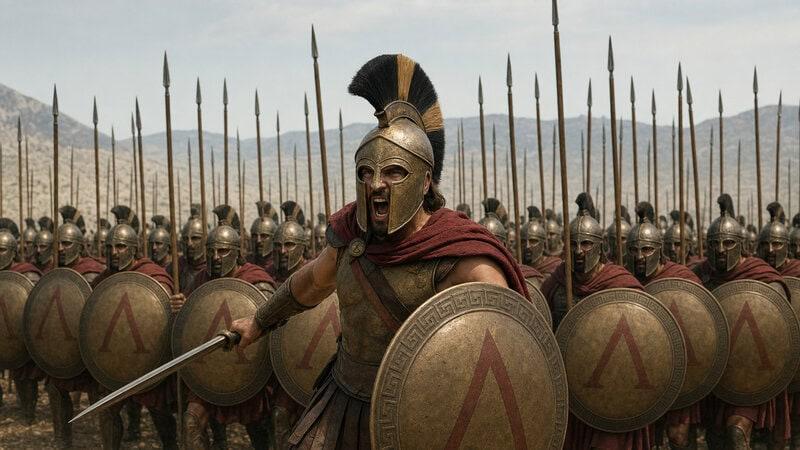

The ground trembled before you could see them. Then the sound arrived — a rhythmic bronze clash, thousands of shield rims striking spear shafts in unison — and then they crested the ridge: a wall of men eight rows deep, spear tips lowering like a closing gate, the whole mass moving as a single impossible creature across the Greek hillside. Soldiers who faced a Greek phalanx for the first time often broke before contact. Those who held their ground and fought it anyway usually lost. For roughly two centuries, this formation was the closest thing the ancient world had to an unstoppable force — until one afternoon in 371 BC, when a Theban general named Epaminondas tilted the entire premise 45 degrees and rewrote the rules of warfare in a single battle.
Engineering a Human Battering Ram

The word phalanx is rooted in the Greek phalangos, meaning a bone of the finger or toe — something rigid, interlocked, part of a larger structure that functions only when every piece holds its position. That etymology reads almost like a technical manual. The phalanx formation was exactly that: a rectangular block of heavily armed infantry standing shoulder to shoulder in files typically several ranks deep, each man carrying a round shield — the hoplon, roughly three feet across — that covered half his own body and half the body of the man to his left. Survival was geometrically distributed. Your shield protected your neighbor’s exposed right side; his shield protected yours. The moment a man broke and ran, the neighbor he had been shielding was suddenly open to a spear thrust. Cowardice wasn’t merely dishonorable — it was mechanically lethal to the men around you.
The equipment these hoplites carried was deliberately punishing: a bronze breastplate, bronze greaves strapped over the shins, and a crested Corinthian helmet that narrowed vision to a dim, tunnel-like slit. The primary weapon was the doru, a spear roughly eight feet long, carried overhand. Front-rank soldiers thrust it at whatever gap appeared in the enemy wall; rear-rank soldiers pressed their shoulders and shields into the backs of the men ahead, converting the whole formation into something closer to a hydraulic piston than an army.
When two phalanxes collided — and in Greek city-state warfare, they almost always did — the encounter became what ancient sources called the othismos, meaning “the push.” This was less a sword fight than a grinding industrial contest of mass, momentum, and nerve. The rear ranks literally shoved the front ranks into the enemy. Men fought for footing, for breath, for the tiny advantage of higher ground. The outcome depended on whose formation held cohesion longer under that crushing pressure. It was, in the most literal sense, the collective will of an entire city compressed into bronze and muscle.
Two Centuries of Dominance

The phalanx emerged from the brutal internecine warfare of the Greek city-states during the seventh century BC. By the time the Persian Wars arrived in the early fifth century, the formation had been refined into something approaching perfection — at least for the world it was designed to fight in. The clearest proof came at Marathon in 490 BC, where Athenian hoplites, heavily outnumbered by a Persian force that included cavalry and massed archers, charged at a run and crashed into the Persian center with such violence that the enemy flanks crumpled. A force that had expected to conquer Greece in an afternoon found itself shoved back to its ships.
Marathon became mythology, but its tactical lesson was real: the phalanx was almost perfectly calibrated to the conditions of Greek warfare. City-states fought primarily over flat agricultural plains — the same plains their economies depended on. Conflicts needed to be resolved quickly, before a prolonged campaign ruined a harvest. The phalanx delivered decisive results on flat ground in a single afternoon. It was the ideal weapon for a political and economic reality that demanded short, sharp, conclusive violence.
Enemies who tried to break it found very few options. Cavalry could not smash a locked shield wall head-on without catastrophic losses. Archers could thin the ranks but rarely stop a determined advance before contact was made. Lighter infantry simply scattered. The phalanx’s real vulnerability — its flanks and rear, where tight cohesion made it agonizingly slow to turn — was almost never seriously exploited, because most opponents were fielding phalanxes of their own and following the same tactical grammar. Greek warfare became ritual almost as much as conflict: two walls of men meeting on a chosen plain, pressing until one gave way, then negotiating terms.
Cultural reinforcement made the formation even harder to question. The hoplite class — men wealthy enough to furnish their own armor — was the backbone of Greek citizenship. Political rights in many city-states were tied to the capacity and willingness to stand in the line. The phalanx was not just a tactic; it was a civic institution, a statement about who mattered and how society ordered itself. Challenging its supremacy meant challenging something close to collective identity.
The Flaw Everyone Knew and Nobody Fixed

The structural weakness of the phalanx was not a secret. Every experienced commander understood it. The formation was devastating from the front and nearly helpless at its flanks and rear — the same tight cohesion that made it a battering ram made it extraordinarily difficult to pivot, redeploy, or respond to a threat that was not directly ahead.
There was also the strange phenomenon of rightward drift. Every hoplite, instinctively protecting his unshielded right side, edged slightly right to stay in the shadow of his neighbor’s shield. The whole formation would slowly migrate rightward during an advance, pulled by an invisible current. Commanders noticed it, wrote about it, and had essentially no remedy. It was baked into the physics of how the shield and the human body interacted.
Broken ground was equally damning. A phalanx crossing a ditch, a hillside, or rocky terrain immediately began losing the tight cohesion that gave it its power. Gaps opened. Files fell out of alignment. The Persians at Thermopylae in 480 BC attempted encirclement to exploit these limits — they were thwarted less by phalanx flexibility than by the geography of the pass itself and the extraordinary discipline of the Spartan contingent holding it.
By 400 BC, Sparta had weaponized that discipline to a degree that made their phalanx appear genuinely invincible. Spartan boys entered military training at age seven in a rigorous state program known as the agoge. By the time they stood in a battle line, they had spent their entire lives preparing for that single experience. No Greek army had beaten them in open battle in living memory. Other city-states had largely stopped trying. Then a Theban general began doing geometry.
Leuctra, 371 BC: The Afternoon That Ended an Era

The plain of Leuctra in Boeotia looked, to most eyes, like the setup for another routine Spartan victory. A Spartan-led force of roughly 10,000 soldiers under King Cleombrotus I faced a Theban-led coalition of around 6,000. The numbers favored Sparta. The reputation favored Sparta. Nearly every commander present assumed the battle’s outcome before it began.
Epaminondas of Thebes had spent years thinking about the flaw that everyone knew and nobody fixed. His answer was not a new weapon or a larger army. It was a deliberate reallocation of weight — a question so simple it sounds almost naive in retrospect: what if the line did not have to be uniform?
Instead of distributing his troops in a standard formation across a symmetrical front, Epaminondas massed his finest soldiers — the Sacred Band, an elite unit of 300 warriors — on his left flank at an extraordinary depth of 50 ranks. He then deliberately thinned and pulled back his center and right, holding them at an oblique angle so they would engage the enemy last rather than simultaneously. He was concentrating overwhelming force at a single point, accepting weakness everywhere else, and timing the contact so that the deep column struck before the rest of either army could influence the outcome.
The effect was both devastating and fast. The Theban left smashed into the Spartan right — precisely where Sparta’s best soldiers, including Cleombrotus himself, were positioned — with a mass and momentum that no standard phalanx formation could absorb. The depth did not merely add weight; it sustained the push far longer than any front-rank resistance could withstand. Cleombrotus was killed in the fighting. The Spartan right collapsed. Without its anchor, the entire Spartan line disintegrated.
The losses Sparta suffered belong in every account of ancient Greek warfare: approximately 400 of the roughly 700 full Spartiates — full citizen-soldiers — present at Leuctra were killed. In a single afternoon, Sparta’s warrior caste suffered a demographic wound from which it never recovered. The Spartan hegemony over Greece ended not through a long campaign or a generational struggle, but because one man refused to accept that the line had to be straight.
Philip, Alexander, and the Formation Transformed

A young Macedonian named Philip II was reportedly living in Thebes as a political hostage during this period, close enough to Epaminondas’s circle to observe the lesson directly. What he carried home to Macedon was the oblique attack, the concentration of force at a decisive point, and the deeper understanding that the phalanx could be a tool rather than a dogma.
Philip’s upgrade was systematic. He replaced the hoplite spear with the sarissa, a pike roughly 18 feet long that required both hands to wield, which meant abandoning the large hoplon shield and rethinking the entire defensive geometry of the formation. He drilled his infantry to hold their sarissas at staggered angles so that the points of the first five ranks all projected forward simultaneously — a bristling hedge of iron that cavalry could not penetrate and that a traditional hoplite phalanx could not close with safely.
His son Alexander used this instrument to conquer an empire. The Macedonian phalanx would fix an enemy in place, grinding forward and consuming the opponent’s attention, while the Companion cavalry — Alexander himself usually leading it — drove at an oblique angle into a thinned flank or the gap the phalanx had created. It was Epaminondas’s core insight scaled up, fused with shock cavalry, and aimed at empires rather than neighboring city-states.
The history of the phalanx is ultimately the history of an idea that grew so effective at one thing that it stopped asking whether that thing was still the right question. The formation that once defined Greek military identity became the foundation on which its own replacement was built.
What the Phalanx Still Teaches

The two-century reign of the phalanx and its sudden unraveling at Leuctra is among the cleanest case studies in military history of how dominant systems generate their own blind spots. The formation’s extraordinary success made it culturally and institutionally nearly impossible to question. The civic identity wrapped around it, the citizenship rights tied to it, the mythology layered on top of it — all of this made intellectual experimentation feel close to treason. It required an outsider’s willingness to ask obvious questions to finally break the spell.
The principle Epaminondas applied — concentrate overwhelming strength at a single decisive point rather than spreading force evenly across a front, and strike before the enemy can coordinate a response — reappears throughout military history. It surfaces in Clausewitz’s concept of the Schwerpunkt, the center of gravity that a commander should drive all effort toward. It appears in the armored breakthrough doctrine of the Second World War, where concentrated mechanized forces punched through thin points in an enemy line rather than pushing uniformly across it. It echoes in modern asymmetric warfare theory, where smaller forces defeat larger ones by refusing to engage on even terms.
The men who stood in the phalanx line were not abstractions. They were farmers who had left their fields, craftsmen who had set down their tools, fathers who had said goodbye to children that morning. They fought in a formation that embedded a social contract into its geometry: I will protect you with my shield; you will protect me with yours. That covenant of mutual survival is what made the phalanx psychologically durable under conditions that should have shattered it.
Which makes what Epaminondas accomplished at Leuctra all the more striking. He did not outspend Sparta or outnumber them. He did not invent a new weapon or uncover a hidden weakness no one had noticed. He stood on a dusty Boeotian plain, studied a military tradition two centuries in the making, and asked what would happen if you placed 50 ranks on the left instead of eight. The answer was bronze on bronze, a king dead in the dust, and the slow realization spreading outward from that plain like a wave — that the wall everyone believed was unbreakable had simply been standing at the wrong angle all along.

 English
 Arabic
 French
 Spanish
 Portuguese
 Deutsch
 Turkish
 Dutch
Dutch
 Italiano
 Russian
 Portuguese (Brazil)
 Greek
Greek