


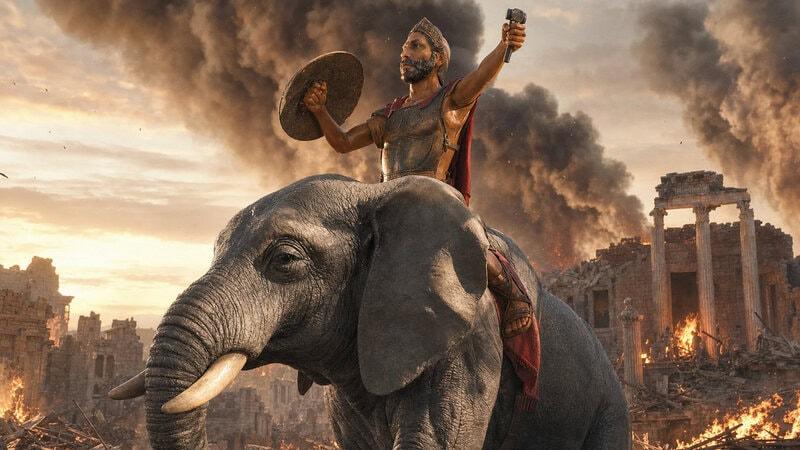

For seventeen days in 146 BC, Roman soldiers burned Carthage block by block, the smoke rising in columns so thick and dark that it was said to be visible from ships far out across the Mediterranean. When it was over, one of the greatest cities the ancient world had ever produced — a metropolis of roughly 700,000 people, the engine of a commercial empire stretching from Spain to Sicily — was rubble, its survivors in chains, its very ground declared cursed by the victors who feared it even in death.
A City So Dangerous Rome Couldn’t Just Defeat It

The story of Carthage is, at its core, the story of a power so formidable that defeating it militarily wasn’t enough. Rome needed it gone from the imagination of the ancient world. The famous detail — that Roman soldiers sowed the fields of Carthage with salt so nothing would ever grow there again — is almost certainly a myth, a later embellishment that historians have largely debunked. But the impulse the story captures is historically real. Rome didn’t want to absorb Carthage. It wanted to unmake it. The difference matters, because it tells us something not just about ancient warfare but about the particular dread that Carthage inspired.
What makes this history feel alive rather than merely ancient is geography. The ruins of Carthage sit today on a hill overlooking the Gulf of Tunis, folded into the suburbs of a modern capital city. Tunisia — a country of roughly 12.1 million people covering 163,610 square kilometres, wedged between Algeria to the west and Libya to the southeast, with its northern and eastern coasts opening to the Mediterranean — is one of the smallest nations in Africa by area. And yet this compact patch of North African coastline once hosted an empire that brought Rome to its knees and gave the Western world one of its most enduring strategic nightmares.
Before Rome, There Was Carthage: The Phoenician Seed That Grew Into an Empire

Carthage was not originally African in culture. It was a colony, founded around 814 BC by Phoenician settlers from Tyre, in what is now Lebanon. Legend gives the city a founder worthy of it: Queen Dido, a refugee princess who, when a local Berber king offered her only as much land as a single oxhide could cover, cut the hide into razor-thin strips and laid them end to end in a great circle around a hilltop. On that hill, she built a city. Whether or not the story is literally true, it perfectly captures the Carthaginian genius: outthinking a more powerful opponent through ingenuity rather than force.
Tunisia’s geography made Carthage’s rise nearly inevitable. Sitting at the narrowest point of the Mediterranean — the Sicilian Channel, where barely 150 kilometres of open water separates North Africa from Europe — Carthage was positioned like a cork in a bottle. Any ship trading between the western and eastern Mediterranean had to reckon with it. The Carthaginians, heirs to the great Phoenician seafaring tradition, understood this advantage completely. At its peak, Carthage controlled a commercial network spanning modern-day Spain, Morocco, Algeria, Tunisia, Libya, Sardinia, Corsica, and western Sicily. Its famous double-ring harbour was engineered so that the military fleet — hundreds of warships — could be concealed from foreign merchants entering the commercial port. Visitors saw a prosperous trading city. What they didn’t see was the war machine behind it.
The Carthaginians — Punics, as the Romans called them — spoke a Semitic language closely related to Hebrew and worshipped a pantheon led by the storm god Baal Hammon and the goddess Tanit. They were not the barbaric enemy Rome’s propaganda later made them out to be. They were sophisticated, literate, globally connected traders whose merchant networks prefigured modern globalized commerce by two millennia. That sophistication is among the facts about ancient Carthage that still surprise readers raised on a diet of Roman sources, which had every reason to paint the losers as monsters.
The Wars That Shook the Ancient World: Three Rounds, One Obsession

The three Punic Wars, running from 264 to 146 BC, were not simply military conflicts. They were a century-long reckoning between two systems of power discovering that the Mediterranean was not large enough for both of them. Rome was a land empire, relentless and hierarchical. Carthage was a maritime commercial power, flexible and far-flung. For a while, the sea kept them apart. Then Sicily became the flashpoint.
The First Punic War (264-241 BC) began as a dispute over the island’s city-states and ended with Rome doing something extraordinary: building a navy almost from scratch, reportedly using a captured Carthaginian vessel as a blueprint, and defeating a power that had dominated the western Mediterranean for centuries. Carthage lost its Sicilian foothold. It was a humiliation, but not a fatal one.
The Second Punic War (218-201 BC) produced one of the most astonishing military careers in recorded history. Hannibal Barca, son of a Carthaginian general who had reportedly made his young son swear eternal enmity to Rome, marched an army — complete with war elephants — from Spain across the Pyrenees, through southern Gaul, and over the Alps in winter, arriving in northern Italy like a thunderclap. What followed was fifteen years of campaign on Roman soil. At the Battle of the Trebia in 218 BC, he outmaneuvered a Roman force in a freezing river crossing. At Lake Trasimene in 217 BC, he ambushed an entire Roman army in fog, killing roughly 15,000 men. And then came Cannae.
Cannae, fought in 216 BC, remains one of the most studied battles in military history. Hannibal’s army, though outnumbered, encircled a Roman force of perhaps 70,000 or more in a double-envelopment manoeuvre so precise that it has been analysed by military academies from Prussia to West Point. The Romans died in a compressed mass, unable to swing their weapons. The slaughter lasted an afternoon and stands as the worst single-day battlefield loss Rome ever suffered — and yet Rome did not break. It retreated, reconstituted, and eventually ground Hannibal down through attrition, cutting off his supply lines and refusing pitched battle wherever possible.
The Third Punic War (149-146 BC) was less a war than an execution. Rome, at the urging of the senator Cato the Elder — who reportedly ended every speech with the phrase Carthago delenda est, “Carthage must be destroyed,” regardless of the original topic — manufactured a pretext. Carthage had already disarmed at Rome’s demand. Rome besieged the city anyway, and over three years systematically reduced it to nothing.
Hannibal: The General Who Almost Ended Rome

It is impossible to tell this story without pausing on Hannibal (247-183 BC), because he is the figure around whom the entire rivalry crystallises. He was in Italy for fifteen years, living off enemy land, winning battle after battle, and never receiving the reinforcements that the Carthaginian senate withheld — whether through jealousy, political caution, or a failure of strategic imagination. He was a genius abandoned by his own government, slowly worn down not by Roman military brilliance but by Roman stubbornness and Carthaginian neglect.
The phrase Hannibal ante portas — Hannibal is at the gates — became the Roman expression for existential dread, invoked for generations after his death whenever catastrophe loomed. That a dead man’s name could still make a civilisation shudder says everything about the scale of what he had represented. He was eventually hunted into exile, pursued from one kingdom to another by Roman diplomatic pressure, until he found himself trapped in Bithynia, in what is now northwestern Turkey. Rather than be captured and displayed in a Roman triumph, he took poison. It was, by any measure, a final act of defiance — and Romans, who valued nothing more than dying on one’s own terms, likely understood it as such even as they celebrated his end.
146 BC: The Anatomy of an Erasure

When Scipio Aemilianus, the Roman general who oversaw Carthage’s final destruction, watched the city burn, he reportedly wept. The historian Polybius, who was present, recorded that Scipio quoted lines from Homer about the fall of Troy — and then said he feared the same fate might one day befall Rome. It is one of the rare moments in ancient history when a conqueror paused to recognise the mirror his victim held up to him.
The destruction was methodical. Buildings were pulled down or burned. The population was killed or sold into slavery. The site was declared cursed. The physical salting of the earth — the image that has passed into cultural memory as the ultimate act of annihilation — is not supported by reliable contemporary sources and is now considered by most historians to be a much later legend. But the legend endured because it captured something emotionally true: Rome’s intent was not merely military victory but psychological erasure. Carthage was not to be absorbed into the empire. It was to cease to exist as a concept.
The archaeological irony is considerable. Within a century, Rome founded a new city on the same site — Roman Carthage, established around 44 BC under Julius Caesar and rebuilt under Augustus. Which means that the ruins tourists visit in Tunisia today are layered in the most literal sense: Punic foundations beneath Roman streets, erasure beneath reinvention, the obliterated beneath the obliterator.
What Survives: The Carthage Ruins Tunisia Preserves Today

The site of ancient Carthage is now a UNESCO World Heritage area, occupying a hill and coastline northeast of Tunis. Standing there, you can look out over the Gulf of Tunis and understand immediately why someone chose this place — the views, the harbour approaches, and the commanding elevation are as legible today as they were three thousand years ago. What the site offers is not a single dramatic ruin but a palimpsest: layers of civilisations pressed together in a few square kilometres.
The Roman Baths of Antoninus — among the largest thermae ever built outside Rome itself — rise from the shoreline in columns that suggest the scale of what once stood here. The outline of the ancient circular military harbour, known as the Cothon, is still visible from above, a ghost shape pressed into the earth and water, refusing to disappear entirely. Punic burial sites, mosaic floors, and the remains of the ancient precinct of Salammbô are scattered across the hill.
That sacred precinct — the Tophet of Salammbô — deserves particular attention, because it sits at the centre of one of history’s most genuinely contested archaeological arguments. Thousands of urns have been found there, containing the cremated remains of young children and animals. Roman sources claimed this as evidence of child sacrifice — Carthaginians killing their own children to appease Baal Hammon. Modern historians remain sharply divided: some accept the sacrificial interpretation, others argue the urns represent a burial ground for children who died in infancy, and that the sacrifice narrative was Roman propaganda designed to dehumanise an enemy. The debate has never been fully resolved, which makes the Tophet one of the most unsettling places in Mediterranean archaeology — not because the answer is clear, but precisely because it is not.
What makes the Carthage ruins Tunisia holds so unusual is their urban context. This is not a remote desert site reached after hours of travel. It is, essentially, a suburb. The modern capital has grown up around and adjacent to this layered past, meaning that apartment buildings and archaeological trenches coexist in the same neighbourhood, and commuters drive past Punic burial grounds on their way to work. Few places on earth place the ancient and the contemporary in such unmediated proximity.
Tunisia’s Geography: The Constant Beneath the History
Understanding why so much history concentrated in this particular stretch of coastline requires a clear look at the map. Tunisia occupies the northeastern corner of the African continent, jutting into the Mediterranean further north than any other part of mainland Africa. Its northern tip, Cape Angela, is the northernmost point of the African continent — a geographical fact that places Tunisia closer to Rome than Carthage’s enemies would have liked. The country’s terrain moves from the fertile, well-watered plains of the Tell in the north, through the High Steppe and the vast salt lakes of the Chotts, to the Sahara in the south. This diversity of landscape, compressed into 163,610 square kilometres, has historically made northern Tunisia one of the most agriculturally productive regions of the southern Mediterranean basin.
That productivity, combined with the strategic position at the Sicilian Channel, means Tunisia has never been merely peripheral. The region was the breadbasket of Roman Africa after 146 BC. It was the base from which the Arab armies of the seventh century launched the conquest of the western Mediterranean. The Byzantine Empire fought hard to hold it. The Ottoman Empire prized it. And during the North African campaigns of the Second World War, Allied and Axis forces fought bitterly across its terrain in 1942 and 1943, recognising — as every power before them had recognised — that controlling this coastline meant controlling the central Mediterranean.
Why Carthage Still Matters — and Why Tunisia Is the Right Place to Ask
The logic of Carthago delenda est did not die with Carthage. It became a template. The idea that a rival power cannot simply be defeated, contained, or co-opted, but must be psychologically unmade, has echoed through history in ways that require no laboured analogy to recognise. Cato’s obsession, repeated like a ritual incantation at the end of every speech, describes something that feels strikingly modern: the transformation of a military and economic rivalry into an almost theological necessity for annihilation.
Tunisia today is a small country by most measures — 163,610 square kilometres, a population of roughly 12.1 million, a Maghreb nation navigating the complicated crosscurrents of Mediterranean geopolitics, European migration dynamics, and its own ongoing democratic challenges. And yet its position has not fundamentally changed since Hannibal’s fleet commanded the waters between Africa and Sicily. Whoever controls this coastline controls the passage between two halves of a sea that has always stood near the centre of Mediterranean civilisation’s story. That was true in 300 BC. It was true during the Arab conquests of the seventh century AD. It was true during the Second World War. It remains, in contemporary debates over migration, maritime law, and North African political stability, true now.
Walking through the residential streets of modern Carthage — the suburb, not the ancient city — or standing on a beach along Tunisia’s eastern coast and looking north toward the faint suggestion of Sicily on a clear day, you are occupying ground that once made the most powerful empire the Western world had yet produced lose sleep. Rome built legions, navies, and alliances specifically because of what lay on this side of the water. It spent a century fighting to contain it. And when containment failed, it spent three years destroying it, stone by stone, person by person — and then, in an act that might be history’s most eloquent admission of defeat, came back and built its own city on top of the rubble.
The Cothon — Carthage’s ancient circular military harbour — is still there, its outline pressed into the Tunisian earth like a watermark on old paper. Two thousand years of conquerors have passed over it. Rome erased what it could and built what it couldn’t resist building. Centuries of subsequent empires followed. And still the shape remains, visible from above, a reminder that some things are harder to destroy than even the most determined empires imagine.

 Arabic
 French
 Spanish
 Portuguese
 Deutsch
 Turkish
 Dutch
Dutch
 Italiano
 Russian
 Romaian
 Portuguese (Brazil)
 Greek
Greek