


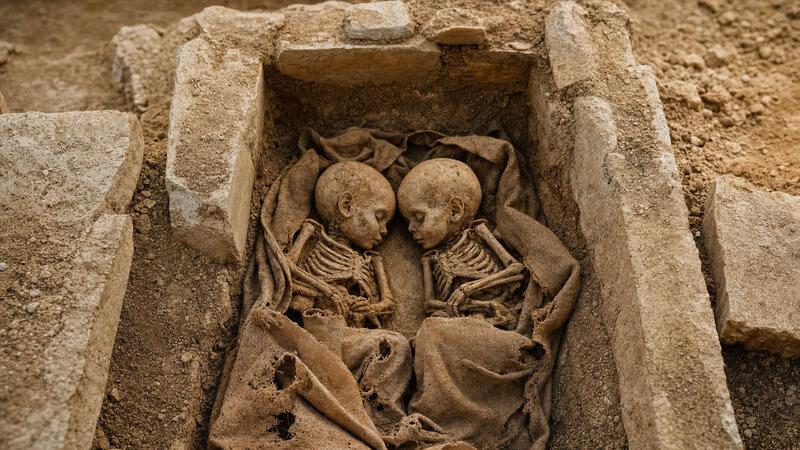

Sometime in the eighth century, in the rubble-strewn outskirts of a city that had once been among the greatest in the Roman world, someone carried two tiny bodies into an abandoned latrine and laid them down side by side with exquisite care. It is one of the most quietly devastating images in recent archaeology — and it refuses to be read as anything other than an act of love.
A Burial in an Abandoned Latrine

The latrine in question belonged to the sanctuary of Artemis at Ephesus, in what is now western Türkiye. By the eighth century, that building had been out of use for generations. Marble had cracked and shifted, columns had toppled or been scavenged for new construction, and the elaborate plumbing that had once served the sanctuary’s visitors was long since silent. Into this forgotten channel, someone descended with two premature newborns and made a grave.
Archaeologists working at the site under the auspices of the Austrian Archaeological Institute (OEAI/OEAW) uncovered the remains during excavations at the sanctuary. What they found was not the careless disposal of unwanted infants — the evidence points emphatically in the other direction. The bodies appear to have been wrapped, possibly in cloth or swaddling, before being placed together. Researchers believe the burial was deliberately and carefully prepared, with the intention of protecting these children in whatever came after life.
The details that make this discovery so arresting accumulate quickly. The two infants were premature, probably surviving only hours or days at most. They may have been twins, though confirming a biological relationship would require DNA analysis that has not yet been reported. And one of them carried a small anatomical variation: an extra rib, a rare skeletal trait that would have been entirely invisible during life, preserved only in bone across more than twelve centuries. These were not abstractions. They were specific people, and someone knew that.
The Sanctuary That Outlived Its Gods

To understand why this burial matters, it helps to understand what Ephesus had been. At its height during the Roman imperial period, the city was one of the most important on the Aegean coast — a major metropolis, a hub of trade, philosophy, and religious life. Its Temple of Artemis was counted among the Seven Wonders of the Ancient World, a structure so vast and ornate that ancient visitors described it with the breathless vocabulary usually reserved for mountains and seas.
By the eighth century, that world was long gone. The temple itself had been dismantled over centuries, its stones claimed for churches and other construction, its sacred precincts reshaped by the spread of Christianity and the slow retreat of the sea that had once made Ephesus a viable port. What remained was a landscape of layered ruins — Roman foundations beneath Byzantine construction beneath the encroachment of soil and vegetation. The sanctuary of Artemis had become neither pagan nor Christian in any clean sense, but something in between: a charged, ambiguous space carrying the memory of what it had been.
This ambiguity was not incidental to the burial. Across the late Roman and early medieval world, abandoned structures attracted a particular kind of attention from the living. Old foundations, sealed cisterns, defunct drains — these were understood as liminal spaces, thresholds between the world of the living and whatever lay beneath or beyond it. Burying the vulnerable dead in such places was not a gesture of shame. It was, in the logic of the time, a gesture of protection.
What the Bones Tell Us

The physical evidence recovered from the latrine channel is spare but eloquent. Two premature newborns were laid side by side, their positioning consistent with deliberate, careful arrangement rather than hasty deposit. The likely presence of wrapping material — suggested by the way the skeletons were found — implies that someone took time to prepare these children for burial in the way one prepares any beloved dead: cleaned, covered, arranged.
Premature infant bones are among the most fragile objects that archaeology ever encounters. The skeleton of a full-term newborn is already delicate; a premature infant’s bones are thinner still, easily dissolved by soil acidity, easily displaced by the shifting of sediment over centuries. The fact that these two skeletons survived at all — intact enough to be recognized, analyzed, and interpreted — is a minor miracle of preservation, and the precondition for the entire story.
The extra rib on one infant is the kind of detail that transforms a skeletal fragment into a person. Cervical ribs — small extra bones emerging from the lowest neck vertebra — occur in roughly one to two percent of the population. They cause no visible outward sign. The person who wrapped and buried this child would not have known it was there. But across more than a thousand years, that small variation in bone has survived to individualize one of these two lives in a way that nothing else can.
The twin hypothesis, while unconfirmed, is consistent with everything known about the burial. The infants were of comparable apparent age and were found together in a prepared grave. Researchers have noted the possibility that they were twins, while acknowledging that only genetic analysis could establish biological kinship. Whether twins or not, they were buried as a pair — together in death as they appear to have been in the final hours or days of their brief lives.
Roman Attitudes Toward Newborn Death — and Their Limits

The history of how ancient societies treated newborn death is neither simple nor comfortable to read. Roman law and social custom did not automatically extend full personhood to infants, particularly in the first days of life. Exposure — leaving an unwanted newborn in a public place — was a documented and legally tolerated practice, used to dispose of infants considered illegitimate, disabled, or simply too numerous for a household to support. Premature infants occupied an especially uncertain status: their survival was so unlikely without medical intervention that they may not always have been counted among the living in any formal sense.
But the archaeological record complicates any clean narrative about Roman indifference to infant death. Infant burials across the Roman world range from elaborately furnished graves to complete absence, suggesting that the gap between legal norm and emotional reality was wide and variable. Private grief did not wait for public permission. Families mourned children that the law might not have recognized as fully persons, and the archaeological evidence — small oil lamps, miniature vessels, carefully positioned bodies — records that mourning in the only language it left behind.
By the eighth century, the theological and cultural landscape had shifted considerably. Christianity had reshaped attitudes toward the soul and toward burial obligation across the former Roman empire, though practice varied enormously by region, community, and circumstance. The unbaptized dead occupied a theologically complicated position in early medieval thinking, and what this meant in practice for the burial of premature infants — who had almost certainly not been baptized — depended entirely on where and among whom one lived.
The Ephesus burial sits exactly at this cultural hinge. It is neither straightforwardly Roman nor fully medieval in its logic, but carries the weight of both traditions. The choice of an abandoned Roman space as a burial site may itself reflect this ambiguity — a place that retained spiritual charge without belonging to any current religious authority, a space where the rules about who could be buried, and how, were not yet fully settled.
Why a Latrine? The Logic of Liminal Spaces

The question that most people ask first — why here? — turns out to have a coherent answer, even if it requires stepping inside a way of thinking about space and death that is not our own. In both late antique and early medieval belief, places that were enclosed, subterranean, or connected to the earth’s interior were understood as thresholds — sitting closer to whatever realm received the dead. Placing someone in such a space was not an act of degradation. It was, within that symbolic framework, placing them at the most direct possible point of passage into what lay beyond.
Infant burials in drains, beneath floors, and within abandoned foundations appear at multiple Roman and post-Roman sites across Europe and the Near East. This was not an aberration specific to Ephesus but part of a broader cultural grammar around burying the very young in enclosed, sheltered, protected spaces. The latrine channel was not understood as a place of filth in this symbolic vocabulary — it was a passage, a threshold, a contained shelter for the vulnerable dead.
Everything about the preparation of this burial reinforces the protective interpretation. The wrapping of the bodies, the side-by-side placement, the selection of this specific location within the ruined sanctuary — none of it reads as casual or shameful. It reads as deliberate. Someone made decisions about each of these details, and those decisions were the decisions of people trying to do right by children they had lost.
The Human Scale of a Grand Site

What this discovery adds to our understanding of ancient Ephesus is precisely the human scale that grand archaeological sites often obscure. Ephesus is usually discussed in terms of its temple, its theater, its library, its role in the commerce and politics of the ancient Mediterranean. These are legitimate and important subjects. But the city was also a place where premature infants were born and died, where parents or communities made decisions about where to place them, and where grief operated according to its own logic regardless of what law or theology prescribed.
Bioarchaeology — the analysis of skeletal remains within their archaeological and historical context — is what makes it possible to read these bones as biography rather than mere data. The OEAI/OEAW research brings together osteological expertise, careful excavation, and historical knowledge to interpret not just what was found but what it meant. The result is an account of two specific lives, however brief, and one specific act of care at a specific moment in a specific place.
Open questions remain. Who were the parents or caregivers who made this burial? Were they residents of whatever community had established itself near the old sanctuary, pilgrims passing through, or members of an early Christian group that had given new meaning to the ruined space? Isotope analysis of the bones could eventually indicate where these infants — and by extension their family — had lived and what they had eaten. DNA testing could address the twin question definitively. These answers may still come.
What Two Small Skeletons Ask of Us
Whatever the theology of eighth-century Ephesus said about premature newborns, whatever the surviving Roman legal framework suggested about their personhood, whatever the local Christian community believed about unbaptized souls — someone wrapped two tiny bodies and carried them to a place they believed was safe. That act precedes and outlasts any of those frameworks.
The assumption that ancient and early medieval societies were simply indifferent to infant death has always been too blunt to hold up against the evidence. What the archaeological record actually shows is a far more textured picture: communities navigating grief with the tools available to them, bending custom and law and space to accommodate loss in ways that felt right even when no official category existed for what they were doing. This discovery pushes back against the blunt narrative with quiet insistence, adding one more data point to an already substantial body of evidence for ancient parental grief.
Excavations at Ephesus continue, and they continue to surface exactly this kind of story — not the grand sweep of empire and monument, but the granular, intimate record of how people actually lived and lost and mourned. Each layer of that extraordinary site adds something to the account of what it meant to be human in a particular place across many centuries.
Across more than twelve hundred years, the careful placement of two premature infants in a worn-out Roman latrine remains legible as what it almost certainly was: not disposal, not neglect, not indifference to lives too short to count — but an act of protection, of love, of someone doing the only thing they could think of to help, and doing it with both hands, in the best place they knew.

 English
 Arabic
 French
 Spanish
 Portuguese
 Deutsch
 Turkish
 Italiano
 Russian
 Romaian
 Portuguese (Brazil)
 Greek
Greek