


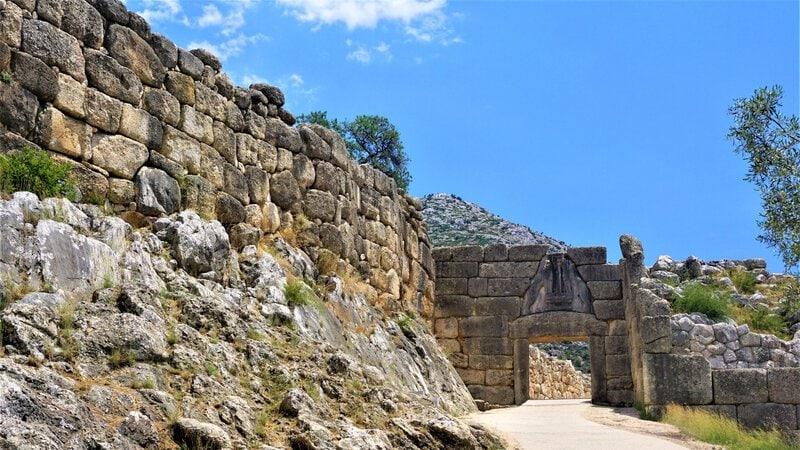

Imagine arriving at the citadel of Mycenae around 1250 BC. You have walked for hours through the parched hills of the Argolid, and then the walls simply appear — limestone blocks so enormous, stacked so high, that your first instinct is not admiration but awe of a slightly frightened kind. The gate ahead of you is framed by a triangular slab of stone weighing roughly twenty tonnes, carved with two lions rearing on either side of a column: the Lion Gate, the oldest monumental sculpture in Europe, and the front door of a civilization that most people today have never properly encountered. Behind you, the Parthenon will not exist for another eight centuries. Ahead of you is a palace-fortress that makes classical Athens look, in purely physical terms, modest.
The First Greeks
The Mycenaeans were not a mysterious pre-Greek people who vanished and left Greece to be repopulated by someone else. They were Greeks — the first Greeks, in fact. Mycenaean civilization was the earliest advanced Greek civilization on European soil, and the people who built those cyclopean walls were the first in Europe to speak and write the Greek language. They did not write it in the alphabet we recognize — that came much later, borrowed from the Phoenicians — but in a syllabic script called Linear B, pressed into clay tablets that recorded grain rations, land tenures, military rosters, and lists of perfumed oils destined for palaces and temples alike.
This civilization flourished roughly between 1700 and 1100 BC, peaking in power and reach during the fifteenth through thirteenth centuries BC. At its height, Mycenaean culture had spread across the Greek mainland, absorbed the older Minoan civilization of Crete after around 1450 BC, and extended trading networks into Egypt, the Levant, and Anatolia. The anchor points of the world they built were the palace complexes: Mycenae itself in the Peloponnese, Tiryns just a few miles away, Pylos on the western coast, Thebes in Boeotia. Each was a combined fortress, throne room, administrative hub, and economic redistribution center. The king — the wanax, in their own language — did not simply rule. He managed. Linear B tablets from Pylos reveal a bureaucratic apparatus tracking hundreds of individual rowers, parcels of agricultural land, and detailed religious offerings. This was not a loose collection of warrior clans sitting around fires. It was, in its own Bronze Age idiom, a state.
To feel the full strangeness of this, hold the timeline in your head: Mycenaean Greece rose and fell more than seven hundred years before the Parthenon’s first stone was quarried. The Mycenaeans are as distant from Pericles as Pericles is from us, sitting today in the twenty-first century. Ancient Greece before Athens was not a rough sketch awaiting the masterpiece — it was its own fully realized civilization, and in certain respects a more physically imposing one.
Society, Trade, and the Palace Economy
Mycenaean society was rigidly hierarchical. Below the wanax sat a second figure, the lawagetas — literally “leader of the people,” likely a military commander — followed by regional governors called korete and local officials beneath them. At the base of the pyramid were landless laborers and slaves, whose rations and duties the palace scribes recorded with the same meticulous indifference they applied to jars of olive oil.
The palace economy functioned as a command system. Workshops attached to the palace produced textiles, bronze weapons, and perfumed oils. Farmers and herders delivered portions of their output as taxes in kind. The palace redistributed commodities to craftsmen, soldiers, and religious institutions. This was not a market economy in any modern sense — prices, as we understand them, did not exist. Everything flowed through the palace and back out again, which made the system extraordinarily efficient in stable times and extraordinarily fragile when the palace itself came under pressure.
Trade, nonetheless, was genuinely international. Mycenaean pottery has been recovered from sites across the Eastern Mediterranean — Cyprus, Egypt, the Levant, Sicily, and the Lipari Islands. Egyptian tomb paintings from the fifteenth century BC depict figures carrying Aegean-style vessels, plausibly Mycenaean merchants or gift-bearers arriving at the pharaoh’s court. The Uluburun shipwreck, discovered off the coast of southern Turkey and dated to around 1300 BC, carried a cargo that included Mycenaean pottery alongside copper ingots from Cyprus, tin of uncertain origin, ebony from Africa, and luxury goods from Egypt and Canaan — a snapshot of the interconnected Bronze Age world in which the Mycenaeans were active participants, not provincial bystanders.
Engineering That Made Later Greeks Invent Giants
Stand at Tiryns and look at the walls. Some of the limestone blocks fitted into the lower courses weigh over a hundred tonnes. Classical-era Greeks, visiting these ruins centuries after the civilization that built them had vanished, were genuinely baffled. Their explanation was mythological: only the Cyclopes, the one-eyed giants of legend, could have moved stones like that. The walls earned the name “cyclopean,” and it has stuck ever since, because no better word captures the sheer improbability of what human hands managed to accomplish with bronze tools and enormous organizational will.
At Tiryns the engineering goes further than brute mass. Corbelled galleries — long, tunnel-like passageways roofed by stones that step progressively inward until they meet — run through walls nearly eight meters thick. These corridors, which served as armories and storage vaults, survive intact today, dimly lit and cool, the stone above your head utterly unmoved after three thousand years. They are among the best-preserved Bronze Age structures anywhere in the world, and they belong to a civilization that most general histories of ancient Greece dispatch in a few introductory paragraphs before hurrying on to Socrates.
The contrast with classical architecture is worth dwelling on, because it reveals something important about what the Mycenaeans were actually building. The Parthenon is a monument to civic and religious beauty — marble columns, mathematical proportions, sculpture designed to catch afternoon light. Mycenaean palaces were command centers built to survive catastrophe. Their megaron throne rooms, centered on a great circular hearth and decorated with frescoed hunting scenes and warriors, were designed as the operational heart of a military economy. The underground cisterns cut into the bedrock at Mycenae and Tiryns — secret passages leading to water sources hidden within the walls — were not a luxury feature. They were preparation for siege.
Then there are the tombs. The Treasury of Atreus, a tholos or beehive tomb just outside the citadel at Mycenae, is a corbelled stone vault roughly fourteen meters in diameter at its widest point. It was assembled without mortar, each stone precisely cut and fitted, and it has stood intact for over three thousand years. The lintel stones above its entrance are among the largest single blocks moved anywhere in the Bronze Age world. Roman engineers, who were not given to admiring their predecessors’ work, would have recognized immediately what they were looking at: a structural achievement of the first order, accomplished before iron tools existed.
Agamemnon’s War: Where Myth Meets the Ground

Homer’s Iliad places Agamemnon, king of Mycenae, at the head of a coalition of Greek kingdoms sailing to besiege Troy. Odysseus comes from Ithaca. Achilles from Phthia. The catalog of ships in the second book of the Iliad reads, to a modern archaeologist’s eye, like a remarkably accurate map of Mycenaean political geography — the right settlements, in roughly the right relationships of power, at roughly the right period. This is not coincidence. Homer was composing his epics in the eighth century BC, but drawing on a deep well of oral tradition that stretched back to the Bronze Age world the poems describe.
Heinrich Schliemann, the nineteenth-century businessman turned obsessive archaeologist, took Homer literally and went looking. His excavations at Mycenae in 1876 produced shaft graves so laden with gold masks, weapons, and jewelry that he famously telegraphed the King of Greece to announce he had gazed upon the face of Agamemnon. He was wrong about the specific identification — the shaft graves predate the Trojan War period by several centuries — but he was not wrong about the essential point: this was a real place, a real civilization, and it was exactly as wealthy and powerful as the epic tradition claimed.
At Hisarlik in northwestern Turkey, Schliemann also found Troy. A destruction layer archaeologists call Troy VIIa has been dated to roughly 1180 BC, placing it squarely within the late Mycenaean period and the broader moment of civilizational decline that was already underway across the Eastern Mediterranean. Linear B tablets from Pylos, meanwhile, record coastal watchers posted at harbors in what reads almost like a military emergency alert, along with detailed muster lists of rowers assembled for sea duty — precisely the kind of coordinated maritime organization Homer describes when he lines up a thousand ships on the beach at Aulis. The scholarly consensus today does not ask whether Homer invented everything or reported everything accurately. It asks, more carefully, whether a real geopolitical conflict between Mycenaean Greeks and the inhabitants of northwestern Anatolia in the thirteenth century BC provided the historical kernel around which the epic tradition grew. Most specialists now think the answer is probably yes.
The Cracks Beneath the Surface
By the middle of the thirteenth century BC, Mycenaean civilization was already showing signs of strain. The massive new fortification programs undertaken around 1250 BC — expanded walls, hidden cisterns, reinforced gates — suggest not confidence but anxiety. Someone, or something, was being prepared for. The palace economies were structurally fragile in ways their architects could not have recognized: they depended entirely on long-distance trade networks to supply the tin and copper needed to produce bronze, the material on which every tool, weapon, and agricultural implement depended. Disrupt those networks — through raiders, political instability, or the collapse of a trading partner — and the entire system of production begins to seize up.
There is also physical evidence of natural stress. Geologists and archaeologists have identified earthquake damage at several Mycenaean sites during this period, including significant destruction at Tiryns. Palaeoclimatological data from pollen cores and isotope analysis increasingly suggests that a prolonged drought affected much of the Eastern Mediterranean during the late thirteenth and early twelfth centuries BC, stressing agricultural yields at precisely the moment palace systems needed surplus to function. The administrative tablets from Pylos, baked into permanence by the fire that eventually destroyed the palace, hint at a bureaucracy watching its coastline with mounting alarm in what turned out to be its final operational season. The palace was posting watchers. It was mustering rowers. It was preparing. It was not enough.
The Bronze Age Collapse: A Civilization Erased in a Generation
Around 1200 to 1100 BC, the world that the Mycenaeans had built came apart with a completeness and speed that still astonishes historians. Palace after palace burned or was abandoned. Mycenae, Tiryns, and Pylos all show destruction layers in the archaeological record. Pylos was never rebuilt. Its Linear B archive, which had recorded in meticulous detail the anxious final months of the palace administration, survived only because the fire that destroyed the building accidentally fired the clay tablets like pottery — an archive preserved by the catastrophe that killed the institution it documented.
What makes the Bronze Age collapse so historically remarkable is that it was not uniquely Greek. It was pan-civilizational. The Hittite Empire, which had been the dominant power of Anatolia and a peer rival to Egypt, disintegrated entirely. Ugarit, the great trading city on the Syrian coast, was destroyed and abandoned, its ruins yielding letters that were never sent — diplomatic correspondence interrupted mid-composition by whatever arrived at the gates. Egyptian records from the reign of Ramesses III describe waves of “Sea Peoples” attacking from the west and north, coalitions of displaced populations whose own homelands had apparently already been destroyed. Trade across the Eastern Mediterranean, the arterial system of the Bronze Age world, effectively ceased.
Scholars have debated the causes for generations. Drought, the Sea Peoples, internal rebellions, earthquakes, epidemic disease, systems collapse — none of these explanations, taken alone, quite fits the totality of what happened. The model that has gained the most traction in recent decades is what researchers sometimes call cascading systems failure: multiple stressors arriving simultaneously at a system that was already tightly coupled and under strain, each failure triggering the next in a cascade that the palace administrations, for all their bureaucratic sophistication, had no mechanism to absorb. The very efficiency that made the palace economy powerful — its tight coordination, its elimination of redundancy — left it with almost no resilience when several things went wrong at once.
The human cost was staggering and long-lasting. Organized palace states ceased to exist across most of Greece. Population declined sharply, as evidenced by a dramatic contraction in the number of occupied settlements visible in the archaeological record. And Linear B, the writing system the Mycenaeans had used to track their world in such meticulous detail, vanished entirely. Greece entered what historians call the Dark Age — roughly four centuries of reduced complexity, sharply curtailed long-distance contact, and no writing whatsoever. The culture that eventually built the Parthenon did not inherit the Mycenaean world intact. It had to reconstruct civilization, slowly and partially, from the rubble of something it could barely remember.
What the Mycenaeans Left Behind
The Mycenaeans were not a prelude to real Greek history. They were Greek history’s first great chapter — the people who established the language, the mythological imagination, and the heroic ideals that Homer later crystallized and that classical Athens then inherited, transformed, and projected onto philosophy, drama, and democratic politics. When Athenians told stories about Agamemnon, Odysseus, and Achilles, they were not making things up entirely. They were, in a complicated and mediated way, remembering.
Their collapse is one of history’s most instructive warnings. A literate, internationally connected, administratively sophisticated civilization can unravel within a single generation when its interlocking systems — trade, food supply, political authority, military capacity — fail simultaneously. The Mycenaean palace states were not brought down by barbarism or ignorance. They were brought down by fragility masquerading as strength: a highly optimized system that had no resilience when multiple things went wrong at once.
Modern archaeology keeps revising the picture upward. New excavations, improved radiocarbon dating, and the ongoing decipherment and analysis of Linear B tablets continue to reveal a world far more complex, literate, and cosmopolitan than the “primitive Bronze Age warrior” stereotype permits. The Mycenaeans traded with Egypt, maintained diplomatic contact with Hittite kings — Hittite texts refer to a western kingdom called Ahhiyawa, widely identified by scholars as the Mycenaean world — managed large-scale agricultural redistribution, and built structures that have survived three millennia of earthquakes, invasions, and tourists.
And the Lion Gate still stands at the entrance to Mycenae, those two limestone lions worn smooth by more than thirty centuries of weather, looking out over the road from the Argolid as they have looked out since approximately 1250 BC. They watched the Dark Age settle over Greece. They watched classical Athens rise and fall. They watched Alexander march east, and Rome absorb Greece into its empire, and Byzantium, and the Ottoman centuries, and the modern Greek state grow up in the landscape below them. They are perhaps the single most resonant monument in the entire story of Western civilization — the front door of the people who started it all, still open, still there, waiting for someone to look up and notice.

 English
 Arabic
 French
 Spanish
 Portuguese
 Deutsch
 Turkish
 Dutch
Dutch
 Italiano
 Romaian
 Portuguese (Brazil)
 Greek
Greek