


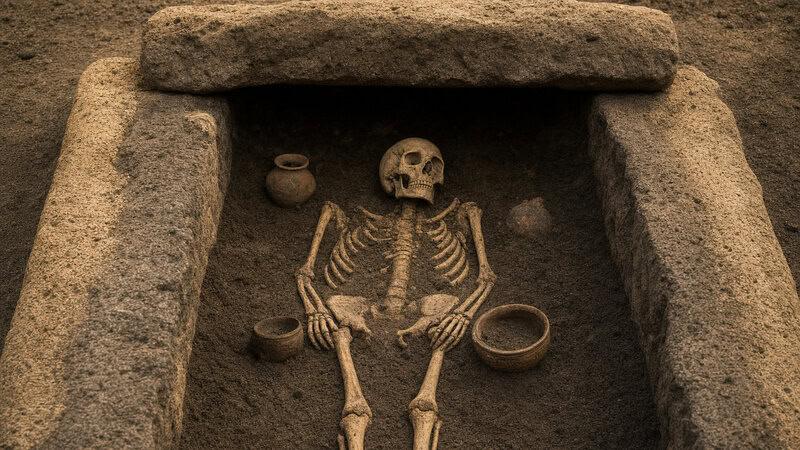

Beneath a quiet patch of volcanic soil in western El Salvador, an individual was laid to rest nearly three millennia ago — and the world only found out in the summer of 2026. Here is the story of that burial, from the moment of interment to the headlines that rippled across the globe, told in the order it actually unfolded.
~850 B.C. — A Person Is Laid to Rest Beneath the Volcanic Soil of Western El Salvador

Roughly 2,875 years ago, during the Early Preclassic period of Mesoamerican prehistory, someone was deliberately placed in the earth at a site in what is now western El Salvador. The community that buried this individual did so with intention — this was not accidental disposal but a considered act, one that speaks to ritual awareness and a belief that the dead deserved a particular kind of send-off.
What made the burial survive at all was geology as much as care. Volcanic ash — the perpetual companion of life in El Salvador — eventually sealed the remains in a near-perfect envelope, turning an ordinary grave into an ancient burial site preserved across millennia. Without that ash layer, the bones almost certainly would not have endured long enough for anyone to find them.
The Early Preclassic World This Person Inhabited

In 850 B.C., Central America bore almost no resemblance to the landscape of towering Maya temples and inscribed stone monuments that most people picture. The Early Preclassic period — running roughly from 2000 to 1000 B.C. — was an era of small, inventive communities feeling their way toward complexity: refining pottery, expanding agriculture, and developing the first formal expressions of ritual life. The great Maya Classic florescence was still centuries away.
Because so much archaeological attention has historically flowed toward the Classic period, the Early Preclassic remains comparatively understudied. That imbalance makes every confirmed site from this era carry outsized weight. The position of this individual’s body, and whatever objects may have accompanied them, can illuminate social hierarchies and cosmological beliefs that no written record from this time and place can supply.
A Separate Late Classic Burial Adds a Second Layer to the Site’s Story

The Early Preclassic burial was not the only revelation at the site. Researchers also documented six complete ceramic pots dated to the Late Classic period, along with human remains placed deliberately beside two of those vessels. The pots were whole and unbroken — not trash, not construction fill, but carefully arranged grave goods signaling a community with a fully developed theology around death and what might follow it.
The layering of a Late Classic burial above or near a deposit from roughly 850 B.C. suggests something important: this patch of ground was not chosen at random. It appears to have carried ritual or ancestral meaning across multiple centuries of indigenous history in Central America — a place returned to again and again precisely because it already held the dead.
A Tuesday Excavation — The Moment Archaeologists Physically Lift the Remains

At some point in the lead-up to the public announcement, a field team gathered around the burial and began the painstaking work of exhumation. El Salvador’s Ministry of Culture specifically noted that the physical removal of the human remains took place on a Tuesday — a detail that grounds the discovery in the unglamorous, methodical reality of archaeological fieldwork. Brushes, dental picks, and careful documentation of spatial relationships came before any broader scientific conclusions could be drawn.
That Tuesday marked a genuine threshold. For approximately three thousand years, these human remains had rested undisturbed beneath the volcanic ash. The moment the first bones were lifted free, this individual crossed from the realm of the buried to the realm of the studied — a subject of science, history, and, ultimately, global news.
The Site Near Antiguo Cuscatlán — Urban Sprawl and Ancient Ground Collide

The find was situated near San Salvador, in the area of Antiguo Cuscatlán — one of the most densely developed municipalities in the entire country. It is a place of office parks, residential towers, and the constant churn of a modern capital’s edge. Finding a 3,000-year-old burial here is a reminder of how thin the membrane can be between contemporary life and deep pre-Columbian Central American archaeology.
Western El Salvador has known archaeological significance, but urban growth has historically outrun systematic excavation across the region. The fact that this burial survived beneath what is now heavily developed ground makes its preservation all the more remarkable — and raises the uncomfortable question of how many comparable sites have already been lost to construction without ever being recorded.
El Salvador’s Ministry of Culture Makes the Official Announcement

The formal announcement came from El Salvador’s Ministry of Culture, which positioned itself as the authoritative voice on the discovery and framed it within the country’s broader heritage narrative. Official state involvement carries real practical consequences: it signals that the remains and any associated artifacts will be treated as protected cultural property rather than incidental finds, shaping everything from laboratory access to long-term curation.
The Ministry’s framing also did something subtler. By connecting a 3,000-year-old burial to Salvadoran national identity, it asserted a deep, continuous indigenous history on this territory — a claim with cultural and political resonance in a country where pre-Columbian heritage has sometimes been overshadowed by colonial and more recent historical narratives.
July 22-23, 2026 — The World Learns About the Find Almost Simultaneously
Within a single 24-hour window straddling July 22 and 23, 2026, coverage of the discovery broke across a striking range of outlets. CBS News, WION News, Fox26, The Truth International, Gulf Times, and Archaeology.org all published within hours of one another. The synchronized pickup reflects a coordinated government release engineered to land with maximum reach across English-language, Latin American, and international media ecosystems.
Specialist platforms such as Archaeology.org anchored the scientific framing of the story on July 23, lending it a layer of credibility that kept it circulating beyond the typical 24-hour news cycle. The breadth of coverage — from cable news to academic-adjacent science journalism — illustrated just how hungry general audiences remain for stories rooted in pre-Columbian Central American archaeology.
What the Volcanic Ash Preservation Reveals About El Salvador’s Geological Character

The ash layer that preserved these remains is not incidental scenery — it is a direct product of El Salvador’s position along the Pacific Ring of Fire, a country strung along a chain of active volcanoes that have shaped, and periodically devastated, human settlement for thousands of years. Volcanic ash preservation works much as it did at Pompeii: an eruption that covers a site simultaneously freezes the moment with extraordinary fidelity, sealing organic material, spatial relationships, and stratigraphy in ways that slower processes of decay would never allow.
For archaeologists, the ash layer also provides an independent chronological tool. It establishes what specialists call a terminus ante quem — the burial must predate the volcanic event that covered it, giving researchers a hard upper boundary for the site’s age that can be tested alongside radiocarbon dating. Geology, in other words, becomes a co-author of the historical record.
Why This Discovery Challenges the Narrative of Pre-Columbian Central America

For generations, Central America has been written into the story of the ancient Americas primarily as a corridor — a passageway between the monumental civilizations of Mesoamerica to the north and the Andean cultures to the south, rather than a cradle of independent cultural complexity in its own right. A formally excavated, Ministry-documented 3,000-year-old burial in El Salvador — with ritual ceramics from a later period layered above it — pushes back against that peripheral framing and argues instead for sustained, sophisticated indigenous occupation across millennia.
Compared to Mexico or Peru, the archaeological record of Central America remains dramatically undersampled. Every stratified site like this one adds resolution to a picture that is still, in many places, more gap than image. The community represented by this burial may be only one of many waiting beneath the volcanic soil — communities that shaped their own world long before anyone thought to write about them.
What a Single Burial Ultimately Offers

A skeleton and some ceramic pots are, on their face, modest objects. But in the right archaeological context — stratified, documented, and set against the deep timeline of Central American prehistory — they become something far larger: a reordering of assumptions about who was here, how sophisticated those communities were, and how long the story of El Salvador’s indigenous peoples has been quietly unfolding beneath our feet. The summer of 2026 gave that story a moment of overdue visibility. The work of understanding it has only just begun.

 English
 Arabic
 French
 Spanish
 Portuguese
 Deutsch
 Turkish
 Dutch
Dutch
 Italiano
 Russian
 Portuguese (Brazil)
 Greek
Greek