


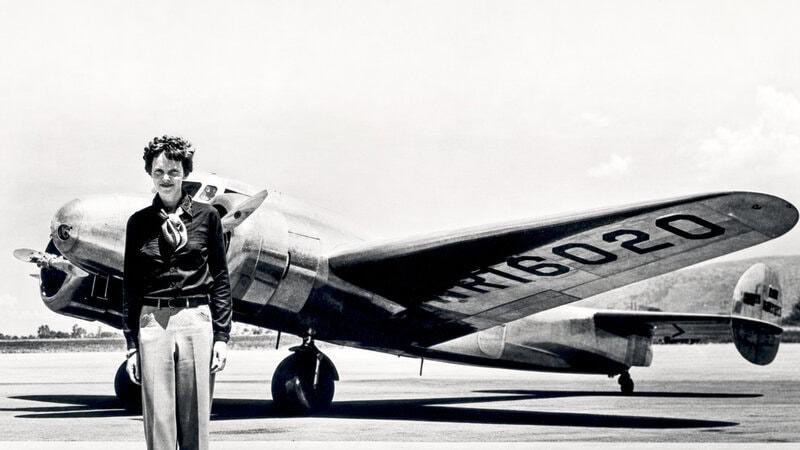

At some point in the pre-dawn darkness of July 2, 1937, somewhere over the vast, indifferent Pacific, Amelia Earhart’s voice crackled out of the radio one last time — and then the ocean swallowed the silence whole. What makes her disappearance so haunting, nearly nine decades later, is not just that she vanished, but that the machinery of rescue was still grinding into motion long after the moment it could have mattered.
The Last Transmission: A Voice in the Static

The U.S. Coast Guard cutter Itasca sat off Howland Island, a coral speck barely two miles long lost in the central Pacific. Its crew had been waiting through the night, ears pressed to receivers, tasked with one critical job: guide Earhart’s Lockheed Electra 10E in from the west. She was somewhere out there in the dark with her navigator Fred Noonan, roughly 2,556 miles of open ocean behind them, their fuel running toward the red line.
The radio contact was fragmentary, maddening, and deeply one-sided. Earhart could transmit. The Itasca could receive her. But she, apparently, could not hear their replies — a communications failure born of mismatched frequencies and missing equipment that turned every exchange into a message thrown into a void. Her transmissions grew shorter and more urgent as the hours passed. She reported clouds. She reported that they must be close. She gave a position line.
Her final confirmed transmission — “We are on the line 157-337… We will repeat this message on 6210 kilocycles. Wait” — hung in the air and then went still. The Itasca‘s crew waited. Nothing came. The silence that followed has echoed for nearly ninety years.
Here is the haunting irony that defines the whole story of the Amelia Earhart disappearance: by the time officials on the American mainland were debating whether a search was even warranted — weighing costs, jurisdictions, and probabilities — Earhart was already gone. The decision-making machinery of government moved at the speed of bureaucracy. Disaster moves faster.
Who Was Amelia Earhart, and Why Did the World Hold Its Breath?

She was born on July 24, 1897, in Atchison, Kansas, into a world that had very clear ideas about what women were permitted to do — and she spent her entire life quietly demolishing those ideas, one altitude record at a time. She took her first flying lesson in January 1921 at Kinner Field near Long Beach, California, with instructor Neta Snook, and was already saving for her own plane within months — a pattern of restless, forward-leaning ambition that would define everything that followed. By the end of 1921 she held her National Aeronautic Association pilot’s certificate, and in 1923 she became only the sixteenth woman in the world to receive an international pilot’s license from the Fédération Aéronautique Internationale.
In June 1928, Amelia Earhart became the first woman to cross the Atlantic Ocean by air — but she crossed it as a passenger aboard the Friendship, a fact she found genuinely humiliating. She described herself as little more than a sack of potatoes on that flight. So she went back. In May 1932, she became the first woman, and only the second person ever, to fly solo and nonstop across the Atlantic — this time with her own hands on the controls for every mile of the roughly 2,000-mile crossing from Harbour Grace, Newfoundland, to a pasture near Londonderry, Northern Ireland.
The records accumulated steadily after that. In January 1935 she completed the first solo flight from Hawaii to California — a crossing considered more dangerous than the Atlantic because of its greater distance over open water — becoming the first person of any gender to solo both oceans. She also held the women’s speed record and the women’s altitude record at various points in the 1930s. By 1937 she was the most famous female aviator on earth, a figure who occupied a rare cultural space: genuinely celebrated, not merely tolerated.
Her round-the-world attempt that year was her most audacious project yet, following a near-equatorial route of roughly 29,000 miles chosen specifically for its difficulty. She had already completed most of it when she disappeared — she and Noonan had flown from Oakland to Miami, across to South America, over Africa, through Asia, and on to Lae, New Guinea. The Pacific was the last great obstacle.
The stakes of her disappearance went far beyond one woman and one airplane. Earhart’s flights had been rewriting, year by year, what women were publicly permitted to dream. Her loss was not merely a tragedy — it was a cultural wound, and the world felt it accordingly. Front pages around the globe carried the news. Her story stopped people in their tracks in a way that only the most resonant figures manage.
The Flight Plan That Left Almost No Margin for Error
The Lae-to-Howland leg — approximately 2,556 miles over open ocean — was always going to be the most dangerous stretch of the entire journey: longer, more exposed, and more technically demanding than anything that had come before it. Howland Island offered no landmarks visible from altitude, no radio beacon powerful enough to cut through interference, and no margin for navigational error. Finding it from the air required everything to work perfectly at once.
Several things did not work perfectly. Evidence strongly suggests that Earhart’s Electra was not carrying the trailing wire antenna needed to receive on the lower frequencies the Itasca was using to reply to her — the antenna had reportedly been left behind to save weight. The two ends of this critical conversation were operating on different assumptions about how to reach each other. Neither side could fully understand why the other was not responding, and neither had the time to resolve it before the fuel ran out.
That fuel window was brutally narrow. The Electra carried enough for roughly twenty to twenty-one hours of flight under the conditions of that leg; the crossing was estimated at eighteen hours, leaving a buffer that headwinds, navigational drift, or time spent circling and searching for a signal could eat through quickly. Noonan was among the finest aerial navigators alive — he had charted transoceanic routes for Pan American Airways — but he was working without GPS, radar, or satellite positioning. A single degree of navigational error, accumulated over 2,500 miles of empty ocean, could carry a plane miles past an island two miles wide that would simply never appear below the wing.
The Government’s Slow Machinery vs. the Speed of Disappearance
The Itasca lost contact in the early hours of July 2, 1937. The crew immediately understood that something had gone very wrong. But the chain of decisions required to mount a real search — the kind involving naval vessels and aircraft and the weight of federal authority — moved at a different pace entirely. Hours passed before a coordinated response reached Washington. The Navy’s formal, large-scale search did not launch until days later, by which point any emergency landing or survival window was narrowing with every passing hour.
When the search finally came, it was genuinely massive. The Navy deployed the aircraft carrier USS Lexington, the battleship USS Colorado, and a squadron of supporting vessels, ultimately covering an estimated 250,000 square miles of ocean in what was, at the time, one of the largest peacetime search-and-rescue operations in American history. They found nothing. Not a piece of debris, not an oil slick, not a signal. The Pacific gave back nothing at all.
The official search was called off on July 18, 1937 — sixteen days after her disappearance — a decision driven by cost, exhaustion, and the apparent hopelessness of the task. Earhart was officially declared dead on January 5, 1939, after her husband, publisher George Putnam, had waited the legally required period. The official record closed. The mystery, as it turned out, was only beginning.
Three Theories, One Enduring Mystery
The dominant official explanation is the simplest one: Earhart and Noonan ran out of fuel, ditched in the ocean somewhere near Howland Island, and sank in water more than two miles deep. It is clean, tragic, and almost impossible to disprove in an ocean that deep. Many serious researchers still consider it the most probable answer to the question of what happened to Amelia Earhart.
But a second theory has accumulated enough physical evidence to command genuine scientific attention. The Nikumaroro hypothesis — championed most persistently by TIGHAR, The International Group for Historic Aircraft Recovery — holds that Earhart and Noonan missed Howland, flew southeast along their final reported position line (the 157-337 line), and landed on the reef of then-uninhabited Gardner Island, now known as Nikumaroro, roughly 350 miles southeast of Howland. The evidence cited in support of this theory includes:
- A partial skeleton found on the island in 1940 by British colonial officer Gerald Gallagher, accompanied by a sextant box and remnants of a campfire. The bones were sent to Fiji, professionally measured, and subsequently lost. A 1998 forensic re-analysis of the surviving measurements by Dr. Karen Burns and Dr. Richard Jantz concluded the skeletal dimensions were more consistent with a woman of Northern European descent than with the island’s known Polynesian population — though this conclusion remains contested among forensic anthropologists.
- Radio distress signals logged between July 2 and July 6, 1937, by multiple listeners, including a credible Pan American Airways direction-finding station at Mokapu Point, Hawaii. Such transmissions would have been possible only if the aircraft’s radio remained powered on solid ground, not submerged.
- Aluminum panels recovered from the island that TIGHAR researchers believe may match dimensions of a custom repair patch fitted to Earhart’s specific aircraft before departure — a claim that has not been independently verified to universal satisfaction.
- Additional artifacts including a woman’s shoe of a style and size consistent with Earhart’s known footwear, and a jar of anti-freckle cream consistent with a brand she was known to use.
It is important to note that none of these items has been definitively confirmed as Earhart’s property, and mainstream researchers remain divided on how much evidentiary weight the Nikumaroro hypothesis deserves. The evidence is suggestive, not conclusive.
A third theory — that Earhart was flying a secret intelligence mission for President Roosevelt, was captured by the Japanese military, and died in captivity — has never produced credible documentary evidence and is largely dismissed by serious aviation historians, however many adherents it retains in popular culture. A widely publicized 2017 photograph purporting to show Earhart and Noonan in Japanese custody was subsequently shown by independent researchers to predate her disappearance by at least two years.
Nikumaroro: The Evidence That Won’t Quit

What makes the Amelia Earhart mystery so unusually durable is not simply the absence of wreckage — it is the persistent presence of tantalizing fragments. The 1940 bones represent perhaps the most significant single piece of physical evidence. Gallagher’s discovery was reported through official British colonial channels and treated seriously enough at the time to prompt a medical examination. The measurements that survived suggest a body that does not straightforwardly fit the profile of the island’s known Polynesian inhabitants, though the absence of the bones themselves means that DNA analysis — the one method that could settle the question definitively — remains impossible unless the bones are relocated.
The radio signals logged in the days after the disappearance add a layer of evidence that is harder to dismiss than it might initially seem. Amateur and professional radio operators in multiple locations recorded transmissions on Earhart’s assigned frequencies during a window when, if the ocean-crash theory is correct, the Electra would already have been on the seafloor. Transmitting from an underwater aircraft is not physically possible. Transmitting from a plane on a coral reef flat, with the tide low enough to keep the antenna above water, is. TIGHAR researchers have analyzed dozens of logged signals and identified a subset they consider credible; skeptics argue the signals could have been atmospheric interference or misidentified transmissions from other sources.
Deep-sea sonar surveys along the underwater slope off Nikumaroro’s reef edge have not yet produced a confirmed aircraft wreck, but the search area is vast, the underwater terrain is treacherous, and the technology available to researchers improves with every passing year. A 2024 underwater survey identified a sonar anomaly on the reef slope that researchers were still analyzing at the time of publication. The Nikumaroro hypothesis remains open, not closed — and the gap between open and answered grows narrower with each expedition.
Earhart’s Legacy Beyond the Mystery
It would be a disservice to reduce Amelia Earhart to the circumstances of her disappearance. Before 1937 she was already one of the most consequential figures in American aviation — not merely as a symbol, but as a working pilot who pushed aircraft and routes to their practical limits. She co-founded The Ninety-Nines, the international organization of licensed women pilots, in 1929 and served as its first president. She used her celebrity deliberately, leveraging it to argue publicly and repeatedly that women were as capable as men of any technical or physical achievement the modern world demanded.
She was also, by the accounts of those who worked with her, a meticulous and serious aviator who took calculated risks rather than reckless ones. The round-the-world flight was extensively planned, funded through a combination of Putnam’s promotional skills and Earhart’s own lecture earnings, and supported by technical advisers at Purdue University, which had provided her Electra as part of a research partnership. That the mission ended in disaster reflects the brutal difficulty of what she was attempting, not a lack of preparation.
Her influence on women in aviation was immediate and lasting. The FAA has recognized her as a foundational pioneer in American aviation history, and the Ninety-Nines she helped found remains active today with more than 5,500 members across 44 countries.
Why the Mystery Still Matters — and What We’re Still Looking For
The Amelia Earhart disappearance is not merely a cold case waiting for physical resolution. It is also a mirror held up to how societies treat extraordinary women — how quickly their deaths are declared, their stories filed away, and the world permitted to move on. Earhart was declared dead approximately eighteen months after she vanished. The Pacific was presumed to have given its verdict. But the Pacific had not finished speaking.
Modern tools — deep-sea autonomous underwater vehicles, refined forensic bone analysis, advanced signal-processing research — mean that the Nikumaroro hypothesis is closer to resolution than at any point since 1937. Each expedition returns with data that previous generations could not have collected. Whatever the final answer proves to be, it is being pursued with more scientific rigor now than at any moment since the search was called off in July of that year.
What her story ultimately reveals — whatever the physical evidence eventually confirms — is the gap between the legends we construct and the facts we can prove. She became a legend the moment she vanished, and legends resist the tidiness of answers. Whether she rests in deep water off Howland Island or on the coral shelf of a tiny atoll in the Phoenix Islands, her final hours were spent doing exactly what she had always done: pushing further than the world thought possible. Nearly ninety years on, we are still trying to find her — and in doing so, still paying attention to a woman who spent her life insisting that attention was worth earning.

 English
 Arabic
 French
 Spanish
 Portuguese
 Deutsch
 Turkish
 Dutch
Dutch
 Italiano
 Russian
 Romaian
 Portuguese (Brazil)