


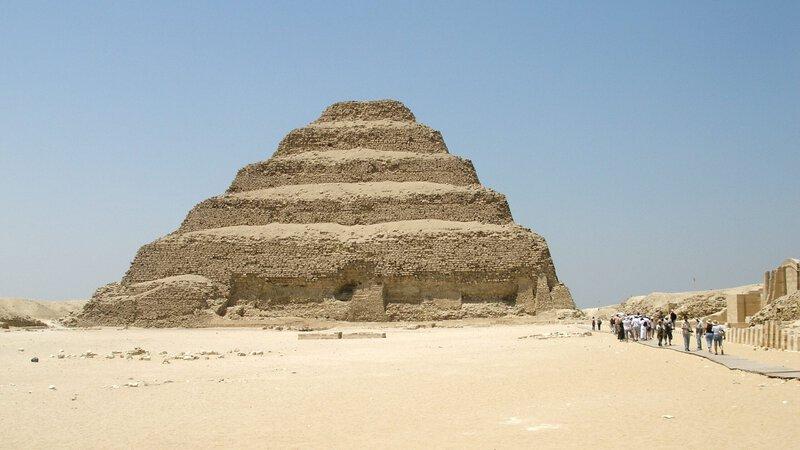

Around 2600 BCE, a man stood before the most powerful ruler on Earth and proposed something that had never been done — not anywhere, by anyone. Instead of the mud brick and bundled reeds that had always housed the dead, he wanted to build in stone, to stack great platforms of cut limestone into a shape that reached toward the sky. His name was Imhotep, and what he built still stands today, more than four millennia later, at a place called Saqqara.
The Man Beneath the Myth

Most people who recognize the name Imhotep picture Boris Karloff wrapped in bandages, or a CGI monster stalking Brendan Fraser across desert dunes. The Hollywood version is theatrical, memorable, and almost perfectly wrong. The real Imhotep was not a villain hauled back from the dead. He was one of the most accomplished human beings who ever lived — physician, architect, mathematician, priest, and chief minister, all compressed into a single extraordinary lifetime.
Consider the scale of that achievement against this single fact: Hippocrates, the man every medical textbook crowns as the father of medicine, was born roughly 2,200 years after Imhotep was already being celebrated for healing the sick.
His name, Imhotep, translates from ancient Egyptian as he who comes in peace. For close to two thousand years after his death, sick and grieving people whispered that name in temple courtyards, seeking his blessing. To place that in perspective: from the birth of Christ to the present day is roughly two thousand years. Imhotep’s cult endured at least that long.
A Commoner Who Rewrote the Rules

Born in Memphis, Egypt, likely sometime between 2655 and 2600 BCE, Imhotep rose not through royal blood but through an extraordinary breadth of intellect. In an ancient world where most officials served narrow roles and most craftsmen died without leaving their names on anything, Imhotep accumulated titles that read like the résumé of an entire university faculty: vizier, architect, astrologer, mathematician, physician, and high priest of the sun god Ra at Heliopolis, all while serving as Chief Minister to Pharaoh Djoser, who reigned from approximately 2592 to 2566 BCE.
The sheer fact that we know his name at all is remarkable. Egypt’s ancient monuments were raised by armies of anonymous laborers and engineered by officials who rarely earned more than bureaucratic obscurity. Yet Imhotep’s name was carved in stone beside the pharaoh’s — on the base of a statue of Djoser found at Saqqara — a distinction so rare for a non-royal that historians treat it as one of the strongest proofs of his singular status. He is widely regarded as the first architect, engineer, and physician in recorded history to be identified as a named individual. When we talk about Imhotep, we are talking about the very first named genius the historical record has preserved.
History’s first demonstrable polymath was not a Greek philosopher or an Italian Renaissance master. He was an Egyptian, and he lived at the dawn of recorded civilization itself.
The Step Pyramid: Inventing the Future in Stone

Before Imhotep, Egyptian rulers were buried beneath mastabas — low, flat-roofed rectangular structures built from mud brick. Functional, dignified, and utterly earthbound. Around 2600 BCE, at the beginning of the Third Dynasty, Imhotep changed the entire trajectory of human construction.
What he designed at Saqqara was audacious in a way that is difficult to fully absorb from a distance of four thousand years. The Step Pyramid of Djoser is the world’s oldest large-scale cut-stone structure — six mastabas of decreasing size stacked one atop another, rising to approximately 204 feet, surrounded by a complex of courts, shrines, and colonnaded halls stretching across nearly 40 acres. Nothing like it had existed before. Imhotep did not merely build a bigger tomb; he invented an entirely new way of building, pioneering the use of stone columns and translating forms previously made from organic materials — bundled reeds, wooden beams, mud brick — into dressed limestone capable of outlasting dynasties.
Stand at Saqqara today and you are looking at the same stones his workers set more than 4,600 years ago. The pyramid is not just old. It is physical proof that a single human mind, at the very beginning of what we call civilization, saw further than everyone around him and possessed the skill to make that vision permanent. Archaeologists have long sought Imhotep’s own tomb somewhere in the Saqqara necropolis — a pointed irony, that the man who perfected monumental burial has never been found in his own grave.
Healer, Diagnostician, and the Father of Medicine Nobody Talks About

The medical legacy of Imhotep is where the historical injustice cuts deepest. Ancient Egyptian sources credit him with composing early medical texts that were clinical, methodical, and grounded in direct observation — texts addressing the diagnosis and treatment of a wide range of diseases and injuries. What makes these attributed methods striking is not sophistication alone but approach: in an ancient world where illness was almost universally explained as divine punishment or demonic interference, the medicine associated with Imhotep leaned toward examining the patient, cataloguing symptoms, and prescribing physical treatments.
That is not magic. That is the beginning of empirical medicine.
The contrast with the dominant healing traditions of his era is stark. And then consider the chronology: Hippocrates, the Greek physician credited in every introductory biology course as the progenitor of Western medicine, lived from approximately 460 to 370 BCE. Imhotep lived around 2655 to 2600 BCE. The gap between them is roughly 2,200 years — long enough for entire civilizations to rise and fall multiple times over. Yet Hippocrates receives the founding credit, and Imhotep receives a horror franchise.
Scholarly honesty requires acknowledging the limits of the evidence. The surviving medical papyri that describe these empirical methods — most notably the Edwin Smith Papyrus — were written down centuries after Imhotep’s lifetime, and the direct connection to his own hand cannot be proven with certainty. But the ancient Egyptians themselves attributed these innovations to him, which constitutes historical testimony worth taking seriously. More compellingly, later Greek physicians reportedly traveled to Imhotep’s temple at Memphis to study. The Greeks did not make pilgrimages to the shrines of figures they considered frauds or legends without foundation.
Priest, Astronomer, Sage: A Renaissance Mind Born Four Thousand Years Too Early

Even setting aside the medical legacy, what remains is astonishing. As high priest of Ra at Heliopolis, Imhotep held one of the most intellectually demanding offices in the ancient world. The solar cult centered there was not merely religious in the modern sense — it was the nexus of Egyptian astronomy, calendar science, and cosmology. The man overseeing it needed to understand how the stars moved, how time could be measured, and how the heavens related to the annual flooding of the Nile that sustained the entire civilization.
Ancient sources also describe Imhotep as a mathematician whose calculations underwrote the engineering feats visible at Saqqara, and as a sage whose proverbs and wise sayings were copied by generations of scribes. His reputation for wisdom was consistent enough across centuries that it became central to his divine identity long after his death. None of his literary work survives intact, which ranks among history’s more frustrating losses, but the breadth of his recognized accomplishments was recorded by contemporaries and successors alike.
In almost any other era, mastery of a single one of these disciplines would have made a person historically significant. Imhotep held all of them simultaneously, under one pharaoh, in one lifetime. The word polymath feels inadequate.
From Mortal to God: A Legacy That Outlasted Empires

Approximately 2,000 years after his death, the Egyptians did something they almost never did: they officially elevated a non-royal to the status of a god. Imhotep became one of only two non-royal Egyptians in recorded history to be fully deified, the other being the wise man Amenhotep son of Hapu. Temples dedicated to his worship rose at Memphis and on the island of Philae in the far south of Egypt. Pilgrims arrived — sick, grieving, infertile, desperate — seeking the intercession of the man who had been both healer and builder.
This worship did not fade quickly. Imhotep’s cult persisted well into the early centuries of the Common Era, long after Alexander the Great had conquered Egypt and the Ptolemaic pharaohs had turned the country into a Hellenistic kingdom. The Greeks, pragmatic about absorbing foreign deities into their own pantheon, identified Imhotep with Asclepius, their own god of medicine and healing. That cross-cultural equation was a formal acknowledgment from one civilization to another: this man’s reputation for healing was real, it was ancient, and it deserved to stand beside their own sacred figures.
The bitter irony is that the man who designed the world’s first great stone monument — built, in part, to make a name last forever — was himself nearly erased from Western popular memory. Filed under monster mythology rather than intellectual history. Reduced to a prop for adventure films rather than recognized as the towering, world-altering figure the historical record shows him to be.
Why Imhotep Matters Now
In a moment when historians, educators, and curious readers are working to recover stories that earlier generations of scholarship overlooked or minimized, Imhotep stands as something more than a corrective footnote. He is proof — physical, architectural, and textual proof — that systematic medicine, monumental engineering, and philosophical wisdom did not originate in Greece. They began earlier. They began in Africa. They began with a man born in Memphis who was brilliant enough that even the gods eventually had to make room for him.
Calling Hippocrates the father of medicine without mentioning Imhotep is roughly analogous to calling Columbus the discoverer of America — rooted in long tradition, freighted with cultural assumptions, and increasingly difficult to defend as the full historical picture comes into focus. It is not that Hippocrates was unimportant. It is that the story started far earlier, with a different man, on a different continent, and his name deserves to appear in the same sentence.
For close to two thousand years, sick and suffering people traveled long distances to whisper he who comes in peace in the courtyards of his temples, trusting that the first genius in recorded history had left something of himself behind that could still help them. Imhotep did not need a Hollywood resurrection. The evidence suggests he never really left.

 English
 Arabic
 French
 Spanish
 Deutsch
 Turkish
 Dutch
Dutch
 Italiano
 Russian
 Romaian
 Portuguese (Brazil)
 Greek
Greek