


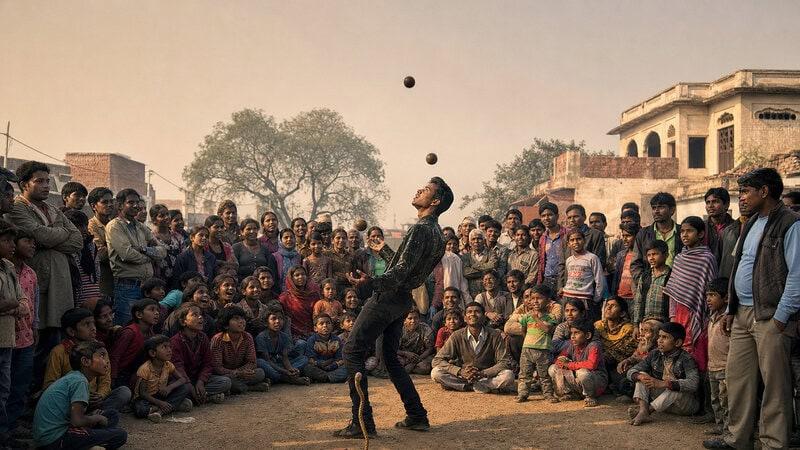

A length of coarse rope lies coiled in the dust of a village road. Then, slowly, impossibly, it rises — stiffening into the air like a charmed serpent, climbing toward a sky that offers no explanation. The circle of onlookers presses closer, mouths open, and the man at the center of it all — the jaadugar — watches their faces with the calm patience of someone who has seen this particular miracle performed a thousand times, because his father performed it before him, and his father’s father before that.
What Is a Jaadugar?

The word “jaadugar” derives from the Persian jadu, meaning magic or sorcery, and entered common usage across the Indian subcontinent through centuries of Persian cultural influence and, later, Mughal courtly language. It refers specifically to the itinerant magician — the hereditary street performer who traveled seasonal circuits between village fairs, pilgrimage festivals, and market days, earning a living through illusion, sleight of hand, and the precise management of a crowd’s attention. The jaadugar was not merely an entertainer in the modern sense. He was a psychologist, a street-theater actor, and, in communities without newspapers or radio, often a carrier of news and social satire embedded in apparently harmless spectacle.
Understanding the jaadugar means understanding a tradition that is simultaneously ancient, politically contested, and in genuine danger of extinction — and that has been systematically robbed of the historical record that might otherwise have preserved its practitioners’ names.
Ancient Roots: Two Thousand Years of Organized Performance

The earliest documentary evidence of organized magic performance in India appears in the Arthashastra, the treatise on statecraft attributed to the scholar Kautilya and composed roughly in the fourth century BCE. Among its meticulous accountings of courtly life and civic order, the text acknowledges illusionists and conjurers as recognized figures in the social landscape — not marginal curiosities but known categories of performer with an understood place in the world. Organized magic performance in India, in other words, predates the Common Era.
The Buddhist Jataka tales, composed over several centuries around and after the same period, populate their moral fables with street performers as background texture — rope manipulators, snake handlers, and sleight-of-hand artists threading through the crowds of ancient Indian towns and trade routes as naturally as merchants and monks. These were not exotic interruptions to ordinary life. They were part of its weave.
Behind the individual performer stood something larger: organized hereditary communities who maintained distinct performing lineages across generations. Families and clans — among them the Nat, the Bazigar, and the Madari — each carried specialized skills through a system of apprenticeship that was also a system of kinship. A child born into a Bazigar family learned acrobatics and illusion the way other children learned their father’s trade: not from books but from bodies, from watching and being corrected, from the slow accumulation of muscle memory and misdirection. The secrets of the craft traveled mouth to ear, generation to generation, with no written manual and no external institution to safeguard them.
The Mughal Courts and the Visibility of the Jadoogar

Under the Mughal emperors, the tradition found its most gilded moment of elite visibility. Court records and imperial memoirs — including the Tuzuk-i-Jahangiri, the autobiography of Emperor Jahangir — describe conjurers and extraordinary performers at imperial gatherings, their feats recorded with a mixture of delight and bewilderment that mirrors what European travelers would later put to paper. For a performing tradition accustomed to earning copper coins on dusty roadsides, the Mughal court represented a spectacular exception: patronage, proximity to power, and the preservation of at least some names and deeds in the historical record.
But this courtly world was always the exception. The overwhelming majority of jadoogar history unfolded not in palace courtyards but on village roads and at seasonal fairs, where a performer might earn enough for a meal or might not. The court magician and the itinerant street performer shared a craft but not a fate, operating in entirely different economic and social registers.
It was precisely during the sixteenth and seventeenth centuries that European traders began arriving in significant numbers — Portuguese, Dutch, and eventually British. Their journals document their astonishment at Indian street performance with a reliability that makes them, whatever their other limitations, useful historical witnesses. They were seeing something genuinely extraordinary. What they were less equipped to understand was that the tradition they exoticized was a sophisticated system of physical discipline, psychological technique, and inherited knowledge. The exoticism that made these performances so compelling to Western eyes would, two centuries later, become part of the ideological furniture of empire — and empire would not be kind.
The Colonial Blow: The Criminal Tribes Act of 1871

In 1871, the British colonial administration passed the Criminal Tribes Act — one of the most damaging pieces of social legislation in the history of colonial India. The law empowered authorities to designate entire communities as “criminal by birth.” Members of designated communities were required to register with police, their movements were restricted, and they were subjected to ongoing surveillance and forced settlement. The logic was Victorian and absolute: certain groups, the law implied, were inherently predisposed to crime, and the solution was to immobilize and monitor them.
For nomadic performing communities — including many hereditary jaadugar families, the Nat, the Bazigar, and the Madari — the consequences were catastrophic. Their itinerant lifestyle, which was an economic necessity rather than a cultural preference, read to colonial administrators as inherent suspicion. Communities that had traveled seasonal circuits for centuries — moving between village fairs, pilgrimage festivals, and market days in rhythms as old as the trade routes themselves — were suddenly illegal in their own movement.
The practical destruction this caused is difficult to overstate. The jaadugar’s livelihood depended entirely on the ability to reach the gatherings where audiences assembled: the mela, the festival, the fair. Strip away the freedom to travel and you strip away the stage. Families who could not perform could not eat. Performers who registered with police were marked, stigmatized, and trapped. The Act did not merely inconvenience these communities — it attacked the structural foundation of their entire way of life.
The legislation was expanded and refined in subsequent decades, and its shadow extended well beyond the formal end of British rule. India’s independence in 1947 brought repeal of the Criminal Tribes Act in 1952, but the communities it had designated were reclassified as “denotified tribes” — a bureaucratic relabeling that carried its own burden of stigma. The poverty the Act had entrenched, the displacement it had caused, and the performing networks it had severed did not vanish with a legislative stroke. The wound had been made. The scar remained.
How the Tradition Survived

That the tradition survived at all is a testament to the resilience of communities who had no other options. Under the pressure of the Criminal Tribes Act, jaadugar families adapted with practical ingenuity. Performing circuits were compressed. The hereditary nature of the craft was concealed where possible to avoid registration. In urban environments, where the anonymity of crowds offered thin protection, some performers integrated into street economies that were harder for authorities to efficiently police.
The oral nature of the tradition was simultaneously its greatest strength and its most acute vulnerability. Because the knowledge lived entirely in human memory — in the hands of practitioners, in the demonstrations of teachers, in the watching eyes of children — it was extraordinarily portable. There was nothing to confiscate, no library to burn. But this also meant that displacement, premature death, or forced settlement could sever a lineage permanently. A family scattered by colonial enforcement might reconstitute itself; a lineage whose last practitioner died in settlement without passing on his knowledge was simply gone.
Some performers found protection in religious context. By attaching their performances to pilgrimage sites and major festival gatherings — places where large assemblies of people were harder for authorities to suppress without political cost — certain jadoogar communities wove their work into a devotional framework that offered a measure of cultural legitimacy. The magic was still magic. But wrapped in the energy of a religious mela, it became something the colonial administration found harder to simply prohibit.
The post-independence years brought fragile opportunity. Freed from the Act’s direct restrictions, some communities began slowly reconsolidating performing networks, reestablishing circuits, and reconnecting lineages that had been forced apart. But decades of poverty, social stigma, and displacement had done damage that freedom alone could not repair. Recovery, where it happened at all, was partial and precarious.
The Art Itself: What a Jaadugar Actually Does

To watch a skilled jaadugar work is to understand that what looks like mysticism is the product of extraordinary physical discipline and psychological precision. The traditional repertoire is wide and technically demanding. The “mango tree trick” — apparently growing a plant from seed to fruit within the span of a performance — requires careful preparation, sleight of hand, and the confident management of audience attention. Cup-and-ball routines, which mirror techniques documented in ancient Rome and Egypt, demand years of finger dexterity to perform convincingly. Snake manipulation, rope work, and the production of apparently impossible objects from apparently empty spaces each require a different constellation of physical skill and psychological cunning.
The jaadugar is simultaneously a psychologist and a street-theater actor, reading the crowd, managing their gaze, and modulating the pace of a performance to build and release tension in exactly the right sequence. This is learned skill rather than intuition — though after decades of practice, the two become indistinguishable.
Beyond entertainment, these performances served a social function that modern audiences might not immediately recognize. In communities without newspapers, without radio, without any of the media infrastructure we take for granted, the itinerant performer was often a carrier of news and a vehicle for social satire — embedding critique into apparently harmless spectacle. A jaadugar who mocked the landlord’s greed or the tax collector’s cruelty through comic misdirection was doing something that carried genuine risk. The craft was cover. The message was the point.
The twentieth century brought a different kind of Indian magic into public view. Stage magicians like P.C. Sorcar brought Western-influenced grand illusion to proscenium theaters and earned genuine international recognition. Sorcar’s world and the street jaadugar’s world occupied entirely different social and economic universes. Stage magic offered spectacle, polish, and the dignity of a ticketed venue. Street magic offered a hat passed through a crowd. The gulf between them was not merely aesthetic — it was the gulf between a named artist and an unnamed one.
The Indian Rope Trick and the Erasure of the Performer
For centuries, European travelers arriving on Indian shores found their letters home hijacked by a single image: an Indian street magician coaxing a rope into the sky by apparent force of will alone. Portuguese merchants wrote about it. British officers wrote about it. The “Indian rope trick” became, over time, arguably the most debated illusion in the history of magic — dissected by scholars, dismissed as mass hallucination by some, and reverently catalogued by others. What those letters almost never recorded was the name of the man holding the rope.
That erasure is not accidental. It is the central wound in the history of the jaadugar — the spectacle was always visible while the artist was always invisible. The performing tradition that produced these extraordinary feats was simultaneously celebrated as exotic spectacle and denied the dignity of historical record. Observers preserved the trick. They rarely thought to preserve the trickster.
The Tradition Today — and Why It Matters
The honest picture of the present is not a comfortable one. Many hereditary performing families have abandoned the craft entirely, driven out by a convergence of pressures: economic unsustainability, the competition of cheap digital entertainment, and the difficulty of drawing a paying crowd in a rapidly urbanizing India where attention has never been more fragmented or more contested. The children of jadoogar families are more likely to be looking for factory work or urban labor than learning the cup-and-ball routine their great-grandparents performed at village fairs.
There are efforts underway — documentary projects, cultural organizations, and scholars working to record what remains of these traditions before the last practitioners stop performing. Government schemes directed at denotified tribe communities have had uneven but real impact in specific regions. Festivals and performance archives have preserved at least some of what the Criminal Tribes Act tried to destroy. These efforts matter. They are also, by their nature, rearguard actions against an accelerating loss.
What is at stake goes beyond nostalgia for a picturesque past. The jaadugar tradition represents a living thread connecting contemporary India to a pre-colonial performing culture — a form of embodied knowledge that is fundamentally irreplaceable. A museum can display the props. A video archive can record the performance. But the thing itself — the accumulated physical intelligence of a lineage, the psychological attunement to a crowd built only through years of practice before real audiences — exists only in living practitioners. Once the last person who knows how to do it stops doing it, the knowledge does not go dormant. It ends.
Return, for a moment, to that village road. The rope rises. The crowd leans forward. The jaadugar watches their faces with the patience of a man who carries two thousand years in his hands. What looks like entertainment is something stranger and more durable: an act of historical defiance, a tradition that outlasted the Mughal court and survived the Criminal Tribes Act and persisted into an age of smartphones and streaming video, performed by artists who were never given the dignity of having their names written down — and who kept performing anyway. The figure of the witch-like wandering magician has even found new life in contemporary anime, as in Tenmaku no Jaadugar – A Witch in Mongolia, a series whose very title reaches back to the same Persian root, and which has been documented by international audiences as a retelling of the itinerant magic-worker’s ancient story in a new cultural register.

 English
 Arabic
 French
 Spanish
 Portuguese
 Turkish
 Dutch
Dutch
 Italiano
 Russian
 Romaian
 Portuguese (Brazil)
 Greek
Greek