


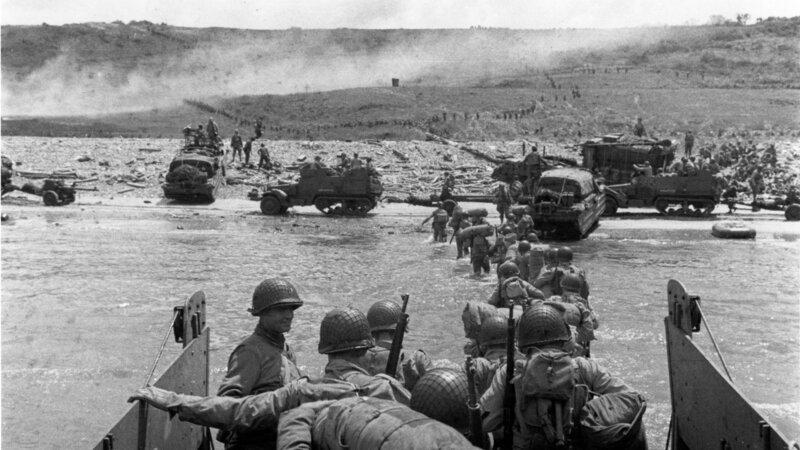

On the morning of June 6, 1944, the most consequential amphibious assault in history came within a single desperate hour of total collapse. What saved it was not airpower, not tanks, and not the careful plan drawn up in London — it was small groups of frightened men who decided, one at a time, to stand up and move toward the enemy. This is the story of Omaha Beach, told through the moments that mattered most.
Early 1944: The Germans Fortify an Already Unforgiving Shore

Field Marshal Erwin Rommel arrived on the Norman coast in early 1944 with a single strategic conviction: the Allied invasion had to be destroyed at the waterline, because if it was allowed to move inland, Germany would lose the war. Under his personal direction, German engineers buried millions of mines in the sand, planted steel obstacles in the shallows to tear open landing craft hulls, and poured concrete bunkers into the bluffs overlooking every beach. Omaha was a natural fortress even before a single weapon was emplaced — a crescent of bluffs rising up to 170 feet above the shore, channeling any attacker across wide open sand into killing grounds pre-covered by more than a dozen Widerstandsnester, or resistance nests, each one carefully sited to overlap the fields of fire of the next.
Then came the intelligence failure that nearly doomed the assault before it began. German commanders moved the battle-hardened 352nd Infantry Division into position directly behind Omaha Beach in the weeks before D-Day. Allied intelligence missed the redeployment entirely. The American soldiers who would wade ashore at dawn had been briefed against a second-rate coastal garrison; they were about to meet combat veterans who had fought on the Eastern Front.
Spring 1944: Omaha Becomes the Linchpin of the Entire Lodgment

Operation Overlord assigned five Allied beach sectors across roughly fifty miles of Normandy coastline, but Omaha was the hinge on which the whole plan turned. It sat directly between the British and Canadian beaches to the east and Utah Beach to the west. Leave that gap unoccupied and German armored divisions could drive straight through it, splitting the beachhead in two and destroying each isolated half at leisure. Omaha had to be taken — which meant men had to cross it.
The beach’s geography made that crossing a planner’s nightmare. At low tide, roughly 300 yards of exposed flat sand separated the water’s edge from the base of the bluffs — 300 yards with no natural cover, no dead ground, and almost no way off the beach except through five narrow draws. The Germans had spent months fortifying every one of those draws with layered gun positions and pre-registered mortar fire.
Pre-Dawn, June 6, 1944: Bombers Miss, Tanks Sink, the Plan Unravels Before H-Hour

In the dark hours before the landing, the elaborate machinery of the pre-assault bombardment went quietly and catastrophically wrong on almost every level. More than 300 B-17 Flying Fortresses arrived over Omaha and released nearly 13,000 bombs — but thick cloud cover forced bombardiers to delay their drops to avoid hitting the approaching fleet, and virtually every bomb fell miles inland, cratering French farmland while the German bunkers sat untouched beneath their concrete roofs. The warships offshore, forced to fire from long range to avoid colliding with the landing craft, sent their shells arcing over the bluff line and landing harmlessly beyond the ridge.
The final blow came in the water itself. Thirty-two DD Sherman tanks — duplex-drive amphibious vehicles designed to swim to shore and give the infantry armored support from the first seconds of the landing — were launched into swells running four to five feet. Twenty-seven of them sank almost immediately, taking most of their crews down with them. The men of the first assault wave were going in essentially alone: against an untouched defense, with no armor support, and no effective air or naval preparatory fire behind them.
6:30 AM: The First Wave Hits the Beach and Is Cut to Pieces

When the landing craft ramps dropped at H-Hour, the German defenders were ready and waiting at their weapons. Men who stepped off into chest-deep water were cut down before they could wade to shore. Strong tidal currents had already scattered the landing craft during the run-in, pushing most boats between 300 and 1,000 yards from their designated sectors. Soldiers were separated from their officers, their equipment, and any realistic hope of executing the assault plan they had trained for. Units that had rehearsed together found themselves mixed with strangers on unfamiliar ground, taking fire from positions they had never studied.
The casualties in the first minutes were almost incomprehensible. Company A of the 116th Infantry Regiment was effectively destroyed within moments of touching the sand — an annihilation so concentrated and so swift that it fell heaviest on men from Bedford, Virginia, a small town that had sent a generation of its young men into that single company. The National WWII Museum’s D-Day records document the full scale of losses across the beach sector that morning, and the numbers remain staggering more than eighty years later.
Mid-Morning: Omar Bradley Considers Abandoning Omaha Entirely

Aboard the command ship USS Augusta, General Omar Bradley was operating nearly blind. Casualty reports arrived in fragments or not at all, radio communications from the beach were intermittent, and for a terrifying stretch of time he could not determine whether any organized American resistance was still being mounted on Omaha. What information did reach him painted a picture of catastrophe. Bradley later wrote in his memoir that he seriously weighed diverting follow-on forces away from Omaha — conceding the beach and redirecting troops to Utah and the British sectors, accepting a dangerous gap in the Allied line as the price of preserving the rest of the operation.
On the beach itself, the scene that might have confirmed his worst fears was playing out in plain sight. Survivors from the shattered first wave had crawled to the only shelter available: a narrow bank of smooth shingle stones just above the high-water line, perhaps four feet high at its tallest point. Behind it crouched hundreds of men — some wounded, some in shock, all of them pinned by fire that swept the open sand the moment anyone raised his head. The beach had become a trap, and no one was moving.
Roughly 8:00 AM: Colonel George Taylor Breaks the Paralysis

Colonel George A. Taylor, commanding officer of the 16th Infantry Regiment, 1st Infantry Division, waded ashore into that chaos and immediately grasped what he was looking at. Men were alive. Men were armed. And men were going nowhere. He moved along the shingle bank under direct fire — a full colonel walking upright on a beach being swept by machine-gun and mortar fire — and spoke the words that have been carried through every serious account of Omaha Beach since: “Two kinds of people are staying on this beach, the dead and those who are going to die. Now let’s get the hell out of here.”
What followed was not a Hollywood charge. It was something more ragged, more real, and ultimately more decisive. Small groups of men began to move. NCOs and junior officers — some of whom had never met before that morning — started leading improvised teams away from the shingle and toward the face of the bluffs, probing for weaknesses that the original assault plan had never accounted for. The paralysis cracked, not all at once, but in pieces, one cluster of men at a time.
Late Morning: Small Units Find the Breakthrough No One Had Planned

The discovery that saved Omaha was nearly accidental. The German defensive positions had been expertly sited to cover the five draws — the obvious, named exits from the beach — with interlocking fields of fire. But the steep grassy faces of the bluffs between those draws had been left in relative dead ground. Men who moved directly up the slope, through the scrub and loose soil rather than into the channeled draws, could survive in places where soldiers funneled toward the draws were simply killed. Sergeant Philip Streczyk and a small group from the 16th Infantry were among the first Americans to reach the top of the bluffs at Omaha, and once American boots stood on the high ground, the geometry of the entire battle began to reverse.
Offshore, individual U.S. Navy destroyer captains made a decision that no written order had authorized. Ignoring standing instructions to remain in deep water, several destroyers drove so close inshore that their keels scraped the bottom, then delivered point-blank direct fire against German bunkers from angles the defenders had never had to account for. The improvisation operated simultaneously at every level of command — destroyer captains, infantry sergeants, and junior officers who had lost their companies and were leading whoever would follow them — and it was working.
Afternoon: A Fragile Momentum Takes Hold

By early afternoon enough of the bluff exits had been forced open that vehicles, ammunition, and reinforcing troops could begin grinding off the sand and up into the Norman countryside beyond. Engineers worked under intermittent fire to clear the tidal obstacles that the rising water had submerged, reopening lanes for the landing craft still ferrying in successive assault waves. The more than 34,000 Americans who came ashore at Omaha on June 6 did not all land in the catastrophe of the early morning; many crossed a beach that, by midday, was still dangerous but no longer entirely murderous.
The foothold remained desperately thin — in places barely a mile deep — and German counterattacks pressed hard against it. But the bluffs were held. The men on top of them were not going back down to the water, and fresh troops were pushing up from the sand behind them.
By Evening: Omaha Secured at a Devastating Cost

Fighting continued across the full length of the day, from the first ramps dropping at approximately 6:15 in the morning until the beach sector could be called operationally secure that evening. When the accounting began, the numbers were brutal. Approximately 2,400 Americans were killed, wounded, or reported missing at Omaha Beach on June 6, 1944 — a toll that made it by far the costliest of the five Allied landing beaches that day, a figure documented by the National WWII Museum’s D-Day records and confirmed by every serious historical study of the operation conducted since.
And yet the beach held. The gap between the British and American sectors was closed. Within days, the five separate beachheads were linked into a single continuous lodgment stretching across Normandy — one that German armor never managed to sever, and that Allied logistics would spend the following weeks transforming into the unbreakable foundation for the liberation of Western Europe.
The Legacy: What Omaha Still Demands We Reckon With

Every significant assumption the planners made about Omaha failed on June 6, 1944. The bombers missed. The tanks drowned. The naval guns overshot. The intelligence was wrong about who was defending the beach. The landing craft were pushed off course by currents no rehearsal had prepared anyone for. The plan, in almost every particular, did not survive contact with that crescent of bluffs and the veterans holding them.
And yet Omaha Beach was taken — because individual soldiers, sergeants, and colonels stopped waiting for a plan that had already broken and started moving on their own authority, uphill, toward the enemy, under fire. The Omaha Beach casualties represent a disproportionate share of all D-Day losses across every sector, and the weight of that sacrifice is inseparable from what the beach has come to represent. The lesson the battle teaches — that what saved the entire invasion was not doctrine, not technology, and not careful coordination, but the decision of frightened men to stand up and move — is one that no recitation of facts and figures can fully carry on its own.
Omaha was nearly lost in the space of a single terrible morning. What pulled it back was the oldest truth in warfare: that plans end at the waterline, and everything after that belongs to the people willing to move forward anyway.

 English
 Arabic
 French
 Portuguese
 Deutsch
 Turkish
 Dutch
Dutch
 Italiano
 Russian
 Romaian
 Portuguese (Brazil)
 Greek
Greek