


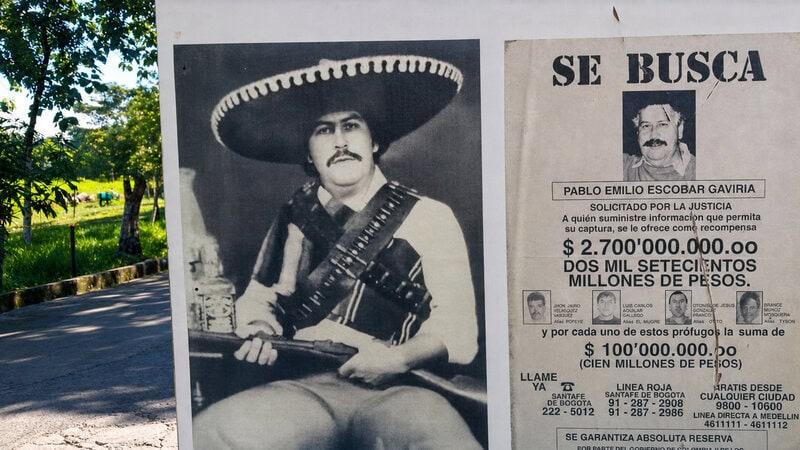

On the morning of December 2, 1993, Pablo Escobar woke up in a nondescript house on a quiet street in Los Olivos — a middle-class Medellín suburb of peeling paint and tiled rooftops — and he was, for the last time in his life, in a good mood. He had turned forty-four the day before, and he had spent his birthday on the telephone, singing to his children, laughing, letting his guard down. By early afternoon, he would be dead on a terracotta roof, barefoot, cornered, and killed by men he had spent years trying to break.
The Morning After the Birthday Call
The dramatic irony of December 2, 1993 is almost unbearable in retrospect. While Colombian authorities were triangulating his signal — closing a net that had been drawing tight for sixteen months — Escobar was doing the one thing a fugitive should never do: being human. The phone calls to his family on December 1 were warm and unguarded. He spoke longer than was safe. He sang. He did not know those calls would betray him, or that the birthday he was celebrating would be his last.
By the following midday, the Search Bloc — Colombia’s elite hunter-killer police unit — had narrowed his location to a single residential block in Los Olivos. Officers were moving into position. And the man who had once made an entire nation afraid to answer its own phone was about to be killed in the most ordinary setting imaginable: a suburban rooftop under an open Colombian sky.
What makes the story of Pablo Escobar’s death more than a footnote in a drug war is the human texture beneath the official operation. This was not a cold, faceless takedown. The men who came for Escobar that day had been mocked by him, threatened by him, and made to feel small by him — and at least one of them had spent months in a surveillance van, listening to Escobar’s voice taunt him by name over police radio frequencies.
499 Days on the Run

Escobar had escaped from La Catedral — the luxury prison he had effectively designed and controlled — in July 1992, slipping away just as the Colombian government attempted to transfer him to a more secure facility. What followed was one of the most intensive manhunts in Latin American history. For 499 days, the leader of the Medellín Cartel moved through a shrinking world: rotating safehouses, burner phones, coded messages passed through a dwindling circle of trusted lieutenants.
He moved every few days. He rarely slept in the same bed twice. The logistics of his fugitive life were elaborate, paranoid, and exhausting — and yet, for nearly a year and a half, they worked. The Colombian government, the DEA, and the rival Cali Cartel all wanted him dead or captured, and none of them could pin him down.
The fatal crack in the architecture of his survival was emotional rather than tactical. Escobar could not stay off the phone. His need to hear his family’s voices — his wife, his children, his mother — was the one vulnerability that no amount of operational discipline could close. Signal-intelligence teams embedded with the Search Bloc were using direction-finding equipment to triangulate his radio calls, and Escobar’s increasingly frequent and increasingly long conversations were giving them everything they needed.
By the morning of December 2, they had their answer. His final mistake was the birthday call itself — a moment of tenderness that the most dangerous man in Colombia could not resist, and that his hunters had been waiting for.
The Search Bloc: Built for One Purpose
The Bloque de Búsqueda — the Search Bloc — was not a conventional police unit. It was assembled with a single mandate: find Pablo Escobar and end his reign. Operating with logistical and intelligence support from the United States, including the DEA and signals-intelligence assets, the unit was nonetheless a Colombian operation at its core. The kill order, the planning, and the boots on the ground all belonged to the Colombian National Police.
Commanding the unit was Colonel Hugo Martínez Sr., a career officer who had been hunting Escobar with a methodical, almost obsessive patience. Embedded with him was his son, Hugo Martínez Jr., a young signals lieutenant whose job was to sit for hours inside surveillance vans, headphones on, tracking the direction and distance of Escobar’s radio transmissions. It was painstaking, unglamorous work — and it was made stranger by the fact that the man he was hunting sometimes talked directly to him.
Escobar had made psychological warfare a signature of his criminal career, and the Search Bloc was one of his favorite targets. He intercepted police radio frequencies and broadcast taunts — directed at Colonel Martínez by name, calling him incompetent, mocking the unit’s failures, threatening his family. These were not empty provocations. They were calculated acts of humiliation designed to demoralize officers, to signal that Escobar knew who they were and where their vulnerabilities lay.
For Hugo Martínez Jr., those taunts were absorbed personally. He had spent months of his young career being ridiculed by a man he was trying to catch, and the experience had curdled into something that went beyond professional duty. When the Search Bloc finally moved on Los Olivos, the officers involved were not simply executing a police operation — they were collecting a debt.
Plata o Plomo: The Weight of Refusal

To understand why December 2, 1993 felt personal to so many of the officers involved, it helps to understand the world Escobar had built around himself. The Medellín Cartel operated on a philosophy Escobar had reduced to two words: plata o plomo — silver or lead. Accept the bribe, or accept the bullet. Judges, politicians, journalists, police officers — everyone received the offer eventually.
The men of the Search Bloc had largely refused the silver. They had chosen to remain in an institution that Escobar had spent years trying to corrupt, co-opt, or simply destroy. And in refusing the silver, they had accepted the implicit promise of the lead: death threats against themselves and their families, colleagues killed in cartel violence, and the daily psychological weight of being named enemies by a man who had demonstrated, repeatedly, that he was willing to act on his promises.
This is the real subtext of what happened on December 2. How Pablo Escobar died is a matter of documented fact — three shots, a rooftop, an afternoon in Medellín. But why it happened the way it did, with the intensity and the personal charge it carried, has everything to do with years of humiliation that the Search Bloc had been forced to absorb and had refused to surrender to.
The Rooftop: Three Shots
The raid on the Los Olivos safehouse unfolded quickly. Search Bloc officers moved in during the early afternoon, and Escobar — caught off guard but not paralyzed — attempted to flee with his sole bodyguard, a man known as El Limón. The two of them ran across the connected rooftops of the residential block, trying to put distance between themselves and the closing officers.
El Limón was killed first. Escobar, barefoot and wearing jeans, was cornered on a terracotta roof — the most powerful drug lord in the history of the Western Hemisphere, reduced to scrambling across clay tiles with nowhere left to run, in the city where he was born.
He was shot three times: once in the leg, once in the upper back, and fatally through his right ear. Colombian police officially credited the Search Bloc with the killing, and the shot through the ear has been the subject of persistent debate ever since — whether it was fired in the chaos of a running gunfight or delivered as a deliberate close-range execution. The Colombian government credited the operation collectively, and the full forensic truth of that final bullet has never been definitively established in the public record. It is a historical ambiguity worth naming honestly, because it sits at the moral center of what a targeted killing actually means.
One claim that circulates widely — that Escobar shot himself to avoid capture, staging his own death — has been consistently rejected by investigators, forensic evidence, and the Colombian authorities who conducted the operation. It belongs in the category of myth, not history.
The Photograph, the Celebration, and the Vacuum
After it was over, Search Bloc officers photographed themselves with Escobar’s body on the rooftop — grinning, triumphant, pressing his head up for the camera. The images became among the most reproduced, and most debated, crime photographs of the twentieth century. They were celebrations of a kind, but also something stranger: men who had been made to feel powerless by this one figure, now asserting in the crudest possible way that the power had shifted.
In Bogotá and Medellín, the news of Escobar’s death triggered immediate scenes of public celebration. Families who had lost loved ones to cartel bombs, to assassinations, to the casual violence of a criminal empire that treated civilian life as a negotiating chip, poured into the streets. The relief was real and it was earned.
But the vacuum Escobar left did not stay empty for long. The Cali Cartel, which had been a quieter rival throughout the Medellín years, moved quickly to consolidate its position. New trafficking networks reorganized along existing routes. Colombia’s drug war continued. Killing Escobar had ended one man’s reign; it had not ended the system he had helped build. That is a crucial counterpoint to any triumphalist reading of December 2, 1993.
For the Martínez family, there was no clean public victory. Colonel Hugo Martínez Sr. quietly retired. His son eventually left Colombia altogether. Both have said in interviews that they spent years fearing reprisals — that even after Escobar was dead, the world he had made remained dangerous for the people who had brought him down. Firsthand accounts of the operation reflect this uneasy aftermath: the relief of ending the hunt shadowed by the knowledge that the hunt had made them permanent targets.
What the Myths Get Wrong
Three decades of documentaries, dramatizations, and streaming series have layered a thick coat of mythology over the events of December 2, 1993. A few distortions recur often enough to be worth addressing directly.
The first is the suicide theory, addressed above: the forensic and investigative record does not support it. The second is the folk-hero framing — the Robin Hood narrative that Escobar himself cultivated, and that some communities in Medellín genuinely internalized, given his early investments in housing and football pitches in poor neighborhoods. That generosity was real, but it was also strategic, and it existed alongside a campaign of mass murder that killed thousands of ordinary Colombians, including civilians blown up on commercial aircraft, police officers killed in their cars, and judges shot at their desks. The charity and the carnage were not separate chapters; they were the same chapter.
The third distortion is the idea that his death marked the end of Colombia’s cocaine crisis. It did not. What it ended was the particular reign of terror Escobar personally directed. The infrastructure — the routes, the corruption networks, the international distribution chains — outlasted him by decades.
Why December 2 Still Echoes
The story of Pablo Escobar’s death resists the clean moral endings that popular culture tends to demand of it. He was not the folk hero romanticized in narcocorridos, and he was not simply a monster whose death solved the problems he created. He was a calculating strategist who understood power, fear, and human psychology with rare precision — and who was ultimately undone by his own emotional needs. The birthday phone calls. The need to hear his children’s voices. The conversations that lasted a few minutes too long.
His death on December 2, 1993, was the result of a sixteen-month pursuit by men he had tried to break and failed to break. It was also the result of a surveillance operation that exploited the one gap in his defenses that no amount of paranoia could close: love.
Thirty years on, the street in Los Olivos is quiet. The terracotta rooftops look like any other rooftop in any other middle-class Medellín neighborhood. But the date sits in the calendar like a splinter — one day after the last birthday of the man who once made an entire country afraid to answer the phone, killed by men who had refused, at considerable personal cost, to be afraid of him.

 English
 Arabic
 French
 Spanish
 Deutsch
 Turkish
 Dutch
Dutch
 Italiano
 Russian
 Romaian
 Portuguese (Brazil)
 Greek
Greek