


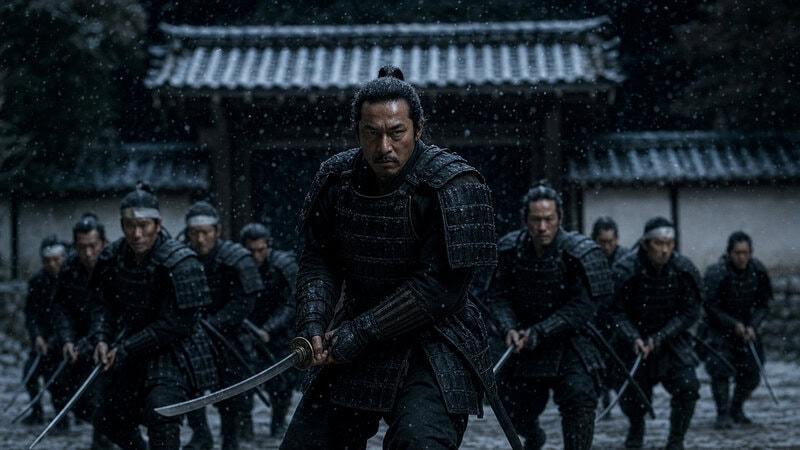

The snow was falling on Edo when forty-seven men in dark armor scaled the walls of a sleeping compound, their breath visible in the December cold, their movements unhurried and precise — the movements of men who had been waiting, and suffering, and pretending for nearly two years to make this single night possible.
What It Actually Meant to Be a Rōnin

Before the story of that December night can land with full weight, it helps to understand exactly what these men had become after their lord’s death — and why that status, in Tokugawa Japan, amounted to something close to a living erasure.
The word samurai (侍) derives from a verb meaning “to serve.” A samurai was defined entirely by his relationship to a lord: his income, his rank, his reason for waking up and strapping on a sword were all expressions of that bond. Strip the lord away and the word itself stops making sense. You are left with a warrior whose entire identity has been grammatically voided.
This is where the concept of the rōnin — the masterless samurai — enters Japanese history as something genuinely haunting. The word is written with two characters: 浪 (rō), meaning “wave,” and 人 (nin), meaning “person.” A wave-person. Someone tossed by currents he cannot control, with no shore to call home. Not a criminal, not exactly an outcast, but something arguably worse in a society built on hierarchy and fixed roles: a person without a place, drifting.
The material consequences of masterlessness were severe. Becoming a rōnin typically meant losing one’s stipend, one’s official position, and one’s domain appointment in a single stroke. Financial ruin arrived alongside social disgrace, and the two compounded each other rapidly. In the social imagination of the Edo period, rōnin occupied an uneasy space between wanderer and mercenary — men who had once been something and were now, ambiguously, something else. Neither the prestige of a retainer in active service nor the clarity of a criminal label applied to them. They simply did not fit.
The range of paths open to a rōnin was narrow and rarely comfortable. Some entered Buddhist monasteries. Some became independent fencing instructors, selling swordsmanship lessons to merchants’ sons who could never have afforded a proper retainer’s tutelage. Some, with fewer options or fewer scruples, drifted into banditry. The history of rōnin in feudal Japan is ultimately a catalog of reinvention under pressure — men trying to rebuild meaning after the structure that gave them meaning had collapsed entirely.
The most celebrated rōnin in Japanese history is Miyamoto Musashi, who embraced wandering duels and philosophical inquiry and eventually produced The Book of Five Rings, a treatise on strategy still read today. But Musashi was singular. Most rōnin had no such reservoir of genius to draw on. They simply drifted, as the word always said they would. Understanding this — the ordinary, grinding indignity of masterlessness rather than its romantic possibilities — is essential to understanding what the forty-seven men of the Akō incident actually sacrificed.
The Incident That Made Three Hundred Men Masterless Overnight

In 1701, a provincial lord named Asano Naganori was summoned to Edo Castle to help oversee ceremonial duties for the Tokugawa shogunate. Assignments of this kind required careful instruction in court protocol — instruction provided, apparently with considerable contempt, by a senior court official named Kira Yoshinaka.
The precise nature of what Kira did to provoke Asano remains historically uncertain. Most accounts point to sustained humiliation and, in some versions, demands for bribes that Asano either could not or would not pay. What is not uncertain is what happened next. Inside the shogun’s palace — one of the most legally protected spaces in Japan — Asano drew his blade and slashed Kira across the face.
Kira survived the wound. Asano did not survive the afternoon. Drawing a weapon inside the palace was a capital offense under Tokugawa law, regardless of whatever provocation had preceded it. Asano was ordered to commit seppuku that same day. His lands were confiscated. His household was dissolved. And in one legally tidy stroke, approximately three hundred samurai became rōnin — masterless men in a society that had no honorable category prepared to receive them.
The Long, Deliberate Performance of Ruin

Here is where the story of the forty-seven becomes something stranger and more psychologically compelling than a straightforward revenge narrative.
The Tokugawa shogunate was not naive. Officials understood perfectly well that Asano’s former retainers might be angry enough to act, and they watched the scattered ex-samurai carefully for signs of organized conspiracy. Any open move toward revenge would be identified and crushed before it could mature. The men who wanted to act — and there were forty-seven who eventually committed to the plan — needed the shogunate’s watchful attention to move elsewhere. That meant they needed to appear to be men who were no longer capable of acting.
The architect of the deception was Ōishi Kuranosuke, Asano’s former chief retainer and the sharpest strategic mind among the group. Ōishi grasped the problem with clinical precision: to survive long enough to strike, he had to become, in the eyes of every informant reporting back to Edo, a man already destroyed by grief. So he relocated to Kyoto and proceeded to demolish his own reputation as methodically as a general razing a fortress to deny it to an enemy.
He drank. Publicly, extravagantly, humiliatingly. He spent months being seen in the company of geisha, stumbling through streets, collapsing in visible places. Spies dispatched to observe him found exactly what they were looking for: a broken man, a once-capable samurai who had responded to his lord’s death not with stoic resolve but with a very thorough collapse into dissolute behavior. The performance was so sustained and convincing that his own wife eventually divorced him — a detail worth sitting with. The cost of the deception was paid not only by Ōishi but by everyone in proximity to him.
Meanwhile, the other conspirators dispersed across Japan and constructed new identities as cover. Some posed as monks. Some found work as craftsmen or merchants. A number, operating with particular boldness, secured employment in or near Kira’s own household — quietly memorizing the layout of his compound, the rotation of his guards, and the geography of the place where they intended to kill him.
Two years passed. The shogunate’s surveillance relaxed. Kira, apparently reassured that no serious threat remained, reduced his security. In December 1702, Ōishi sent word to the forty-six other conspirators: it was time to stop pretending.
The Strike, the Death, and the Impossible Choice Left Behind

On the night of December 14, 1702, the forty-seven reassembled in Edo — some traveling from distant provinces, all of them stepping back into an identity they had spent two years publicly discarding. They divided into two assault groups, scaled the walls of Kira’s compound, and moved through the snow with the efficiency of men who had been rehearsing every step for a very long time.
The fighting was brief. Kira’s guards resisted and were overcome. Kira himself was found hiding in a storage outbuilding. He was killed with a short blade — according to the account that has come down through generations, the same blade with which Asano had committed seppuku. The symmetry was entirely deliberate. This was not mere violence; it was a communication in the formal language the samurai code spoke fluently.
What followed is, in some ways, the most remarkable element of the story. The forty-seven did not flee. They carried Kira’s severed head to Sengaku-ji temple, where Asano was buried, placed it on his grave, offered incense, and then presented themselves to the authorities. They had broken the law. They knew it. They were prepared to face the consequences, and the act of surrender was itself part of the statement they were making: we are not criminals working in darkness; we are samurai discharging a debt in the open, before witnesses.
The shogunate was left with a problem that had no clean resolution. Executing the forty-seven as common criminals would visibly insult the samurai ideal they had so publicly embodied — and would make the regime appear to be punishing exemplary loyalty. But pardoning them carried an equally dangerous implication: that any samurai who felt sufficiently aggrieved could take the law into his own hands and expect forgiveness once the deed was done.
The deliberations lasted weeks. The solution the shogunate reached was characteristically precise: the forty-six surviving conspirators (one had been separated from the group before the raid and was not present at the attack) were ordered to commit seppuku in February 1703. Not executed as criminals — ordered to die as samurai. The distinction mattered enormously in a world where the manner of your death determined the meaning of your life.
Why the Story Refused to Stay Quiet

Within months of the forty-seven’s deaths, a kabuki dramatization of the events was staged in Edo. The authorities banned it by name. Playwrights simply shifted the setting to a different historical period, changed the characters’ names, and staged it again. It ran. It kept running. The story proved impossible to suppress because the questions it raised were impossible to settle.
Was Ōishi right to destroy his own reputation, rupture his marriage, and spend two years performing convincing wretchedness in order to honor his dead lord? Was the shogunate right to punish men whose loyalty was, by every cultural standard available, exemplary? Is a code of honor still honorable when the system it operates within is unjust? Does loyalty to a person outrank loyalty to law — and if so, who gets to decide when?
The forty-seven became the touchstone narrative of bushidō — the way of the warrior — precisely because the story declines to resolve these questions. It sits permanently at the intersection of loyalty and law, patience and grief, personal obligation and public order. The rōnin was never simply a diminished samurai. He was a samurai placed in an impossible position by forces outside his control, forced to improvise an identity from the wreckage of the one he had lost — and, in forty-seven exceptional cases, to use that very wreckage as the foundation of something that would outlast him by centuries.
Visitors still come to Sengaku-ji temple in Tokyo. They burn incense at the graves of the forty-seven. The gravestones are worn smooth from centuries of hands touching them. It is a striking thing to stand there and think about what those men actually did — not the raid itself, which was over in minutes, but the two years that preceded it: the deliberate self-destruction, the public drunkenness, the scattered lives and the menial jobs taken in an enemy’s household, the divorces, the long cold work of becoming a ghost in order to remain, in some essential way, a man.
That is what the rōnin — the wave-person, the masterless samurai adrift in feudal Japan — could mean at his most extraordinary: someone who had already lost everything, and who used that lostness, carefully and patiently, as the only weapon he had left.

 English
 French
 Spanish
 Portuguese
 Deutsch
 Turkish
 Dutch
Dutch
 Italiano
 Russian
 Romaian
 Portuguese (Brazil)
 Greek
Greek