



In the summer of 1876, a stocky German businessman stood on a sun-scorched hill in the Greek Peloponnese, a battered copy of Homer tucked under his arm and a workforce of Greek laborers waiting for his orders. The scholars of Europe had told Heinrich Schliemann he was chasing a fairy tale. He told them to keep their opinions and started digging.
The Man Who Took a Poem Literally

By the time Schliemann arrived at Mycenae, he had already done the impossible once. Using the Iliad as something between a treasure map and a field guide, he had excavated the hill of Hissarlik in modern Turkey and pulled the ruins of Troy from the earth — a city that most educated Europeans had confidently assigned to the realm of poetic imagination. The classical establishment was not impressed, but Schliemann was not looking for approval. He was looking for gold.
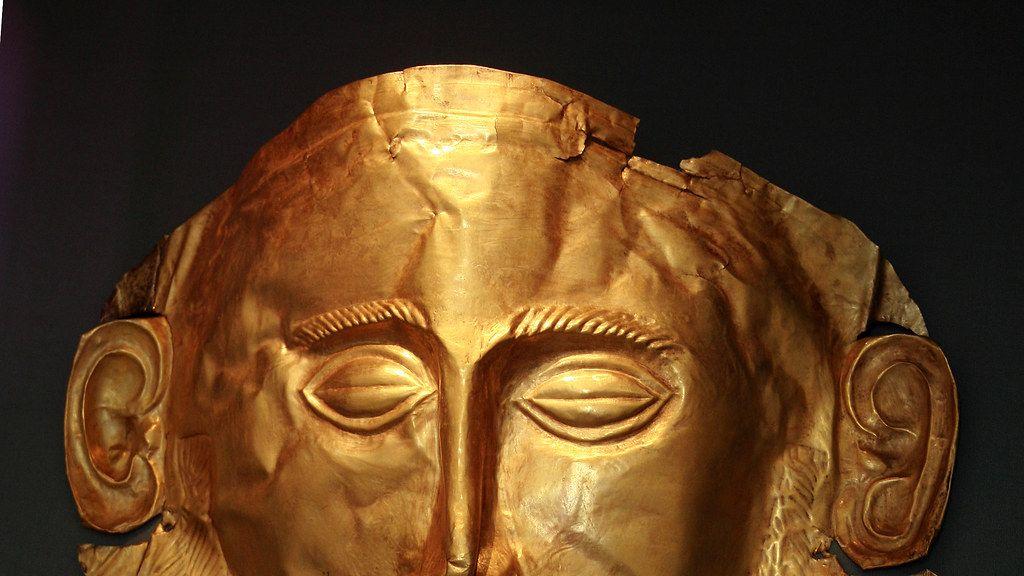
At Mycenae, he found it. Within weeks of breaking ground, his crew struck a cluster of shaft graves sunk deep inside the citadel walls. What came out of the earth stopped everyone cold: golden death masks pressed against the skulls of long-dead warriors, bronze swords inlaid with hunting scenes, amber beads strung into necklaces, and drinking cups hammered from solid gold. It was the most spectacular haul from the ancient world recovered in modern memory, and it had been sitting in the ground, quietly waiting, for three thousand years. The central tension of Mycenae’s story is right there in that moment — how does a city that once commanded an entire civilization simply vanish, preserved only as an epithet in an epic poem?
A City Homer Called ‘Rich in Gold’

Mycenae sits on a compact hill wedged between two larger peaks, commanding the fertile Argolid Plain in the northeastern Peloponnese with the quiet authority of something built to last and to be seen. The position was not chosen carelessly. From its height, the citadel’s rulers could monitor the roads threading across the plain below, control the movement of trade between the coast and the interior, and project military force in any direction they chose. Geography, here, was policy.
Homer knew what he was talking about when he called the city “broad-streeted” and “golden.” Those were not decorative flourishes — they were, it turns out, compressed archaeological fact. Mycenae was celebrated in ancient verse as the kingdom of Agamemnon, the high king who assembled the Greek forces and sailed for Troy. That made it the gravitational center of the Greek heroic imagination, the place all the great stories circled back to. Scholars studying Mycenae’s place in ancient Greece now recognize it as something even grander than legend allowed: the political and cultural nerve center of an entire Bronze Age world, so dominant that the civilization it anchored takes its name from this single hilltop city.
The Heyday: When Mycenae Ruled the Bronze Age

Between roughly 1350 and 1200 BC, while Egypt was consolidating its empire and the Hittites were clashing with pharaohs on the plains of Syria, Mycenae was the undisputed heavyweight of the Aegean. The civilization it led dominated much of southern Greece, absorbed Crete after the long decline of Minoan power, controlled the Cyclades, and pushed traders and soldiers across the Eastern Mediterranean as far as the Levantine coast and into Egypt’s commercial orbit.
The palace on the citadel hill was not merely a royal residence — it was a bureaucratic engine. Thousands of clay tablets inscribed in Linear B, the earliest deciphered form of Greek, survive as the filing system of this Bronze Age administration. They record consignments of olive oil and wool, inventories of chariots and bronze, and lists of workers and their rations. Behind the epic grandeur was a state that ran on paperwork. Frescoes decorating the palace walls showed hunts, processions, and battles in vivid blues and reds — a court obsessed with prestige and the theater of power.
The Lion Gate anchors all of this in stone. Standing at the main entrance to the citadel, two carved lions rear up against a central pillar in a relief so massive and so confident that later Greeks, arriving centuries after Mycenae’s fall, refused to believe that ordinary human hands had lifted those stones into place. They called the architecture Cyclopean and decided that giants must have built it. The lions are still there today, still watching the plain below, still insisting on their makers’ ambition.
Gold, Power, and the Logic of Burial

At its peak, the citadel of Mycenae was a place of concentrated, intoxicating power. The palace rose above storerooms packed with grain, oil, and wine. Craftsmen worked gold into objects of extraordinary delicacy — death masks that captured the broad faces of dead rulers, drinking vessels a living hand would grip naturally, sword hilts inlaid with silver and niello in patterns of running lions and lily fields. This was a warrior aristocracy that took its comforts seriously and its burials even more so.
The shaft graves Schliemann excavated belong to the earliest phase of Mycenae’s greatness, predating the palace’s peak by several generations. But they reveal the ritual logic of the whole era: rulers went into the ground accompanied by everything that had made them powerful in life. Swords, crowns, drinking vessels, and those extraordinary golden masks were the currency of the afterlife as much as of the court. When Schliemann lifted one mask and saw a face staring back at him across thirty centuries, he sent a famous telegram to the Greek king declaring that he had gazed upon the face of Agamemnon. The romanticism was pure Schliemann. The mask almost certainly predates any historical Agamemnon by two or three centuries. But the gold was real, the craftsmanship was astonishing, and the discovery was genuine — even if Schliemann’s interpretation, characteristically, outran his evidence.
The Mysterious Collapse

Around 1200 BC, something catastrophic moved across the Eastern Mediterranean, and almost nothing was left standing in its wake. Historians call it the Bronze Age Collapse, and it is one of the great unsolved puzzles of ancient history. Within a generation or two, the palace civilizations of the Aegean crumbled. Mycenae did not survive.
The physical evidence is stark. Palace complexes showed signs of burning. Storerooms were abandoned mid-inventory. Linear B tablets — that meticulous record of a functioning state — simply stopped, as if scribes walked away from their desks one morning and never came back. The theories about what caused all this remain contentious: prolonged drought that shattered agricultural systems, internal rebellions by overtaxed populations, the disruption of trade networks on which the palace economies depended, and the arrival of the so-called Sea Peoples — raiders and migrants moving in waves across the Mediterranean. Most scholars today favor a cascading systems failure, a convergence of stresses in which each catastrophe made the next one worse, rather than any single decisive cause.
What followed was a dark age in the most literal sense. The population of the Argolid plain shrank dramatically. Writing disappeared from Greece for roughly four centuries — the entire Linear B tradition lost and forgotten, as if it had never existed. The great citadel dwindled to a small settlement haunting its own ruins, its walls too massive to demolish but serving no one. Only in the poems of Homer, composed centuries later and passed through generations of oral tradition before anyone wrote them down, did the memory of what Mycenae had been stay alive — burnished into legend, but not extinguished.
Schliemann’s Gamble and What It Unlocked

Heinrich Schliemann was, by any measure, an unlikely archaeologist. He made his fortune as a merchant and speculator, taught himself ancient Greek as an adult alongside more than a dozen other languages, and arrived at the questions of Troy and Mycenae not through academic training but through obsessive, self-directed reading. He treated the Iliad as a primary source when every respectable classicist treated it as literature. That stubbornness was both his greatest gift and his most damaging flaw.
At Troy, he famously tore through stratigraphic layers he should have preserved, destroying evidence in his impatience to reach what he was certain must lie beneath. His identification of finds was routinely colored by romantic overreach — Agamemnon’s mask, Priam’s treasure, Helen’s jewels. He was not a careful scientist by the standards of his own time, let alone ours. But the instinct that drove him was correct in a way that changed the field permanently. Behind the mythological veneer of Homeric epic lay a real, archaeologically verifiable Mycenaean civilization with traceable politics, a documented economy, and a material culture of extraordinary sophistication. He proved it by digging, and no amount of methodological criticism can undo that.
The archaeological sites of Mycenae and Tiryns are today UNESCO World Heritage Sites, recognized as the ruins of the two greatest cities of the Mycenaean civilization. The vindication Schliemann craved arrived, but it arrived slowly and thoroughly — built not on his telegrams to Greek kings but on the decades of careful excavation that followed his first dramatic cuts into the earth.
What the Archaeology Has Added Since Schliemann
Schliemann’s 1876 excavation was the beginning, not the end. Greek archaeologist Panagiotis Stamatakis, who supervised the dig on behalf of the Greek government, began imposing more methodical standards even as Schliemann worked. Subsequent excavations by the Greek Archaeological Society and the British School at Athens through the twentieth century filled in the picture Schliemann had only sketched. The Treasury of Atreus — a monumental tholos tomb whose corbelled stone dome spans nearly fifteen meters — was studied in detail long after Schliemann’s departure and confirmed that Mycenaean funerary architecture reached a scale and precision unsuspected from the shaft graves alone.
Linear B, the administrative script found across Mycenaean sites, was deciphered by British architect Michael Ventris in 1952. That breakthrough transformed understanding of how the palace economy actually functioned: not as a heroic aristocracy making impulsive decisions, but as a highly organized redistributive state tracking commodities, labor, and military assets with bureaucratic precision. The tablets do not mention Agamemnon or Achilles. They mention ration allocations for rowers, wool quotas for textile workers, and oil distributions for religious ceremonies. The gap between the epic and the administrative record is one of the most instructive contrasts in all of classical studies.
Why Mycenae Still Matters
Mycenae is not simply a ruin. It is an argument — and a powerful one — about the relationship between myth and history, about the capacity of oral tradition to preserve the memory of real events across centuries of silence. The Mycenaean world collapsed so completely that it left no written record in any language the people of classical Greece could read. What they had instead was Homer. And Homer, it turned out, was enough to point a stubborn German merchant toward one of the most significant archaeological discoveries in history.
Every reader who opens the Iliad, every filmmaker who imagines the walls of Troy, every person who uses the word “Homeric” to describe something vast and consequential is downstream of the world that Mycenae built. The city’s influence runs through Western culture so deeply that we rarely notice it, the way we rarely notice the foundations of a house we have lived in all our lives.
A visitor to the site today can stand at the Lion Gate and rest a hand on stones fitted together without mortar more than three thousand years ago. The joints are still tight. The lions still hold their pose above the lintel. Across the plain below — the same Argolid Plain that Agamemnon’s soldiers once crossed on their way to the ships, if Homer’s memory can be trusted at all — the light falls in the same slant it always has: golden and a little ruthless, the way Greek light tends to be. The myth and the archaeology overlap here with a precision that feels almost designed.
Schliemann was laughed at for believing a poet. The lesson of Mycenae is that sometimes the storytellers remember exactly what the scholars have decided to forget.

 English
 Arabic
 French
 Spanish
 Deutsch
 Turkish
 Dutch
Dutch
 Italiano
 Russian
 Romaian
 Portuguese (Brazil)
 Greek
Greek