


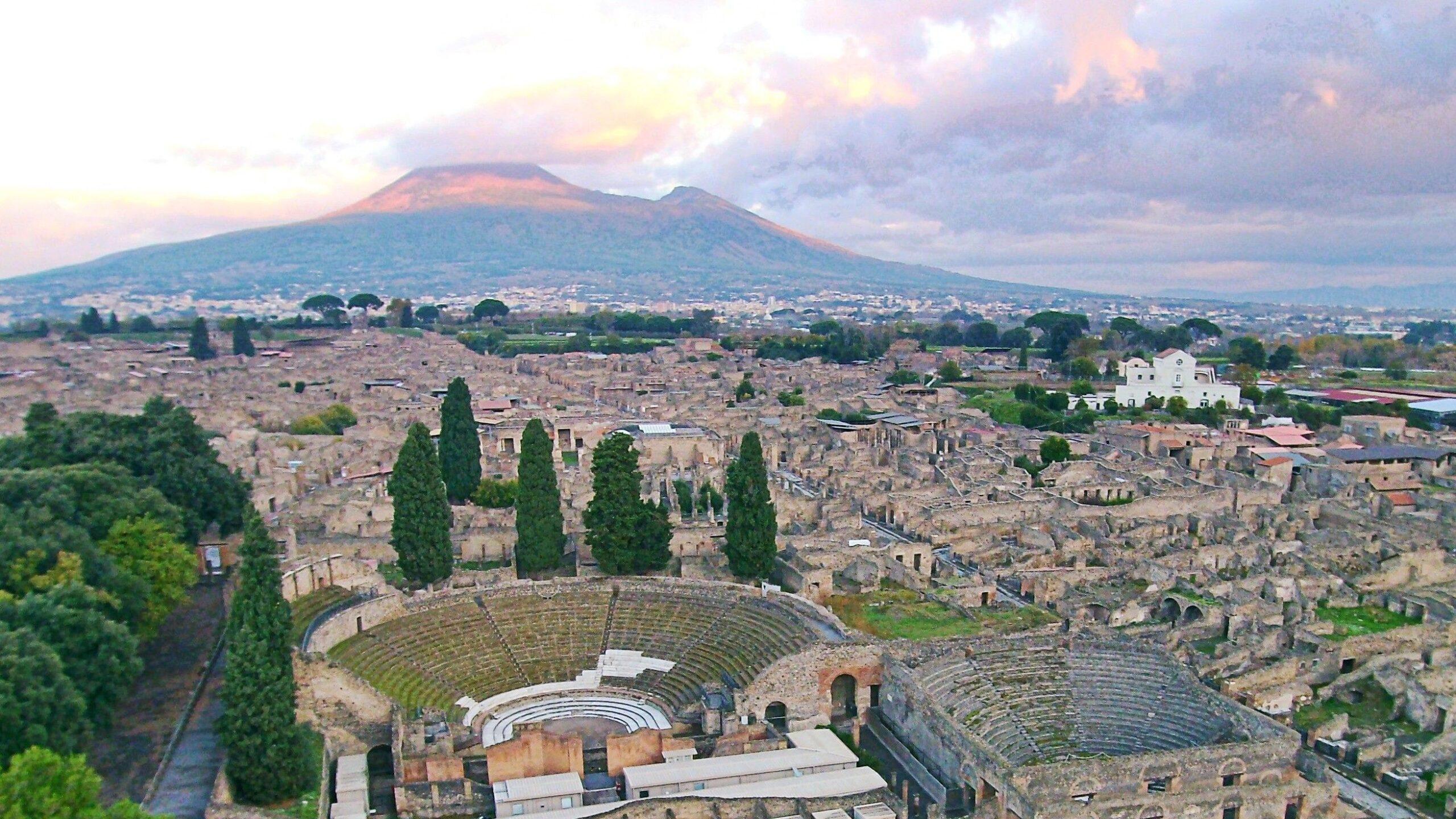

The bread was still in the ovens. Merchants were arguing prices in the forum. Children were playing in the streets, dogs were sleeping in doorways, and the faint smudge of smoke rising above Mount Vesuvius on the morning of August 24, 79 CE looked, to anyone who noticed it at all, like nothing worth interrupting a sale for. Within hours, the city of Pompeii would be gone — not buried slowly under rivers of glowing lava, as generations of popular imagination have insisted, but consumed by something far stranger, faster, and more terrifying than any river of fire. Understanding what actually happened, and what it left behind, changes the way you see both ancient Rome and the fragility of every civilization that has followed it.
What Pompeii Was Before the Eruption

To understand what was lost that morning, you have to understand what Pompeii actually was. This was not some dusty provincial outpost. Pompeii was a sophisticated, cosmopolitan city whose roots stretched back to the 9th or 8th century BCE — making it ancient even by Roman standards, with centuries of layered culture pressed into its cobblestones long before the Roman legions claimed it in the 4th century BCE. By 79 CE, it had grown into a thriving southern Italian city of somewhere between 10,000 and 20,000 residents, drawing wealthy Romans down from the capital to build lavish villas and enjoy the spectacular views of the Bay of Naples.
Walk through Pompeii’s streets in your imagination and the city crackles with life. There was a grand amphitheater — one of the oldest surviving stone amphitheaters in the Roman world, built around 70 BCE — along with bakeries with grain still lodged in the millstones, thermopolia (Roman fast-food counters) with wine and stew kept warm in sunken terra-cotta vessels, and walls plastered with election slogans and political insults. One surviving graffito reads like a modern campaign endorsement. Another is an insult so crude it would still raise eyebrows today. This was not a civilization of marble abstractions — it was loud, messy, ambitious, and deeply, recognizably human.
Crucially, Vesuvius was trusted. A powerful earthquake had rattled the region in 62 CE, causing significant structural damage across Pompeii and the surrounding towns, but the volcano itself had been dormant for so long that its slopes were terraced with productive vineyards. The mountain was generous, its volcanic soil legendarily fertile. No one alive in Pompeii in 79 CE had any experiential reason to believe their mountain was capable of what it was about to do. That misplaced trust would prove catastrophic. There is also a scholarly debate worth acknowledging here: some researchers, examining the ripeness of fruits and nuts found in the ruins alongside references in ancient texts, have argued the eruption may have occurred in October rather than August — a detail that remains unresolved but illustrates how actively historians continue to interrogate even the most basic facts of one of history’s most documented disasters.
What Vesuvius Actually Did in 79 CE

The eruption did not announce itself as a death sentence. At first, it presented as a spectacle — a towering column of ash and pumice rocketing miles into the sky, later described by Pliny the Younger, watching from Misenum across the Bay of Naples, as resembling an enormous pine tree, its trunk of smoke spreading into a vast canopy above the mountain. This type of eruption — an extremely powerful, column-generating event — is now formally classified by volcanologists as a Plinian eruption, named directly after Pliny’s account. For hours, the column rained debris down onto the city: pumice stones, ash, and an oppressive, growing darkness. Terrifying, yes. Survivable, for those who fled early. Many residents did exactly that — grabbed what they could carry and ran toward the coast or into the countryside. Historians believe a significant portion of Pompeii’s population escaped during these early hours.
But then came the collapse. When the eruption column could no longer sustain itself and fell back toward the mountain, the physics changed catastrophically. The collapsing material generated pyroclastic flows and surges — superheated avalanches of gas, ash, and pulverized rock racing down Vesuvius’s flanks at extraordinary speeds. These were not slow-moving rivers of debris. They were dense, roiling walls of destruction traveling at velocities that made flight impossible, carrying temperatures capable of killing instantly on contact. Multiple surges swept over Pompeii in rapid succession, and by the time the eruption was finished, the city lay buried under at least 19 feet of volcanic material — a sudden, catastrophic shroud of ash, pumice, and pyroclastic debris that sealed everything beneath it with the precision of a mold.
Pliny the Younger’s letters to the historian Tacitus remain one of the most remarkable eyewitness records of any natural disaster in the ancient world. He described a darkness so complete it extinguished the midday sun, a terror that sent people fleeing into the sea with cushions tied to their heads as crude protection against falling pumice, and clouds of ash so dense the air itself seemed to solidify. His uncle, Pliny the Elder — commander of the Roman fleet at Misenum and a celebrated naturalist — sailed toward Vesuvius both to assist survivors and to observe the eruption firsthand. He died in the attempt, most likely overcome by toxic gases or the thermal effects of the surges near Stabiae.
The Real Cause of Death: Not Lava, Not Slow Suffocation

Here is where the popular story of Pompeii collapses under scrutiny. For generations, people assumed the victims suffocated gradually — buried by ash, slowly overwhelmed, given at least the terrible mercy of time to say a final word. Modern forensic science has dismantled that picture almost entirely. The evidence, drawn from decades of skeletal analysis, points to a different conclusion: most victims found within the city were killed nearly instantaneously by the pyroclastic surges.
These superheated clouds caused thermal trauma of a severity that is difficult to comprehend. Studies of skeletal remains from Pompeii have documented evidence of extreme, rapid heat exposure. Research published by Italian scientists, including work led by physical anthropologist Pier Paolo Petrone, found indicators suggesting that in some cases the heat was intense enough to cause the evaporation and subsequent vitrification of brain matter inside the skull — essentially transforming soft tissue to a glassy solid in an instant. Bone fractures consistent with extreme thermal stress have also been documented across multiple victims. The muscles of those caught in the surges contracted violently and simultaneously in the heat, a phenomenon that locked bodies into sudden, unguarded postures — not the positions of people bracing for death, but of people stopped mid-motion, mid-breath, between one moment and the next.
This is precisely what the famous plaster casts make visible. When archaeologists discovered that the compacted volcanic ash had hardened around the decomposed bodies of victims and left perfect voids in their exact shapes, they developed a technique — pioneered by Giuseppe Fiorelli in the 1860s — of pouring liquid plaster into those voids. The results were among the most haunting objects in the history of archaeology: a dog still chained to its post, its body twisted in its final moment; a man with his hands raised toward his face; a family curled together against a wall. These are not the postures of slow suffocation. They are moments violently arrested, preserved by the very material that killed them.
The lava question must also be addressed directly. While Vesuvius did erupt with pyroclastic flows, lava did not reach Pompeii. The city was buried under ash, pumice, and pyroclastic material. The distinction matters enormously — lava, for all its cinematic menace, typically moves slowly enough that most people can outrun it. Pyroclastic surges cannot be outrun. They cannot be hidden from. They arrive before the sound of their own approach. The people of Pompeii were not drowned in fire. They were erased by something that moved faster than instinct.
Lost, Then Found: How Pompeii Disappeared and Was Rediscovered

After the eruption, Pompeii did something remarkable for a city of up to 20,000 people: it vanished. Not just physically — its very name faded from living maps and memory over the centuries that followed. Nearly 20 feet of volcanic material was more than enough to bury not just a city but its entire cultural existence. The fields above it were eventually farmed. The compressed ash became soil. Pompeii became, quite literally, underground history, its location known only by an obscure reference here or there in surviving Roman texts.
Ruins were first encountered in the late 16th century during the construction of an underground aqueduct channel, but the significance of the discovery was not immediately understood. It was not until 1748 that systematic excavation began in earnest under the direction of the Spanish military engineer Roque Joaquín de Alcubierre, commissioned by the Bourbon King Charles VII of Naples. What the excavators found staggered the European world: a city frozen mid-sentence. Food still in vessels on tables. Wine amphorae still stacked in taverns. Electoral graffiti still bold on walls that had not seen sunlight since the reign of Emperor Titus. The completeness of the preservation was almost surreal — a primary source for Roman daily life that no written history alone could have provided, offering scholars a granular view of how ordinary Romans actually lived, ate, worked, worshipped, and moved through the world.
The excavations have never stopped. Ongoing work in areas such as the Regio V district — part of the Great Pompeii Project launched in 2012 — continues to produce remarkable finds: new victims, elaborately frescoed rooms, ceremonial objects, and inscriptions that complicate or enrich existing historical understanding. Pompeii is not a closed book. It is an active, evolving investigation, and every new season of excavation carries the genuine potential to revise what historians thought they knew.
What the Victims Tell Us Now

Modern science has dramatically expanded what the bodies of Pompeii’s victims can reveal. Isotopic analysis of skeletal remains has shown that many of those who died in Pompeii were not locally born residents but had originated from across the Mediterranean world — immigrants, traders, travelers, and enslaved people transported from distant provinces. DNA analysis of remains is an active area of research that continues to add detail to this picture. Pompeii was a genuinely cosmopolitan place, its population a mosaic reflecting the reach of the Roman Empire and the restlessness of ancient human movement across it.
Archaeologists have now created plaster casts of more than 100 victims, and each carries a posture that communicates something achingly specific. A man shielding his face. A woman fallen forward. A child curled against a wall. These are not statistics or anonymous casualties — they are individuals, and the surge that killed them also preserved them with a specificity that written records almost never achieve for ordinary people of the ancient world. The science and the emotion are inseparable: the data tells us how they died, and the casts tell us who they were in the precise moment it happened.
Why Pompeii Still Refuses to Stay Buried

Nearly two thousand years after Vesuvius erupted and erased a living city in under 24 hours, Pompeii remains one of the most visited and most important archaeological sites on Earth, drawing more than three million visitors annually in recent years. The enduring pull has less to do with morbid fascination — though the scale of the tragedy is real and immense — and more to do with recognition. Walk through Pompeii’s excavated streets and what strikes visitors is not the exotic strangeness of ancient Roman life but its startling familiarity: the fast-food counters serving working people in a hurry, the political graffiti on public walls, the class anxieties written into the architecture, the small domestic details of people who loved and argued and planned for futures that were never allowed to arrive.
The eruption that destroyed Pompeii also, by catastrophic accident, preserved it with a completeness no other ancient site can match. It created an archive. And the true story of how its people died — not drowned in slow lava, not suffocated over hours, but killed in seconds by a superheated surge moving faster than any warning could travel — is a reminder that nature’s most lethal forces are often the ones that give no notice and allow no response. The bread was in the ovens. The merchants were arguing. And then, between one heartbeat and the next, the morning of August 24, 79 CE simply stopped — and Pompeii has been telling us about that moment, in richer and richer detail, ever since.

 English
 Arabic
 French
 Spanish
 Portuguese
 Deutsch
 Turkish
 Dutch
Dutch
 Russian
 Romaian
 Portuguese (Brazil)
 Greek
Greek