


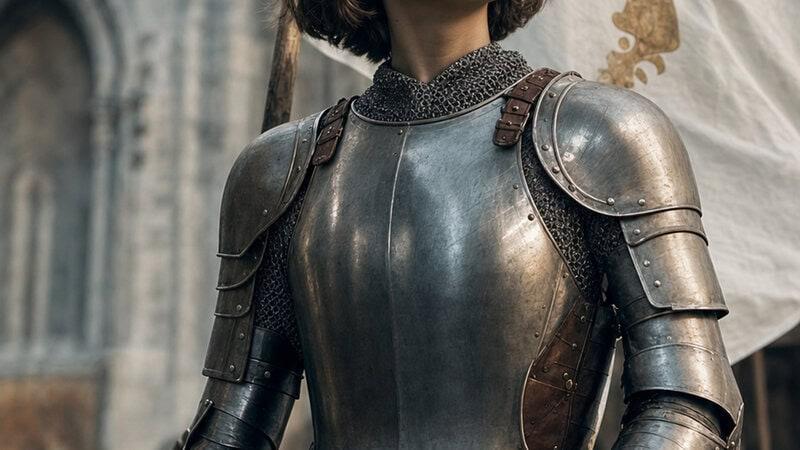

In the spring of 1429, a seventeen-year-old girl from the farming village of Domrémy walked into a royal workshop in Tours and did something that had almost certainly never happened before: she asked trained armourers to measure her body and forge a full suit of plate armor, fitted precisely to her frame, so that she could lead an army into one of the most desperate sieges in French history.
The Girl Who Ordered a Suit of Armor at Seventeen

The moment deserves to linger, because its audacity tends to get buried beneath centuries of paintings, theatrical productions, and Halloween costume listings. Joan of Arc — Jeanne d’Arc — arrived at the court of the Dauphin Charles with no military rank, no noble title, and no precedent for what she was proposing to do. Women in fifteenth-century France did not commission bespoke field armor. Knights did. Commanders did. And yet there she stood, presenting herself as exactly that, and the royal court, astonishingly, agreed.
King Charles VII funded the commission personally. This was not a symbolic gesture or a piece of theatre. Custom plate armor was extraordinarily expensive — it required weeks of skilled labor, specialized tools, and an armorer’s intimate knowledge of the wearer’s proportions. By authorizing it, the French crown declared, in the clearest possible material language, that Joan of Arc was a military commander who would be placed in genuine danger and expected to fight.
We obsess today over the Joan of Arc costume — in art galleries, films, and costume shops where a white dress and a plastic breastplate pass for historical accuracy. But the real outfit began not with cloth and a needle, but with hammers and hot steel.
What Historical Sources Actually Tell Us She Wore

The most detailed surviving descriptions of Joan’s appearance come from a deeply uncomfortable source: the transcripts of her 1431 condemnation trial. Her English-backed accusers interrogated her clothing and physical appearance with forensic persistence, because those details formed part of the formal charges against her. The trial records, precisely because they were hostile and legal in nature, are an accidental goldmine. Nobody was trying to romanticize Joan in those proceedings — they were trying to convict her.
What those records confirm is that Joan consistently wore male military dress throughout her campaign. This included a short tunic, hose, boots, and the plate armor commissioned at Tours. The accusation of cross-dressing — wearing men’s clothing — was not a minor footnote in her trial. It was one of the central charges, treated by the church court as a grave violation of divine and natural law. The fact that her enemies found it so threatening tells us exactly how powerful her appearance was as a statement of identity and authority.
Contemporary chroniclers noted that Joan wore her dark hair cropped short — a practical decision driven by the realities of wearing a helmet for extended periods, not purely a spiritual statement, though it was later interpreted as both. As for her historical appearance more broadly: there is no verified portrait painted from life. The image most people carry in their heads — the red-haired, fair-skinned, ethereal young woman of Romantic painting — is almost entirely a nineteenth-century invention. What we know is that she was described as physically robust, capable of sustained riding and the demands of a military campaign, and dark-haired. Everything else is projection.
The Armor Itself: What Custom-Fitted Plate Actually Meant in 1429

When we say Joan of Arc’s armor was custom-fitted, it is worth understanding precisely what that phrase meant in the fifteenth century. A medieval armorer did not work from standard sizes. He took direct measurements of the wearer’s torso, shoulders, arms, and legs, then shaped individual steel plates over an anvil, checking and rechecking the contours against the person’s actual body. The resulting suit was essentially a second skeleton, engineered to the individual.
A full harness of the period — the technical term for a complete plate armor suit — was a sophisticated system of interlocking components: a breastplate and backplate protecting the torso, pauldrons covering the shoulders, vambraces guarding the forearms, gauntlets for the hands, articulated leg armor from thigh to foot, and a visored helmet that could be closed during combat and opened for breath and visibility between engagements. The whole assembly typically weighed somewhere in the range of fifteen to twenty-five kilograms, distributed carefully across the body so that a trained wearer could run, mount a horse, and swing a weapon without being immobilized.
Joan’s armor was not decorative. It was not tournament plate polished for pageantry. It was functional field armor designed for the brutal siege warfare she was about to enter at Orléans, where English forces had held the city under a strangling blockade for months. That distinction matters enormously when we think about what she actually needed it to do.
Modern costume makers interpret this legacy with varying degrees of historical care. Collections such as the Fantasy Joan of Arc Women’s Outfit at Dark Knight Armoury and the Fantasy Joan of Arc Women’s Outfit at Medieval Collectibles offer a starting point for those wanting armored costume pieces, though both are explicitly costume interpretations rather than historical replicas.
Orléans and the Reality of Joan in Battle Dress

In May of 1429, Joan of Arc entered the siege of Orléans. The French relief effort she helped lead broke the English blockade within days, a military reversal that shocked observers across Europe. What eyewitness accounts and later testimony describe is a figure directing troops while armored from head to foot, carrying her personal standard rather than a sword in her hand.
During the fighting, she was struck by an arrow that penetrated between her neck and shoulder. This detail is not hagiography — it is documented in multiple accounts. Joan reportedly withdrew briefly to tend the wound before returning to the field. The injury is proof, if proof were needed, that she was present in genuine combat conditions, exposed to real projectiles at close range, not positioned safely behind the lines as a symbolic figurehead.
Her standard — white cloth embroidered with fleurs-de-lis and bearing figures of Christ and angels — was in many ways as important to her identity as the armor itself. Joan reportedly said that she loved her banner forty times more than her sword. She was seen raising it against the walls of fortifications to signal assault, and witnesses recalled it as a rallying point for troops. The combination of gleaming steel plate and a devotional battle standard created a deliberate visual vocabulary: here was a holy warrior operating within the recognized symbols of martial authority.
The Sword, the Banner, and the Objects That Completed Her Identity

Joan famously directed her supporters to retrieve a specific sword from behind the altar of the church of Sainte-Catherine-de-Fierbois. The sword was reportedly found there, said to be engraved with five crosses, and the story of its discovery spread quickly, lending Joan an aura of divine endorsement that no amount of conventional credentialing could have provided. She carried multiple swords over the course of her campaign, but none achieved the symbolic weight of that first recovered blade.
She also wore spurs — a detail that might seem minor but carried enormous cultural weight in a society that understood knighthood as a visual and ceremonial system. Spurs were a knight’s emblem. By wearing them, Joan was not merely dressing practically; she was making a legible claim to martial status that her soldiers, trained to read these signals from childhood, would have recognized instantly.
So when we ask what Joan of Arc actually wore, the honest answer is: a complete and carefully constructed identity. Plate armor shaped to her teenage body. A sword retrieved under circumstances that amplified her mystical authority. A devotional standard that she valued above any weapon. Spurs that declared her rank in the language of chivalric culture. Every element was doing work — practical, symbolic, strategic — all at once.
How Painters, Playwrights, and Hollywood Rewrote Her Wardrobe

The mythologizing began almost immediately after her death and accelerated dramatically in the nineteenth century. French Romantic painters transformed Joan into a vision of pale, often golden-haired femininity — an ethereal martyr whose gender was softened into something the era found comfortable. The armored military commander who wore men’s clothes, and who was condemned partly for refusing to abandon them, became canvas after canvas of a luminous girl in flowing white, sword raised toward heaven.
This transformation served political purposes as much as aesthetic ones. Post-Revolutionary France, and later the France of the Franco-Prussian War era, needed Joan as a national martyr-saint. A cross-dressing military commander who had defied church authority and been condemned for it was a complicated symbol. A radiant, feminine spiritual vision was a far cleaner one. The paintings chose accordingly.
Film adaptations have oscillated between gleaming fantasy plate — often anatomically shaped for a female figure in ways that had no historical basis — and simplified peasant dress, rarely engaging seriously with the actual record of functional fifteenth-century field armor. The result is the Joan of Arc costume sold widely today: a white dress, a decorative silver breastplate, a flowing wig. Browse Joan of Arc costumes on Amazon or explore handcrafted Joan of Arc costume options on Etsy and you will find this image reproduced across dozens of variations — striking in their own right, but almost a photographic negative of the historical reality. For those drawn to the mythologized visual tradition rather than the historical record, this Pinterest collection of Joan of Arc costume ideas shows the full range of interpretations that tradition has produced.
Why Getting Her Costume Right Actually Matters
Joan’s clothing choices were not personal eccentricities. They were tactical decisions made by someone thinking carefully about how power worked in the world she inhabited.
Male military dress gave her freedom of movement that female dress of the period would have prevented. It offered protection from sexual assault among an army of men — a real and documented concern; she reportedly kept her armor on at night for exactly this reason. And it signaled military authority in an immediate, legible way that crossed language barriers and literacy barriers among troops who might not know her name but knew exactly what a fully armored commander looked like.
Her accusers understood this perfectly. The charge of wearing men’s clothing was not prudish fussiness about gender norms. It was a calculated attempt to dismantle the identity through which she exercised power. Strip away the armor, put her back in a dress, and she became something her enemies could categorize and dismiss. Joan understood this too — which is why, near the end of her trial, she briefly agreed to wear women’s clothing, then returned to male dress, a decision that sealed her fate but that she apparently considered non-negotiable.
Engaging seriously with what Joan of Arc actually wore forces us to see her not merely as a visionary who heard divine voices, but as a strategic thinker who understood the semiotics of military power and deployed them with precision. That is both more historically accurate and, frankly, more remarkable than any painting of a girl in white robes gazing skyward.
The teenager who walked into that Tours workshop and asked for armor made to her measurements was not dressing up. She was suiting up. She knew exactly what she was doing — and the distinction between costume and equipment, between symbol and weapon, between myth and the hammered-steel reality, is everything.

 Arabic
 French
 Spanish
 Portuguese
 Deutsch
 Turkish
 Dutch
Dutch
 Italiano
 Russian
 Romaian
 Portuguese (Brazil)
 Greek
Greek