


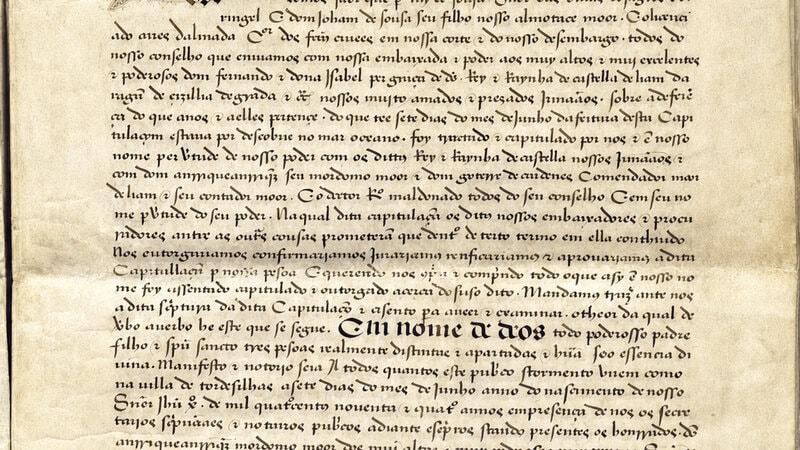

On the morning of June 7, 1494, in a modest Castilian town on the banks of the Duero River, royal scribes dipped their quills and two sets of diplomats pressed their seals into warm wax — and in doing so, divided the entire world between two kingdoms without asking a single person who actually lived in most of it.
A Room in Tordesillas, and a Property Deed for the Planet

The town of Tordesillas was not a grand stage for world history. It had no particular strategic significance, no commanding harbor, no ancient prestige. What it had, in the summer of 1494, was a convenient location and a table large enough to spread a map across. The diplomats who gathered there represented Ferdinand II of Aragon and Isabella I of Castile on one side, and King John II of Portugal on the other. What they negotiated that day was, in effect, a legal instrument of almost cosmic arrogance: a line drawn across the Atlantic Ocean, assigning the undiscovered and half-discovered world to one crown or the other.
The Treaty of Tordesillas sits quietly in most history books — a date, a meridian, a footnote to the age of Columbus. But the line drawn that day would determine which languages billions of people would speak, which religions would be imposed upon them, and which colonial powers would extract their land and labor for centuries. It is one of history’s most consequential documents, and one of its most audacious acts of presumption.
The World Before the Line: Two Kingdoms on the Edge of War

To understand why two kingdoms felt entitled to divide the planet, you have to understand just how electric and dangerous the early 1490s felt to European maritime powers. Portugal had spent decades — and extraordinary sums of money, ships, and lives — pioneering sea routes down the African coast, searching for a path to the spices and silks of Asia. Lisbon had built its national identity and its treasury around this oceanic project. Then, in 1492, Christopher Columbus sailed west under Spanish patronage and returned claiming he had found islands on the far side of the Atlantic. Portugal was furious.
From Lisbon’s perspective, Spain had barged into a neighborhood Portugal considered its own. The rivalry between the two crowns was already old and bitter, rooted in competing claims over Atlantic islands and African trade routes. Columbus’s voyage sharpened that rivalry toward something that looked very much like the prelude to open conflict. Both kingdoms appealed to the highest authority available to Christian monarchs of the era: the Pope.
Pope Alexander VI responded in 1493 with a series of papal bulls — the most important of which was Inter caetera — drawing an earlier, cruder line roughly 100 leagues west of the Azores and Cape Verde Islands and granting Spain authority over lands to the west. John II of Portugal rejected this settlement immediately. The line was too favorable to Spain, cutting Portugal off from sea lanes it considered essential to its African and eastward ambitions. He demanded renegotiation — and the result, after months of direct diplomacy between the two crowns, was the Treaty of Tordesillas.
What followed was a bilateral negotiation between two crowns bargaining over territories most Europeans had never seen, based on maps that were partly guesswork and entirely self-serving. The history of the treaty’s negotiation is, at its core, a story of two imperial powers trying to formalize their ambitions before the other could act on them.
The Mechanics of Division: 370 Leagues West of Nowhere

What the Treaty of Tordesillas actually said was elegant in its simplicity and absurd in its practicality. A meridian line would be drawn 370 leagues west of the Cape Verde Islands. Everything to the west of that line — all newly discovered lands, all lands yet to be discovered — would belong to Spain. Everything to the east would belong to Portugal. The world was cut in half like an orange and the two halves handed to two kingdoms.
The practical problem was immediate and insurmountable: in 1494, no one could precisely locate 370 leagues in open ocean. Navigation of the era relied on dead reckoning, compass bearings, and educated estimation. The unit of measurement itself — a league — varied in definition depending on who you asked and which regional standard was in use. The line was cartographically aspirational, a legal fiction dressed up as a geographical fact. The treaty’s original text carries the solemn weight of international law, but the line it describes existed more in imagination than on any real ocean surface.
Nevertheless, the procedural machinery ground forward with impressive seriousness. Spain ratified the treaty on July 2, 1494. Portugal followed on September 5, 1494. The agreement was witnessed, sealed, copied, and archived with the full ceremony of binding international law. UNESCO later recognized the original documents held in Lisbon and Simancas as part of the Memory of the World register, an acknowledgment of their extraordinary historical significance.
The treaty’s defining clause covered lands “newly discovered and to be discovered” outside Europe — language broad enough, and vague enough, to swallow continents. Which is exactly what it did.
Who Was Not in the Room: The Voices the Treaty Erased

Here is the moral center of everything that followed: not one Indigenous leader was consulted. Not one representative of the tens of millions of people already living across the Americas, Africa, and Asia was notified, invited, or considered. The Aztec Empire, with its capital city of Tenochtitlán holding a population larger than most cities in contemporary Europe, did not have a seat at the table. The Inca Empire, which governed a vast territory along the western spine of South America through one of the most sophisticated administrative and road systems in the pre-Columbian world, carried no legal weight whatsoever in a room in Tordesillas. The Tupí peoples of coastal Brazil, the countless civilizations of the Caribbean, the kingdoms of West Africa — all were parceled out like vacant land, because European legal doctrine of the era held that territory without a Christian European sovereign was effectively ownerless. The fiction of vacancy was the engine of the entire enterprise.
This was not an oversight. It was a philosophical position — one that treated sovereignty as something only Christian European monarchs could legitimately possess or bestow. The treaty gave both crowns an ideological and legal framework to explore and claim these lands, often by force, with devastating consequences for the people who already called them home. The impact on Indigenous civilizations was not incidental to Tordesillas — it was structurally encoded in the document from the moment the scribes finished writing.
The conquest, enslavement, and demographic collapse that followed across the Americas did not spring solely from this treaty. But Tordesillas provided essential scaffolding — a legal and moral vocabulary that told conquistadors, priests, and colonizers that what they were doing carried royal and divine sanction. The wax seals pressed in that Castilian room were, in a very real sense, pressed into the futures of millions of people who would never know they existed.
The Line Lands: How Tordesillas Shaped Two Hemispheres

The most dramatic geographical consequence of the treaty was almost accidental. The eastern coastline of South America bulges significantly into the Atlantic — far enough east that when Pedro Álvares Cabral landed on the coast of what is now Brazil in 1500, his landfall fell on Portugal’s side of the Tordesillas line. That geographical fact, combined with a line drawn six years earlier in a Castilian town, is the direct reason Brazil speaks Portuguese today while the rest of South America speaks Spanish. One meridian, one bulge in a coastline, and the linguistic map of an entire continent was fixed.
For Spain, the treaty was an extraordinary windfall. Virtually everything west of the line — which meant virtually all of the Americas — fell under the Spanish crown. This provided the legal scaffolding for Hernán Cortés in Mexico, Francisco Pizarro in Peru, and dozens of other conquistadors to operate under royal authority as they dismantled civilizations and claimed their wealth. The treaty did not cause the conquest, but it licensed it.
What Tordesillas could not do was bind anyone who had not signed it. England, France, and the Netherlands looked at the Iberian division with undisguised contempt and proceeded to build their own colonial empires wherever they could manage it. French diplomats famously questioned the premise that two kings could simply award each other the world by papal decree. In this sense, Tordesillas was always partly a performance — a bilateral arrangement dressed up as universal international law. But the performance mattered, because it shaped Spanish and Portuguese behavior with considerable consistency across more than a century of expansion and gave both crowns a ready-made justification for resisting rival incursions.
The Treaty of Zaragoza and a Template for Empire

Tordesillas proved so useful as a diplomatic technology that the two kingdoms repeated it. In 1529, Spain and Portugal signed the Treaty of Zaragoza, extending the same logic to the other side of the world — dividing the Pacific along an antimeridian line to settle competing claims over the Moluccas, the Spice Islands. The same imperial confidence, the same cartographic audacity, and the same absence of any consultation with the people actually inhabiting the places being divided.
This sequel reveals something important about what Tordesillas really was. It was not a one-time act of hubris but a template — a repeatable method for converting territorial ambition into legal language. And like Tordesillas, Zaragoza was violated whenever profit made violation worthwhile. Both kingdoms trespassed into each other’s designated zones often enough that the treaties functioned less as firm geographical boundaries than as opening positions in a continuous negotiation. What they enforced with consistency was not geography but ideology: the idea that distant lands could be owned by decree, and that sovereignty flowed from European courts rather than from the millions of people who inhabited the earth.
Why Tordesillas Still Echoes
The effects of the Treaty of Tordesillas did not end when the age of exploration gave way to the age of revolution. They remain visible today in the linguistic borders of Latin America, in ongoing legal disputes over Indigenous land rights across two continents, and in the very shape of nation-states whose boundaries were drawn by colonial administrators working within frameworks that Tordesillas helped establish. The Portuguese language in Brazil, the Spanish dominance across most of the western hemisphere, centuries of extractive colonialism that stripped wealth from the Americas and Africa — all of these have deep roots that run through a document signed in a Castilian town on a June morning more than five centuries ago.
What the treaty represents, as a historical object, is one of the most explicit surviving records of how European powers in the age of exploration treated sovereignty as something only they could possess or bestow. It is not a relic of a distant and unrecognizable world. The legal concepts it embodied — that land without a European deed was effectively empty, that discovery conferred ownership, that papal authority could legitimate conquest — shaped jurisprudence, policy, and violence for centuries. Their echoes have not fully faded. Modern international law’s slow, incomplete reckoning with Indigenous territorial rights is, in part, a reckoning with the long aftermath of precisely this kind of thinking.
The question the treaty ultimately poses is a simple and unsettling one: what does it mean that two kings could draw a line across the world, and that the line could actually work? Not because it was technically precise — it was not. Not because it was universally respected — it was not. But because the power behind it was real enough, and the violence that enforced it was real enough, to reshape continents and peoples for generations. The answer says less about cartography than it does about whose claim to reality gets recognized — and whose does not.
In the room in Tordesillas, the wax cooled. The scribes packed up their instruments. The diplomats began their journeys home. And on the other side of the ocean, in cities of stone and gold, in forests no European had yet entered, in fishing villages on coasts no one in that room could accurately draw — no one knew that anything had changed. And yet, for millions of people and their descendants across generations, everything had.

 English
 Arabic
 French
 Portuguese
 Deutsch
 Turkish
 Dutch
Dutch
 Italiano
 Russian
 Romaian
 Portuguese (Brazil)
 Greek
Greek