


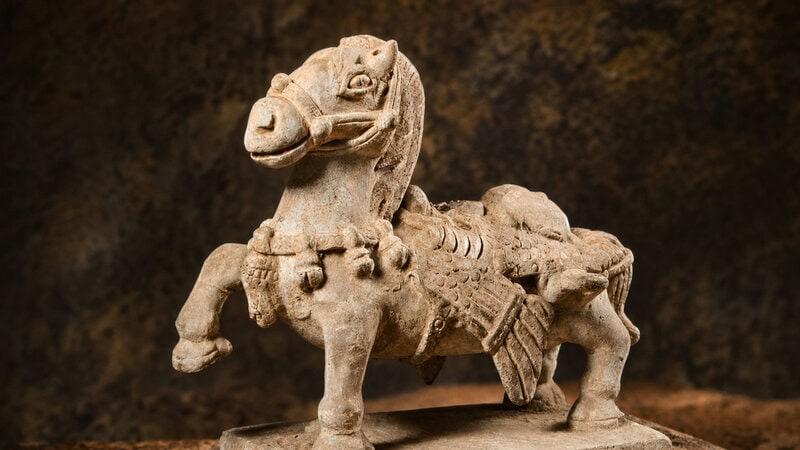

In 221 BC, the king of Qin stood at the center of a conquered world and reached for a title no Chinese ruler had ever used before. He called himself Huangdi — the First Emperor — and announced that his line would rule for ten thousand generations. His dynasty collapsed within fourteen years of his death, making it one of the most spectacular miscalculations in the history of human ambition.
The Emperor Who Thought He’d Last Forever

Qin Shi Huang’s failure is worth sitting with, because he was not a weak man. He unified a fractured subcontinent, standardized the written script, the currency, and the axle-width of carts so that roads could serve a single empire rather than a patchwork of kingdoms. He built walls, canals, and a terracotta army of thousands to guard his tomb. He created the first true centralized Chinese state through sheer coercive force. And yet the dynasty he named for himself — the Qin — lasted from 221 to 207 BC, a lifespan shorter than the reign of some individual European monarchs.
If the most ruthlessly efficient political machine China had ever produced couldn’t hold on, what kept other dynasties alive for centuries? And why, across four thousand years of Chinese dynastic history, does the same breaking point keep appearing around the 200-to-300-year mark, as reliably as a fault line under a growing city?
The answer involves demography, political economy, agricultural collapse, and an ideology so durable it could survive the very dynasties it was invented to explain. But to find it, we have to start at the beginning — before the written records, before the emperors, in a time when China’s most enduring political idea was still being formed.
Before the Records: Xia and Shang — Where the Cycle Was Born

The traditional Chinese timeline opens with the Xia Dynasty, dated to roughly 2070-1600 BC. Whether the Xia constitutes a true archaeological civilization or a mythologized memory of earlier chiefdoms remains a genuine debate among scholars. Excavations at Erlitou in Henan province have revealed a complex Bronze Age site that some researchers associate with the Xia, but direct textual confirmation is lacking. The dynasty’s cultural function, however, was never in doubt: it established the foundational idea that legitimate rule flows from heaven’s approval, and heaven’s approval flows from virtue. A king who governed justly held the Mandate of Heaven, Tianming. A king who grew cruel and corrupt had lost it. That logic — simple, flexible, infinitely reusable — would govern Chinese political thought for the next three millennia.
The Shang Dynasty, which followed from approximately 1600 to 1050 BC, gives us the first hard archaeological evidence for this framework in action. Oracle bones — animal bones and turtle shells heated until they cracked, the cracks then read as divine messages — reveal a royal court already obsessed with legitimacy, ritual, and the anxious management of heaven’s opinion. Tens of thousands of these inscribed fragments have been recovered, primarily from the site of Anyang in modern Henan, giving historians an unusually direct window into Shang royal preoccupations. Bronze ritual vessels from this period display a sophistication of craft that implies centuries of accumulated technique. The late Shang period, sometimes dated to around 1300-1046 BC per Oxford Academic scholarship on early China, left behind a civilization that was unmistakably complex and unmistakably fragile.
The last Shang king, Zhou Xin, is remembered across every subsequent Chinese historical account as a tyrant who indulged in cruelty while his people starved. Whether or not the portrait is fully fair — victors write history in every culture — the moral architecture it encodes matters enormously. When the Zhou rebels overthrew him, they didn’t merely claim military victory. They claimed that heaven itself had switched sides. The Mandate had moved. The cycle had turned for the first time in recorded memory, and it would keep turning, with eerie consistency, for thousands of years to come.
The Record-Holder: Why the Zhou Dynasty Lasted 789 Years

The Zhou Dynasty, which ran from approximately 1046 to 256 BC, is the longest-lasting dynasty in Chinese history — nearly 789 years, a span that dwarfs almost any comparable political entity in the ancient world. For perspective: the Zhou lasted longer than the entire arc from Rome’s traditional founding in 753 BC to the fall of the Western Empire in 476 AD. It is a staggering number, and it demands explanation, because the Zhou were not simply better at governing than everyone else.
They survived by doing something counterintuitive almost immediately: they gave power away. The Zhou king distributed territory to lords — relatives, allies, subordinates — who governed in the king’s name but with significant local autonomy. This feudal network held together through the Western Zhou period (roughly 1046-771 BC), when the royal court retained genuine authority. Then, nomadic incursions from the northwest forced the court to relocate eastward, and the Eastern Zhou (771-256 BC) began — a phase in which the king increasingly became a ceremonial figurehead while powerful regional states competed for real supremacy. This era produced two distinct sub-periods: the Spring and Autumn period, characterized by rivalry among dominant states that still nominally acknowledged Zhou authority, and the Warring States period, a centuries-long tournament of territorial aggression in which seven major states fought openly for total dominance. It was during this brutal crucible that Confucius, Mencius, and the Legalist thinkers formulated the political philosophies that would define Chinese governance for millennia.
The paradox is worth examining closely: the Zhou “survived” as long as it did partly because it stopped truly ruling. Its longevity is a story about brand persistence — the enduring moral legitimacy of the Zhou name — rather than continuous political power. This sets up one of the central tensions in all of Chinese dynastic history, one that every subsequent dynasty would be forced to navigate: strong centralization produces spectacular empires that burn bright and collapse fast, while looser arrangements stretch the timeline but hollow out the center until there is nothing left to defend.
The 300-Year Clock: From Qin’s 14 Years to Han’s 400

The Qin lesson was absorbed with remarkable speed. The Han Dynasty, which rose from the wreckage of the Qin between 206 BC and 220 AD, lasted over 400 years and became the template for what a successful Chinese dynasty could look like. Its founders dramatically reduced the brutal labor demands of the Qin state, embraced Confucian ideology as social glue rather than Legalist coercion, and gradually built a bureaucracy in which officials were recruited through examinations testing knowledge of classical texts rather than purely through aristocratic birth. This last innovation was perhaps the most consequential in Chinese history: it created a class of administrators whose loyalty attached to the imperial institution and to Confucian ideals, meaning the administrative machine could survive dynastic transitions relatively intact even when ruling families changed entirely.
The Han also demonstrates how dynasties managed internal crises through legitimacy resets rather than outright collapse. The Western Han (206 BC-9 AD) gave way to the brief Xin Dynasty under the usurper Wang Mang before the Eastern Han (25-220 AD) restored the Liu family name and restarted the legitimacy clock. It bought the dynasty another two centuries. Later dynasties would attempt similar resets, sometimes successfully, sometimes not.
It is around this point in the chronology of Chinese dynasties that historians begin to articulate what is sometimes called the dynastic cycle thesis: a recurring arc of founder’s energy, institutional consolidation, mid-dynasty prosperity, factional corruption and land concentration, peasant rebellion or frontier invasion, and finally collapse. The full rotation, in dynasty after dynasty, tends to complete in roughly 200 to 300 years. It is not a perfect clock — nothing in human history ever is — but the regularity is striking enough that it cannot be dismissed as coincidence or retrospective pattern-matching.
The Pattern in Motion: Tang, Song, Ming, and the Repeating Fractures

The Tang Dynasty (618-907 AD) is widely remembered as China’s cosmopolitan golden age. The capital Chang’an, with a population that may have exceeded one million, was among the largest and most diverse cities on earth. Silk Road trade brought Central Asian music, Persian fashions, and Nestorian Christianity into the imperial court. Poetry was elevated to a near-sacred art form, and the examination system reached new levels of institutional sophistication. The Tang lasted 289 years — almost textbook 300-year timing — before the An Lushan Rebellion of 755-763 AD fractured imperial authority so severely that regional military governors, the jiedushi, gradually supplanted central control. Warlordism finished what rebellion had started, and 53 years of fragmentation in the Five Dynasties and Ten Kingdoms period followed before the Song reunified the country.
The Song Dynasty (960-1279 AD) produced innovations that reshaped the world: paper money, movable-type printing, sophisticated naval technology, and some of the earliest military uses of gunpowder. Its economy was, by some estimates, the most commercialized on earth at the time. It was also a dynasty that never fully controlled its northern frontier, paying tribute to the Liao and later the Jin dynasties to maintain an uneasy peace before losing the north entirely to Jurchen invaders in 1127. The remnant Southern Song held on for another century and a half until the Mongol armies of Kublai Khan ended it in 1279. The Song’s fall introduces a critical additional variable in the dynastic equation: the powerful, unified steppe confederation that any dynasty struggling with internal fiscal and military problems simply could not simultaneously repel.
The Ming Dynasty (1368-1644 AD) lasted 276 years, and its end reads almost like a case study in how multiple stresses converge at the cycle’s final stage. A prolonged cold snap associated with the Little Ice Age reduced harvests across China’s agricultural heartland through the late sixteenth and early seventeenth centuries. A fiscal system too rigid to adapt left the government unable to pay its own frontier soldiers. Peasant rebellions erupted across the interior, most consequentially under Li Zicheng, whose forces captured Beijing in 1644. Manchu armies — organized, disciplined, and positioned to exploit the chaos — pressed from the north. No single cause toppled the Ming; it was the simultaneous arrival of all the cycle’s terminal pressures at once.
Each collapse is unique in its particulars, but the major Chinese dynasties in sequence all show the same structural fingerprint: a prosperous middle period followed by a late-stage land inequality crisis in which powerful landowners absorbed the tax base while smallholder peasants were squeezed past the point of endurance. This is not mysticism dressed up as history. It is demography and political economy playing out on a vast canvas, again and again, across millennia.
Why China Reset Instead of Fragmenting Permanently

The more striking question, in some ways, isn’t why the dynasties fell — it’s why China kept reassembling. Rome fragmented into successor states that never reunified; the political map of Europe today is still, in some meaningful sense, the wreckage of the Western Empire. China treated division as a temporary emergency and unity as the natural, morally correct condition of civilization. Warlords during chaotic interregna did not typically build competing national identities; they competed to become the next dynasty. The goal was always reunification, because the Mandate of Heaven could only rest on one head.
Several reinforcing forces produced this gravitational pull toward unity. The written examination system created a pan-Chinese administrative class that could staff any government claiming imperial legitimacy, regardless of the ruling family’s ethnic or regional origin — the Mongol Yuan and the Manchu Qing both governed through substantially Chinese bureaucratic structures. The North China Plain’s immense agricultural productivity meant that whoever controlled it controlled the tax revenues needed to fund reunification armies, a structural incentive toward central authority that Europe’s more geographically fragmented terrain never produced at comparable scale. And the Mandate of Heaven itself functioned as an ideological two-way ratchet: it delegitimized failing rulers, making rebellion morally defensible, while simultaneously legitimizing successful rebels, smoothing the path from military conquest to recognized governance.
What the Cycle Means — and When It Finally Stopped
The Qing Dynasty (1644-1912 AD) followed the pattern with almost uncomfortable fidelity. The early Kangxi and Qianlong reigns produced genuine prosperity, significant territorial expansion, and an elaborate cultural synthesis between Manchu and Han Chinese traditions. The late Qing period brought corruption, institutional paralysis, and the Taiping Rebellion of 1850-1864 — a civil war of devastating scale that killed an estimated twenty to thirty million people and remains among the deadliest conflicts in recorded history. The dynasty limped on for another half-century, hemorrhaging sovereignty through a series of unequal treaties with European powers and Japan before the 1911 Xinhai Revolution ended imperial rule entirely.
That rupture is as revealing as the pattern that preceded it. For most of China’s history, as historians of Chinese civilization have observed, the assumption of cyclical dynastic restoration ran so deep that early republican warlords and even some founding figures of the new republic flirted with imperial restoration — Yuan Shikai famously attempted to crown himself emperor in 1915, reigning for only 83 days before nationwide opposition forced him to abandon the effort. What finally broke the dynastic cycle wasn’t internal decay alone — China had survived countless rounds of that. It was the combined pressure of industrial-age European imperialism, a catastrophic gap in military and economic technology, and the arrival of ideological frameworks — nationalism, republicanism, and later Marxism — that offered entirely different answers to the question of what legitimate rule even means.
The bronze-age Shang kings who cracked bones to read heaven’s will, the examination candidates who memorized Confucian classics by Tang-dynasty candlelight, and the Ming generals who watched Manchu cavalry cross the northern passes were all participants in the same vast, multi-millennial experiment: how does a civilization handle the inevitable decay of its own institutions? How does it renew itself without destroying what it built? The Chinese dynastic cycle, running across four thousand years of recorded history, is the longest continuous record of that question being asked, answered, and asked again that human civilization has yet produced. The answer, it turns out, was never final — only repeatedly, stubbornly, and almost miraculously deferred.

 English
 Arabic
 French
 Spanish
 Portuguese
 Deutsch
 Turkish
 Dutch
Dutch
 Italiano
 Russian
 Portuguese (Brazil)
 Greek
Greek