


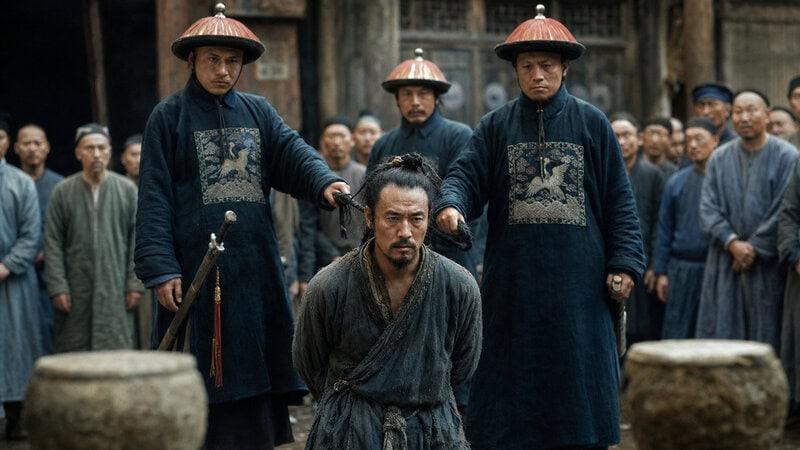

In the summer of 1645, imperial proclamations arrived in Han Chinese villages carrying a message that was equal parts grooming instruction and death threat: shave most of your head, braid what remains into a single tail at the back of the skull, and do it within ten days — or be executed as a traitor to the new Qing order. The phrase that spread through the population like a cold wind captured the brutal logic perfectly: keep your hair, lose your head; keep your head, lose your hair.
A Razor, a Braid, and a Choice: Comply or Die

The dynasty behind this edict had swept down from Manchuria with terrifying speed. The Manchu-led Qing forces breached the Great Wall in 1644, toppled the Ming dynasty, and installed the Shunzhi Emperor in Beijing before most of China had fully absorbed what was happening. With military conquest largely accomplished, the new rulers turned to a subtler — and in some ways more intimate — instrument of domination: the queue, a hairstyle historically worn by the Jurchen and Manchu peoples of Manchuria, involving a shaved forehead and crown with the remaining hair braided into a long tail down the back.
The queue was not incidental to Qing rule. It was the point. By mandating this single hairstyle across an empire that held roughly a third of the world’s population, the Qing court was demanding something far more intimate than tax payments or military submission. They were demanding that every man in China write his loyalty to the new dynasty on his own body, every single day, in a form visible to every neighbor, magistrate, and passing soldier.
It is worth noting the edict’s scope precisely: it targeted Han men specifically. Women’s hairstyles were not regulated under the queue law. Manchu women maintained their own distinctive styles — most notably the elaborate elevated coiffure associated with Qing court fashion — while Han women largely continued their existing practices. The queue policy was a gendered instrument of control, aimed squarely at Han male identity and the Confucian values bound up in it.
What Hair Meant to Han Chinese Men Before the Conquest

To understand why the queue order landed with the force of a cultural earthquake, you have to understand what hair meant to Han Chinese men before the Manchu arrived. Confucian teaching held that the body — skin, flesh, hair, and all — was a gift from one’s parents and ancestors, not to be willfully harmed or altered. The relevant passage from the Classic of Filial Piety (Xiaojing) states it plainly: “Our bodies — to every hair and bit of skin — are received by us from our parents, and we must not presume to injure or wound them.” Long hair, carefully maintained and elaborately pinned into a topknot, was not merely fashionable. It was a mark of filial piety, masculine dignity, and civilized identity. By the time of the Qing conquest, Chinese gentlemen wore their hair long, and long hair was considered a mark of masculinity. A gentleman’s topknot announced that he was a person who honored his ancestors and respected the moral order of the universe.
Cutting or shaving the hair, by contrast, was associated with mourning rituals, criminal punishment, or the customs of peoples the Han considered culturally alien. All three categories carried profound shame. When the queue edict arrived demanding that men shave most of their heads and braid a small remaining tail in the Manchu style, it was not heard as a fashion update. It was heard as a command to publicly brand yourself a criminal, a barbarian, or a man in perpetual mourning — and to repeat that humiliation every morning for the rest of your life.
This context transforms the queue mandate from a curious historical footnote into an act of deliberate cultural coercion. The Qing court understood exactly what it was asking. The Manchu queue functioned as a mechanism of submission, designed to fracture Han cultural confidence and establish the new dynasty’s dominance as something natural, permanent, and worn into the skin.
The Hairstyle That Launched Actual Rebellions

The response was immediate and, in places, catastrophic. The 1645 Queue Order triggered armed uprisings across recently conquered territories. Most famously, the cities of Jiangyin and Jiading in the Yangtze Delta became sites of prolonged resistance and massacre. Contemporary accounts, including the Jiangyin County Gazetteer and survivor testimonies compiled afterward, describe sieges lasting weeks and killing tolls in the tens of thousands. Historians who have studied this period observe a striking pattern: in some locales, resistance to the queue law was fiercer than resistance to the initial Qing military conquest. Men who had accepted foreign rulers balked at accepting a foreign haircut, because the haircut demanded something conquest alone did not — their visible, daily, embodied consent.
The Qing court had engineered it this way. The edict offered no middle ground, no gradual transition, no exemptions for sentiment. The binary was absolute: comply fully or die. This all-or-nothing logic served a specific political function. A man who shaved his forehead and braided his hair had not merely changed his appearance. He had performed an act of capitulation that he would have to perform again every time he looked in a mirror, every time a neighbor glanced at the back of his neck, every time he stepped outside his door. Resistance that survived the sword could still be broken, the Qing rulers calculated, by the slow erosion of daily compliance.
Scholars examining the queue policy continue to emphasize this point: the hairstyle was not a side effect of Qing rule but one of its primary governing technologies, sitting alongside law, taxation, and military force as a tool for managing a vast Han majority with a Manchu minority at the top.
The Early Queue vs. the Iconic Image You’ve Seen in Films

Here is where popular history most reliably goes wrong, and where the real story becomes more interesting. The image most people carry of Qing dynasty hair — a half-shaved head with a single long, thick braid running down the back — is largely a product of the dynasty’s final decades. The iconic half-shaved queue look widely associated with the Qing dynasty reflects a late-Qing style that differed significantly from what was mandated and practiced at the dynasty’s beginning. The hairstyle mandated at the start of the Qing dynasty was considered more severe and humiliating than the later, more familiar half-shaved version.
The early Qing queue was far more severe. A much larger portion of the skull was shaved clean — some period sources describe the shaved area as covering roughly the front two-thirds of the head — leaving only a small patch of hair at the very crown, which was then braided into a thin, almost wispy tail sometimes compared in contemporary Han accounts to the tail of a rat or horse. To Han eyes accustomed to full, pinned topknots, the effect was, by those same accounts, deliberately degrading. There was nothing dignified about it. That was the intention.
Over the following two centuries, without any formal revision to the law, the shaved area gradually shrank and the braid grew thicker and longer. The silhouette softened. By the late Qing period, the queue had acquired a kind of austere aesthetic coherence that made it photographable, recognizable, and — to outside observers encountering it for the first time — exotic rather than punitive. This slow drift within the law’s broad framework is its own small revelation: even a coerced hairstyle is subject to human vanity and the quiet negotiation of everyday life. The most recognizable symbol of the Qing era turns out to be, ironically, the softened and partly voluntary version of an originally harsher imposition.
Living Under the Queue Law: Daily Compliance and Its Limits

For the generations of Han men who grew up entirely within Qing rule, the queue became simply part of life — a daily ritual of maintaining the shave, oiling the braid, and presenting a neat appearance enforced not just by imperial troops but by neighbors, employers, and local officials. Social conformity, once enough time had passed, did much of the government’s work for it. A man with unkempt hair or, worse, no queue at all, stood out immediately as someone to be questioned, reported, or worse.
Some groups navigated the edges of the law with varying results. Daoist and Buddhist clergy operated under separate rules and were often exempted from the queue requirement — a pragmatic concession the Qing court extended to religious communities whose cooperation it needed. Theatrical performers playing certain historical roles were permitted to wear period-appropriate wigs or costumes on stage. But these were narrow carve-outs. Ordinary men in ordinary towns could not count on such flexibility, and local enforcement varied considerably by region, period, and the disposition of individual magistrates.
The queue also traveled across oceans. When Chinese men emigrated to the United States during the nineteenth century — drawn by the California Gold Rush beginning in 1848, the construction of the transcontinental railroad through the 1860s, and subsequent economic opportunities — they arrived wearing their braids. The Qing court had no means of enforcing the queue law beyond its own borders, yet many Chinese immigrants continued to wear the hairstyle voluntarily. Some wore it from habit and cultural continuity; others feared what awaited them if they returned home without it. The braid had become, in some sense, genuinely theirs — a marker of identity that no longer required an emperor’s decree to persist.
In the United States, the queue encountered a different kind of hostility entirely. It was mocked in newspaper caricatures, forcibly cut by hostile crowds, and in some jurisdictions specifically targeted by discriminatory local ordinances — most notoriously San Francisco’s 1876 Queue Ordinance, which required men imprisoned in the city jail to have their hair cut to within an inch of the scalp, a measure understood by all parties as directed at Chinese inmates. The symbol the Qing court had invented to mark submission to Manchu authority had been recycled in a new context into a marker of racial otherness — a second life of degradation the original architects could not have anticipated.
Cutting the Braid: Revolution at the Nape of the Neck

When the Qing dynasty collapsed in 1912 and the Republic of China was proclaimed, one of the first and most emotionally charged acts of the new government was the cutting of the queue. Sun Yat-sen’s provisional government issued a queue-cutting order in January 1912, actively encouraging — and in some cases requiring — men to shed their braids as a declaration of modernity, national self-determination, and liberation from Manchu-imposed tradition. Barbers did brisk business. Public queue-cuttings took on the atmosphere of civic ceremonies, with crowds gathering to watch the braids fall.
Yet for many men, the scissors met the braid with something more complicated than uncomplicated triumph. Men who had worn the queue since childhood, whose mothers and wives had braided it for them for decades, who had organized some portion of their daily self-presentation around its presence, experienced a disorientation that was not quite grief but was not entirely joy either. An identity worn — however it was first imposed — for 267 years does not simply disappear with the hair.
Some refused to cut at all. Loyalists to the old order and rural conservatives clung to the queue as a marker of legitimacy against what they regarded as foreign-influenced radicalism — neatly inverting the original political valence, in which wearing the queue had meant submission to foreign conquerors. The braid had become a symbol of resistance to change rather than a sign of surrender to it. The meaning had flipped entirely, and the flip itself illustrates something important: symbols do not carry fixed meanings. They carry the meanings that historical circumstance loads onto them, and that load shifts with time.
Why a Hairstyle Tells Us Everything About the Qing Dynasty
The arc of the Qing dynasty queue — from imposed humiliation in 1645 to unconscious normalcy across generations to revolutionary shedding in 1912 — offers one of history’s most instructive case studies in how power inscribes itself on the human body, and what happens when that inscription outlasts the authority that made it.
The queue policy encapsulates the central paradox of Qing rule: a minority dynasty governing a vast Han majority not through demographic weight, which the Manchu never possessed, but through military force, symbolic domination, and the slower work of cultural absorption. The Manchu rulers had to make Han men complicit in their own subjugation, and they found an instrument of extraordinary elegance and brutality in a single braid of hair.
The policy also exposes the limits of top-down cultural engineering. The hairstyle evolved organically over two centuries, migrating toward something that suited ordinary human vanity far better than its original form. Emigrants carried it voluntarily across oceans, where it acquired entirely new meanings. It outlasted the dynasty’s capacity to enforce anything and survived into a republic that despised the civilization it represented. Late Qing photographs of men with their queues, now widely circulated, tend to read as dignified portraiture — a remarkable distance from the deliberate degradation the 1645 edict was designed to produce.
The story of Qing dynasty hair is, at its core, a story about who gets to decide what your body means — and about the strange, slow process by which a forced symbol can become, against all apparent logic, genuinely your own. The razor’s edge between compliance and identity turned out to be finer than any imperial edict could measure, and far more durable than any dynasty.

 English
 French
 Spanish
 Portuguese
 Deutsch
 Turkish
 Dutch
Dutch
 Italiano
 Russian
 Romaian
 Portuguese (Brazil)
 Greek
Greek